

Creating The World's Fastest Tractor Took A Feat Of Engineering
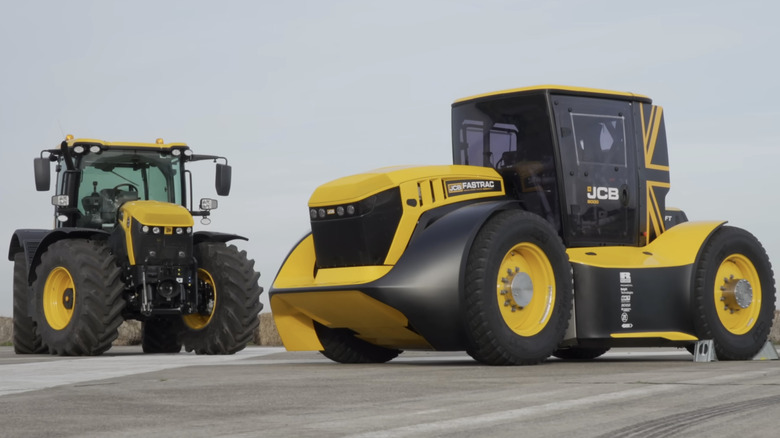
If you know your heavy machinery, then the name JCB should sound familiar. However, for those not in the know, the British company — in addition to selling you farm and construction equipment — has a habit of proving just how fast these hulking pieces of metal can go. Back in 2019, one of its tractors, weighing around 5 tons, managed a peak speed of 153.771 mph during its record-setting run in the UK. After completing the run in both directions and Guinness officials verifying the attempt, the JCB Fastrac Two became the world's fastest modified tractor, with a two-way average speed of 135.191 mph. Allowing JCB to achieve this monumental feat was a combination of Guy Martin's driving skills and a whole lot of engineering wizardry.
At the core of this speed machine is JCB's off-the-shelf 8000-series Fastrac — the world's fastest production tractor, capable of reaching up to 43 mph. The record-setting Fastrac Two is basically a more aerodynamic, streamlined version of the already bonkers Fastrac One, which the company previously used to set a domestic record of 103 mph that same year. Think of it like the JCB equivalent of Koenigsegg breaking its own records and Bugatti doing something similar with its 282-mph Mistral.
Powering the Fastrac Two is a turbocharged 7.2-liter six-cylinder diesel churning out 1,016 horsepower and over 1,844 pound-feet of torque with a 3,400-rpm redline. This engine, which shares the same block, head, and crank with a standard JCB 672 motor, sends power to the spool differential on the rear axle via a ZF-sourced, lorry-spec, six-speed manual transmission with really long throws. Upping the exotic factor even more is the tractor's 3D-printed Inconel exhaust system, which can get as hot as 1,832 degrees Fahrenheit.
But there's more
Furthering the notion of this tractor not being your average farm tool is the bespoke aero bumper that sticks out at the front, developed in collaboration with Williams Advanced Engineering. In addition to a front splitter and rear diffuser, the tractor's cab was also optimized for better airflow through the use of wind deflectors. Speaking of the cab itself, it's 200 millimeters lower and 300 millimeters narrower than the 8000-series' standard cab. On top of all this, the entire tractor is lowered by 200 millimeters, resulting in the Fastac Two having a drag coefficient of just 0.48, which, in tractor land, is pretty significant.
To wrap your head around how "light" this circa 5-ton tractor is, a typical JCB Fastrac can weigh anywhere between 8.5 and 9 tons, depending on its spec. Weight-saving measures include the omission of several production-tractor essentials, such as the massive battery used to start its engine and the compressors for its air brakes. Engineers, however, didn't overlook the importance of stopping such a massive, fast-moving object, and pressurized gas tanks are used to handle braking duties. All four corners of the tractor feature disc brakes, and should they not suffice, a comically small parachute is there as well.
One cannot overstate the importance of tires in these record-setting runs, and the situation is no different here. Special tires — tested at speeds of 160 mph on an aircraft test rig — were developed by BKT, featuring shorter tread blocks and a narrower carcass to improve stability and aero efficiency. The tractor, being the engineering marvel that it is, shouldn't come as a surprise, since JCB holds the land speed record for the world's fastest diesel vehicle at 350 mph.