

All Wankel Engines Are Rotaries, But Not All Rotaries Are Wankels
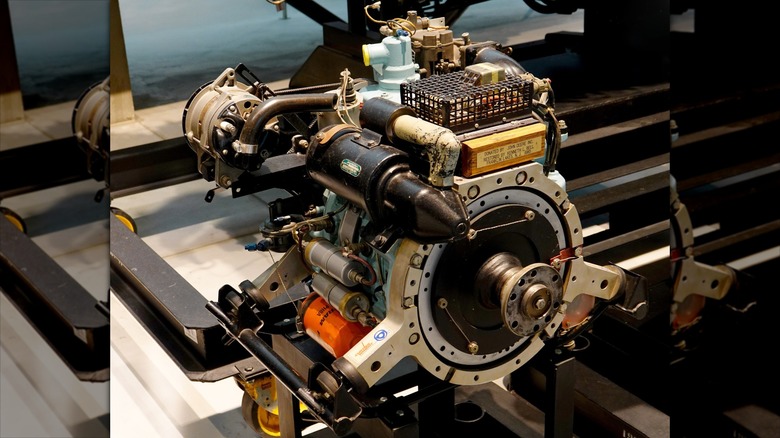
Ask most people what a rotary engine is, and they'll describe a Mazda RX-7 with a triangular rotor spinning inside a housing, combustion happening in sequence as the rotor moves rather than across a row of pistons. That engine is a Wankel. But "rotary engine" is a broader category the Wankel merely occupies, and there are other ways to build one.
The Wankel is the most commercially successful pistonless rotary engine ever built. Its roughly triangular rotor spins eccentrically inside an epitrochoid housing — shaped like a two-lobed oval — creating three separate combustion chambers as it moves. Each face of the rotor cycles through intake, compression, combustion, and exhaust, producing three power strokes per rotor orbital revolution and one per eccentric‑shaft revolution. That frequency, combined with fewer moving parts than a piston engine, is the Wankel's core appeal.
The defining characteristic of a rotary engine is the absence of reciprocating pistons. In a conventional engine, pistons travel back and forth, converting linear motion into rotation via a crankshaft. A rotary eliminates that conversion — a continuously spinning element moves inside a housing — and intake, compression, ignition, and exhaust all happen through that rotation alone. This is why the more precise term is "piston-less rotary" — it separates these engines from the radial-piston rotaries common in early aviation, a design made obsolete by the early 1920s.
Rotary engine problems are equally well-documented: apex seal wear, poor fuel economy at low loads, and higher emissions than comparable piston engines. These eventually pushed every automaker away from the design, with Mazda the last to let go after discontinuing the RX-8 in 2012. Rotary technology briefly returned to Mazda's lineup in the form of a single-rotor range extender in its 2023 MX-30 R-EV.
The rotary identity goes beyond Wankel
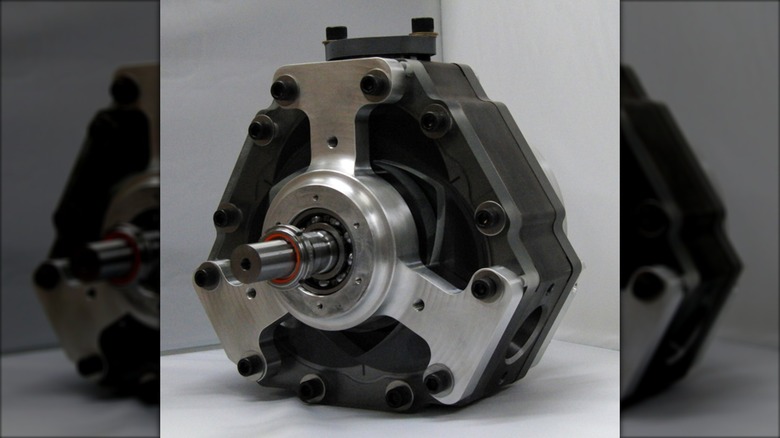
LiquidPiston's X Engine is a rotary that explicitly is not a Wankel. The company's own website describes it as a "non-Wankel rotary engine" with a "fundamentally different thermodynamic cycle, architecture, and operation." Where the Wankel spins a triangular rotor inside a fixed epitrochoid housing, the X Engine inverts that geometry: a two-lobed, figure-eight-shaped rotor turns inside a roughly triangular housing. The result is still three combustion events per rotor revolution, but through a patented High Efficiency Hybrid Cycle that LiquidPiston claims delivers 30 percent better efficiency than traditional diesel engines.
An X Mini — LiquidPiston's 70cc prototype — weighs four pounds, produces over three horsepower at 10,000 rpm with only two primary moving parts. At full development it's expected to reach five horsepower at 15,000 rpm from a package the size of a grapefruit.
The Wankel proved a pistonless rotary could power a production car reliably enough to win at Le Mans. LiquidPiston is a reminder it was never the only way to solve the problem.