

Long Before Chrysler's Hot Rod Jeeps, AMC Stuffed V8s In CJs, Wagoneers, And More
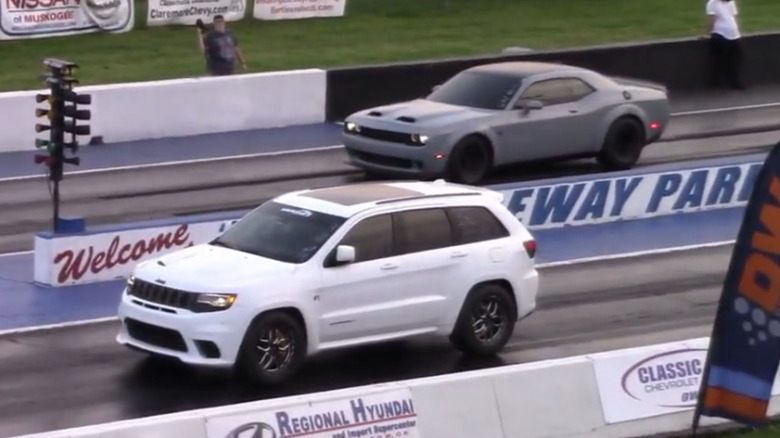
The 1998 Jeep Grand Cherokee Limited 5.9 — designed and produced during the brand's Chrysler years — rewrote the rulebook for SUV performance. By plunking a potent 5.9-liter V8 under the Jeep flagship's hood, Chrysler created what was at the time the quickest SUV ever tested by MotorTrend, with a 0-60 mark of 6.8 seconds.
It set the template for hi-po successors like the 2018 Grand Cherokee Trackhawk that debuted as the quickest and most powerful production SUV ever tested by anyone — at least according to Jeep. The Trackhawk showed off a supercharged 6.2-liter V8 capable of 707 horsepower, 645 pound-feet of torque, a 0-60 time of 3.5 seconds, and a top speed of 180 mph.
That said, those were hardly the first Jeeps to offer V8 motivation. For example, before the 5.9-liter Magnum V8 from the 1998 Grand Cherokee Limited, Jeep had supplied models with a 5.2-liter Magnum V8 and a 4.7-liter PowerTech with the same configuration. And before that, when it was part of Kaiser Jeep International, the brand had leveraged some earlier ties with Buick to source a V8 from the same brand. The Dauntless V8, displacing 350 cubic inches/5.7 liters, could be found in 1968-'71 Gladiators and Wagoneers. There, it made 230 hp and 350 lb-ft.
It was in between Kaiser and Chrysler that AMC got in on the action. That automaker introduced some of the world's most popular Jeeps during its 17-year ownership run — and offered a quartet of V8 engines over the years to move them.
Which AMC V8 engines were first used in Jeeps?
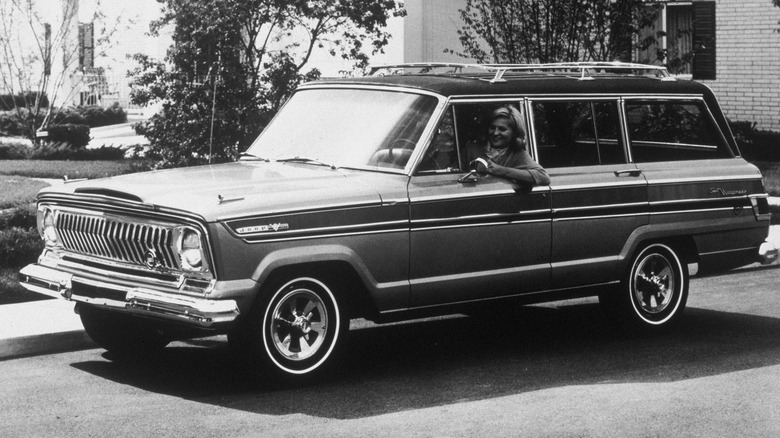
Let's start by clarifying the situation with that first AMC V8. The Kaiser-Jeep tie-up had its financial ups and downs, and lacked the resources to develop engines in-house during its final years. That's why it turned to Buick — still known for its vehicle reliability today — for the Dauntless V8. But prior to this, Kaiser had relied on a 327-cubic-inch V8 from AMC for the same reason. The engine was called the Vigilante V8 and was installed in Jeep's Wagoneer and J-truck models beginning partway through the 1965 model year. A four-barrel version, kicking out 270 hp, could be ordered for the 1966 Super Wagoneer.
So Jeep vehicles began using AMC engines about 4½ years before the latter purchased the former. When AMC took control of Jeep in 1970, however, it actually had a new-generation V8 waiting. This was a 304-cubic-inch mill used for the Wagoneer and J Series trucks with 210 horses and 310 lb-ft for the 1972 model year. The 304 was also in the mix for the CJ roster — albeit with output marked down to 150 ponies and 245 lb-ft.
Those numbers may not seem to stand out today, but a big V8 stuffed into a short-wheelbase 4X4 SUV was no doubt a sporty surprise during the early Malaise Era. The only other vehicle to fit the bill at the time was the Ford Bronco, and its available 302-cubic-inch motor was down 11 horses and 20 lb-ft to its Jeep rival.
What were the biggest AMC V8s for Jeeps?
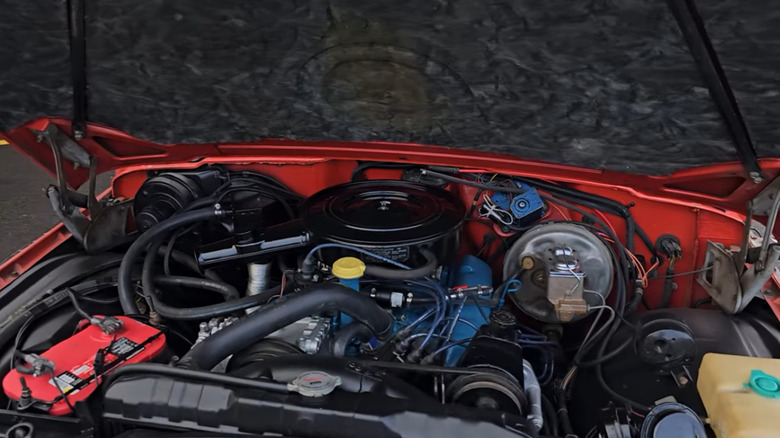
We just said that the 304 was new for 1970, but it wasn't a clean-sheet design. It was an evolution of AMC's 290-cubic-inch V8 that premiered for the 1966 Rambler Rogue — this was before AMC purchased Jeep, remember. AMC bored out the 290's cylinders in 1967 to increase displacement to 343 cubic inches, then both bored and stroked the block to debut a 390-cubic-inch V8 for 1968 models like the AMX muscle car.
These three engines were then upgraded beginning in 1970 to create AMC's third-generation V8 family, which includes not only the 304 V8, but also versions displacing 360 and 401 cubic inches. The latter two soon migrated to the newly acquired Jeep brand to join the 304, with the 360 originally appearing in early 1970s models such as the SJ Wagoneer and J-Series trucks. The short-lived 401 V8, in production from about 1971 to '78, was meant for the engine bays of the same Jeeps as the 360 as well as for the Cherokee. In its most powerful form, the 401 V8 was good for 335 hp and 435 lb-ft.
Of course, all of these output measures are from production engines. Yet the trio of third-gen motors is often considered by enthusiasts to be the very best of the AMC V8s. Highlights include a taller deck height that enabled gearheads to expand displacement with longer strokes, along with cylinder heads featuring L-shaped "dogleg" exhaust ports for better airflow. With that as a foundation, modern tuners have squeezed close to 500 horses from a relatively stock 401 V8, and a more heavily modded mill can handle 700.