

You Can't Buy Mazda's $10,000 Flair Crossover, And Not Just For The Obvious Reason
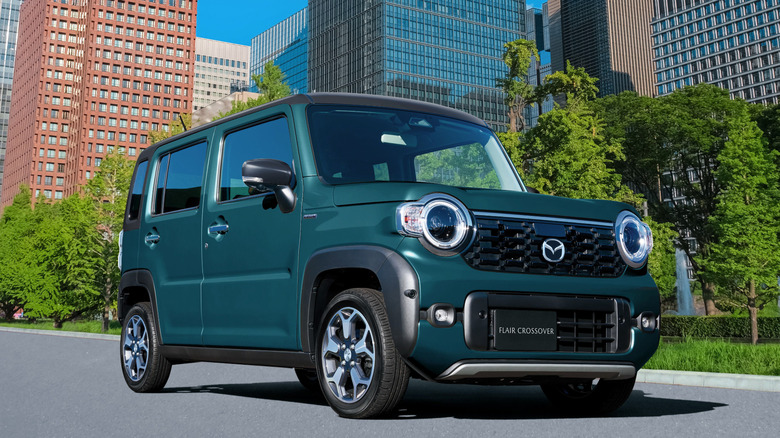
Mazda just gave Japanese buyers a subcompact four-door crossover with adaptive cruise control, lane keep assist, and pedestrian detection for under $10,000 (¥1,610,400). If it sounds too good to be true for American buyers, it's because it is. America will never see the Mazda Flair, but the reason isn't simply that Mazda doesn't sell it here — it's that the car was never built for American roads to begin with.
Mazda's Flair Crossover is actually a rebadged Suzuki Hustler, built specifically to satisfy Japan's kei car regulations — a category of vehicle defined by strict government limits on engine size and output. At just 133.7 inches long, the new Flair is nearly two feet shorter than Mazda's nimble roadster, the MX-5 Miata, which every American should drive at least once. Despite the compact size, the Flair's tall roofline and 96.9-inch wheelbase allow it to seat four adults quite comfortably. Power comes from a 660cc three-cylinder mild hybrid powertrain that produces 48 horsepower, but an optional turbocharged variant pushes that to a blistering 63 hp — the agreed-upon cap for the Japanese kei car class. Both the naturally aspirated and turbo models come with a CVT that sends power to either the front or all four wheels, but the turbo variants' CVTs also get a 7-speed manual mode.
The primary reason the Flair is not sold in the U.S. is regulatory: American crash and safety standards weren't written with 660cc, 63-horsepower vehicles in mind, and the Flair Crossover doesn't meet them. But that's only part of the story. The second reason is cultural. American driving habits are built around sustained highway speeds and long-distance cruising, conditions the kei car category was never engineered to handle.
The less obvious reason why the Mazda Flair banned
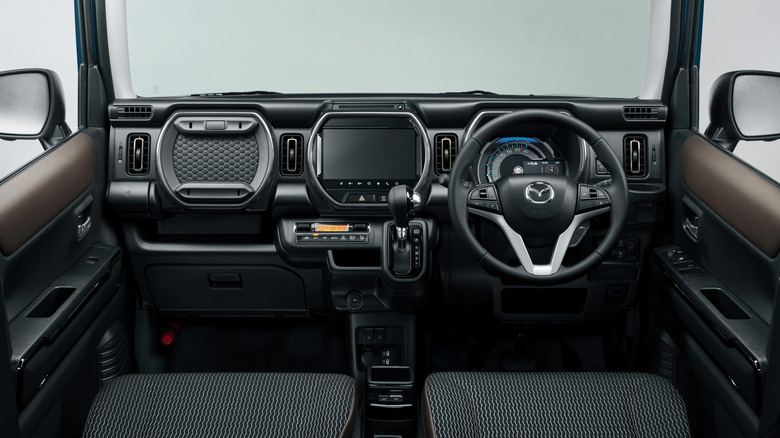
Mazda also refreshed its Flair lineup with a bigger grille and Mazda emblem on most trims, a new Woodland Khaki Metallic paint option and a substantial safety upgrade. Suzuki's Dual Sensor Brake Support II system features a monocular camera with millimeter-wave radar for improved pedestrian detection, front parking sensors, blind-spot monitoring, and adaptive cruise with a stop-hold function.
Pricing for the Mazda Flair starts at roughly $9,950 for the base 2WD XG and about $14,050 (¥2,275,900) for the turbocharged AWD ZT. But despite the attractive price tag, Kei cars exist to solve a uniquely Japanese problem — dense urban streets, scarce parking, and a tax structure that rewards small displacement engines. None of those conditions define the typical American commute, which leans toward higher speeds and far greater distances. Even setting aside the safety certification hurdle, the Flair Crossover would likely struggle in a market built around three-row SUVs and sustained 75-mph interstate driving. As the average new car price in America creeps above $50,000, the value for the capable, sub-$10,000 Flair crossover is obvious. Though we may not have kei cars on demand in the U.S. right now, President Donald Trump has shown interest in bringing kei car production to America — but who knows when that'll happen.