

Wisconsin-Built Neo-Classic Excalibur Was A Genuine American Supercar
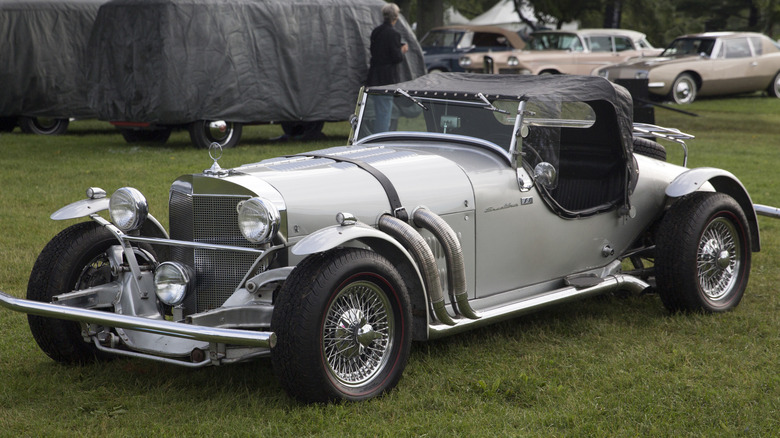
When design icon Brooks Stevens was asked to come up with an eye-catching new design for Studebaker to show off at 1964's New York Auto Show, he looked to great cars of automotive history for his inspiration. Styled around the 1928 Mercedes-Benz SSK, with proportions of the fiberglass two-seat body lowered and widened to fit the Studebaker Lark chassis, this neoclassical monster really set people to talking. A dozen orders were placed right there at the show, but it wasn't enough. A short- on-cash Studebaker shuttered its South Bend engine plant and killed the V8 and the Lark this car got its underpinnings from, ending the low-volume Stevens machine before it started production.
The car was originally planned to use Studebaker's 290-horsepower V8 as a starting point, potentially seeing the Andy Granatelli-built supercharged R3 V8 (rated at 335 horsepower, but rumored to actually deliver over 400 ponies) as the high watermark. Considering it was slated to tip the scales at just a smidge over 2,000 pounds, the car could have been Studebaker's moonshot supercar if the automaker had stuck around.
The hamstrung company soldiered on, but no longer had the ability to carry Stevens' dreams to fruition. Thanks to positive reception on the show circuit, the legendary industrial designer decided to strike out on his own and have the car produced anyway. Stevens, along with his two sons, William and David, set up SS Automobiles in Milwaukee, Wisconsin. Stevens bought leftover Lark chassis from Studebaker and asked his Chevrolet buddies Bunkie Knudsen and Ed Cole to throw him some Corvette 327 V8s for the project. The dream would live on.
What makes it a supercar?
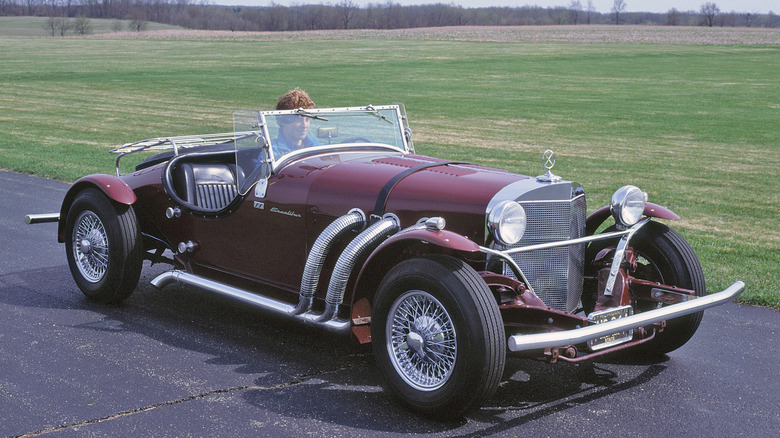
I asked my pal Myron Vernis, a Series I Excalibur owner, to give me his rundown on why the car is so important and what makes it a special part of his collection.
"Brooks Stevens perfectly achieved his goals with the Series I Excalibur Roadster. The appearance is an homage to his favorite car, the 1928 Mercedes SSK. The vocal, visceral, and raw feel of it on the road ideally evokes the German icon with a hint of its American iron core thrown in. The speed of the Excalibur is where it takes on its own character. With a 5-second 0-60 time, it was in a class with other performance cars, outperforming Corvettes and Cobras of its era. A drive in one of these cars is an exciting 'wind in the hair' experience in its truest form."
While Carroll Shelby was out in California putting Ford V8s in his little British chassis, Brooks Stevens was using Midwestern American know-how to add Corvette-matching power to a chassis weighing 1,000 pounds less than a C2 Corvette. There was a case for this car to become a Cobra-beater. The step-over design meant there were no doors or side-curtain windows, and all four wheels used cycle-style fenders. The Excalibur was slightly pricier than 'Ol Shel's Cobras with a supercharged model commanding $8,600 in 1965 compared to the British/American 427 Cobra priced at around $7,500.
If nothing else, it certainly looked unique on America's roadways. What it lacked was aerodynamics. The SS was capable of little more than 130 miles per hour, while the Cobra could run about 160. In fact, Stevens' own Studebaker Avanti (in its own way another uniquely styled machine) managed to take 29 different speed records at Bonneville in 1962, topping out at 168 mph.
Excalibur's legacy
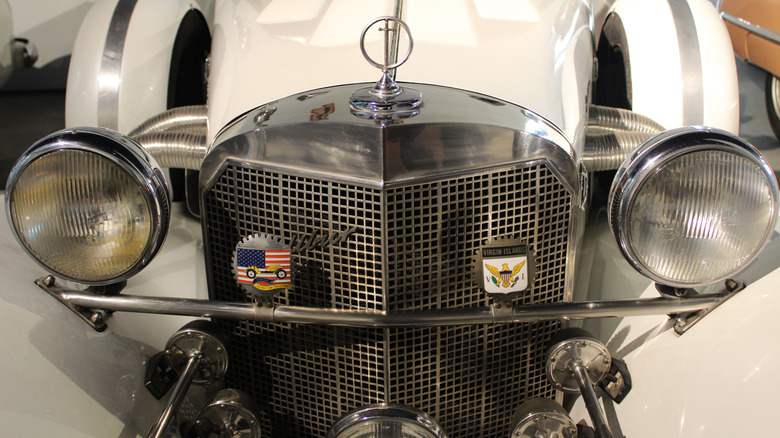
Once the supply of Studebaker chassis ran out, the Stevens crew got serious about this project, developing their own unique ladder frame with suspension and brakes cribbed from the Corvette. The engine was moved from the 327 V8 to the ubiquitous 350 small block, still making 300 horsepower. Standard equipment was added, and weight — and the price — went with it. Just in time for an oil crisis, the Excalibur added a 454 big block engine. Federalized taillights and turn signals from the Volkswagen Beetle were added, cheapening the car's look. Most importantly the four-seater Phaeton model was added to the lineup, increasing the car's appeal.
The Series III was introduced in 1975 with most buyers opting for the Phaeton model, and in the doldrums of the malaise era even the 454 could only muster 215 horsepower. Worse, many were saddled with a three-speed automatic transmission. This was the company's sales success era, delivering more than 1,100 cars between 1975 and 1979, but they were no longer building supercars in Milwaukee. Curb weights of the full-fat Phaeton were nearly double that of the 1965 Roadster.
The beginning of the end was found in the Series IV car for 1980, which introduced a longer, more comfortable car and an anemic Chevrolet 305 V8 with 155 horsepower. At over 4,000 pounds, the car that was once the equivalent of young Elvis was now the equivalent of old Elvis. It was also just plain too much money, with pricing starting at $50,000. By 1986 the company filed for bankruptcy. Three different attempts were made to revive the company through the 1990s, but none was successful.
What once was an American supercar had become something of a joke. It's a shame, really, because the first one was so good.