

The History Of Harley-Davidson's V-Twin (And All The Nicknames, Too)
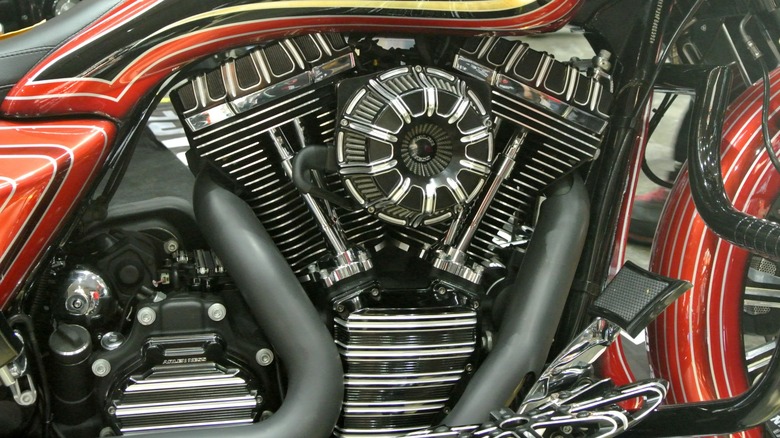
For more than a century, Harley-Davidson has built its motorcycles around a few engines, none more defining than the V-twin, as this engine layout is a big part of why Harleys have such a distinct sound. Ever since the company introduced its first V-twin in 1909 with the atmospheric-valve Model 5-D, the V-twin has been at the center of the brand's mechanical soul, all while being refined against a backdrop of wars, financial crises, and shifting rider tastes.
Along the way, the engines earned nicknames as colorful as the bikes themselves, including the Knucklehead, Panhead, and Shovelhead. Credit goes in equal measure to a keenly observant fan base that spotted every defining visual quirk, and to an engineering team perpetually seeking to right the wrongs of the previous model.
Harley-Davidson's engine story is one of two steps forward, one step back. Cracks did appear, even after revisiting the drawing board following dramatic events like the Great Depression and the AMF years of the '70s and '80s threatened the company's legacy. Still, each generation absorbed the lessons of the last, and what emerges is a portrait of a company that repeatedly pulled itself back from the brink.
What is a V-twin engine?
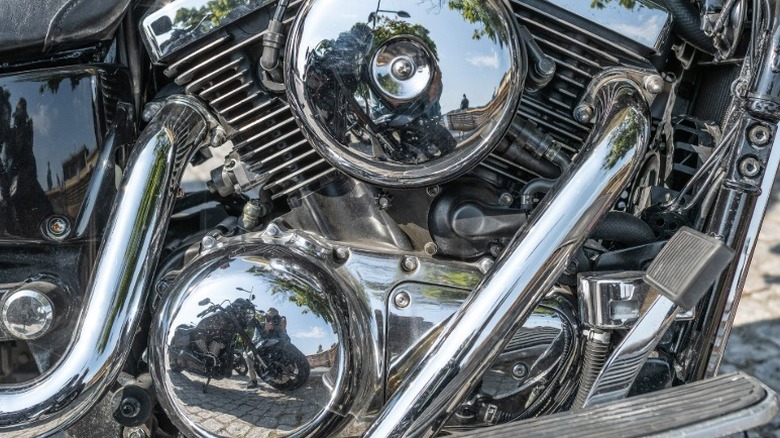
V-twin engines take their name from the layout: two cylinders positioned at an angle to form a V. This is opposed to the side-by-side or parallel configuration of parallel twin engines. The angle between the cylinders plays a major role in determining firing intervals, as do the crankshaft and the crankpin design.
Early V-twins emerged as a more powerful alternative to single-cylinder engines, increasing capacity without drastically increasing engine size. Of course, with improvement often comes complexity. A single-cylinder engine uses fewer moving parts: one piston, one cylinder head, one carburetor, and a single exhaust system, and thus is often cheaper. In a V-twin, each cylinder typically requires its own valvetrain, intake setup, and exhaust routing, which makes it unsurprisingly more complex and expensive.
All of this comes together in a V-twin engine to give Harleys that rumbling signature "potato-potato-potato" sound. This comes from the engines' uneven firing intervals. One cylinder fires, then the second cylinder fires after a short interval, and finally there is a pause during the longer interval as the cycle repeats.
The birth of the V-twin (1909–1910s)
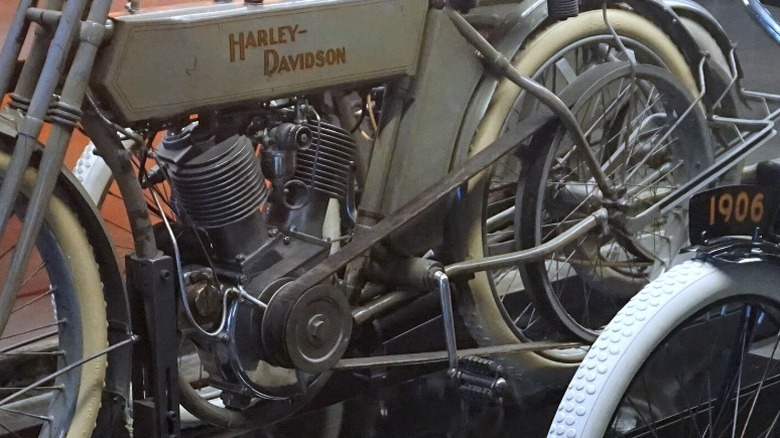
Contrary to what you may think, the first V-twin engine was built by Daimler in 1889. Harley-Davidson began developing its revolutionary 45-degree V-twin in 1907 but didn't introduce it until 1909, two years after rival Indian Motorcycle had already brought the first American V-twin to market with its 39-cubic-inch, 42-degree angle V-twin.
This 45-degree angle was chosen originally because it fit the loop frames of the day. And so, the 49.5 ci, 7-horsepower Model 5-D, Harley-Davidson's first 45-degree V-twin, was born. By 1918, Harley-Davidson would halt the production of its singles in favor of the already immensely successful V-twin.
However, there was room for improvement, as the atmospheric intake valve the V-twin used (which gave it the Atmospheric V-twin nickname) still left much to be desired in reliability. After all, there was a reason why it was produced for only one year. Enter the F-Head.
The F-Head era (1910s–1920s)
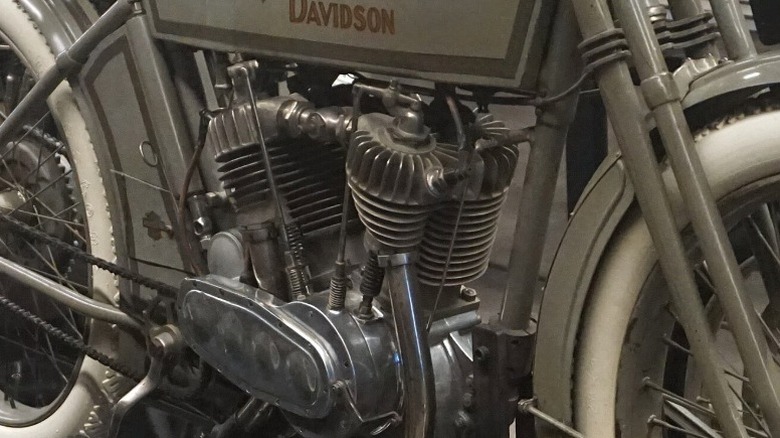
Many remember 1911 as the year Harley-Davidson refined its V-twin into a reliable powerplant with the Model 7D. It featured an inlet-over-exhaust (IOE) design, launched in the original single-cylinder and perfected into a reliable 49-cubic-inch, 7 horsepower V-twin by 1911, with subsequent upgrades to 61 ci and 74 ci that would eventually churn out 24 hp.
The F-Head earned its name from its valve layout, which resembled the letter F: the intake valve sat above the piston in the cylinder head, while the exhaust valve stayed on the side. The engine used a mechanically operated inlet valve that improved airflow into the combustion chamber and positioned the spark plug at the upper part of the chamber, giving the engine better performance and efficiency.
Harley-Davidson adopted this design in its bikes for another 18 years, which meant it served the company through World War I and beyond, before replacing it with the Flathead. Even as Harley abandoned this design, the F-Head setup was so effective that even the cream of British automakers fancied it — Rolls-Royce used similar engines until 1959.
Flathead engines (1929–1948)
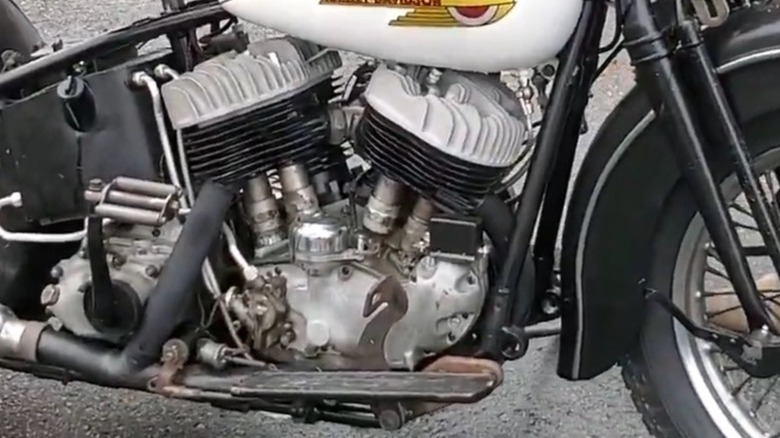
The Flathead was the first to wear an unofficial nickname, kicking off a habit that would follow nearly every Harley-Davidson engine that came after it. In this particular engine, the distinctively flat-topped cylinder heads — a consequence of the valves being pushed to the side — inspired the nickname.
These side-valve engines started as a 45-cubic-inch workhorse — hence its other nickname, the 45 — that was eventually beefed up to 74 ci and a much larger 80 ci. The 80 ci design could produce 34 hp. The Flathead engine bowed out in the motorcycle line in 1952, though its story didn't end there. It found a second life in the Servi-Car, which was Harley's utilitarian three-wheeler, where it soldiered on until 1973.
There's a good reason this engine ruled for this long: the Flathead built a reputation on durability, simplicity, and reliability. By keeping the valve components low near the crankshaft, the Flathead design made lubrication and maintenance easier while remaining compact. Fewer moving parts also let the engine achieve relatively high rpm despite respectable valve spring pressure. However, heat loss, cylinder distortion, and poor airflow efficiency were always issues to deal with on the Flathead.
Knucklehead (1936–1947)
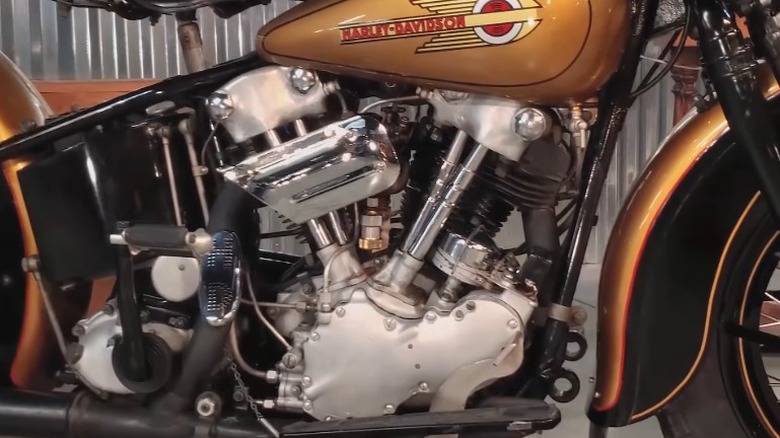
The Flathead's successor also got a fitting nickname when fans started calling it the Knucklehead because of its rocker boxes that resembled a clenched fist. First introduced in 1936, the Knucklehead offered some firsts for a Harley-Davidson. It was Harley's first production OHV (overhead valve) V-twin, the first to use recirculating dry sump lubrication, and the first to be paired with an oval gas tank.
The bike it served even sported different aesthetics, such as its valanced fenders. Adding these innovative features — even if some, such as OHVs and dry sumps, had been seen in competitor designs — helped keep the company afloat during and after the years of the Great Depression. Between 1929 and 1933, Harley-Davidson faced an 81% production lull in the factory, wage cuts among the staff, and lost overseas sales from foreign import taxes. Despite all these challenges, the Knucklehead was able to draw riders back to the brand.
The legendary Knucklehead originally debuted as a 61-cubic-inch pushrod OHV V-twin, available in the 37 hp E model or the 40 hp EL model before later growing to 74 ci FL model in 1941. New engineering challenges did introduce themselves in the OHV design — keeping the upper valve mechanism properly oiled without causing leakage was a Herculean task. However, first-year sales exceeding 1,500 bikes meant these problems were secondary.
Panhead (1948–1965)
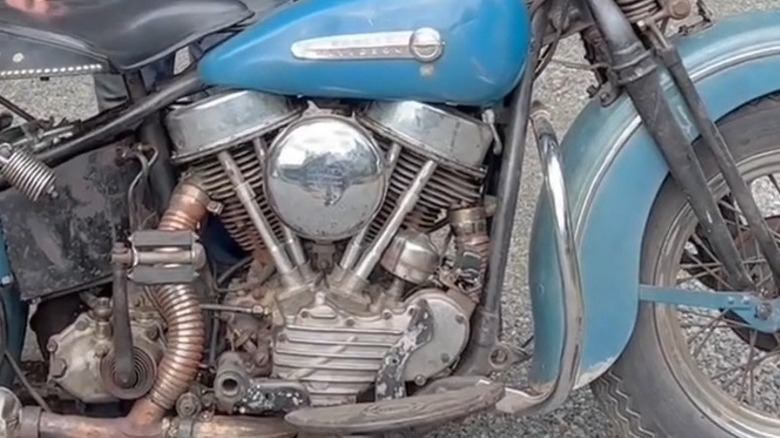
In 1948, the Panhead engine was offered in 61-cubic-inch and 74 ci variants. As the Knucklehead's successor, this engine introduced aluminum cylinder heads cast from the same high-strength alloys used in WWII combat aircraft, but still retained cast-iron barrels. This combination let the engine dissipate heat far more efficiently than its predecessor, since aluminum transfers heat much better than cast iron.
The Panhead marked a major leap forward for Harley-Davidson during the postwar era, when new roads encouraged speedy long-distance riding. The Knucklehead's persistent oil leaks and lubrication headaches were addressed through an improved oil pump and the redesigned pan-shaped rocker covers that gave it the nickname Panhead. This solution wasn't entirely oil-tight, but Harley-Davidson continued refining the lubrication system and sealing throughout the engine's production life.
Further refinements arrived in 1955, including stronger crankcases and bottom ends, as well as an upgraded O-ring intake manifold; 1958 saw alloy valve-guides replace bronze, and Torrington bearings became the norm for the inner cam. By 1965, these upgrades allow the Panhead to produce up to 60 hp.
Ironhead (1957–1985)
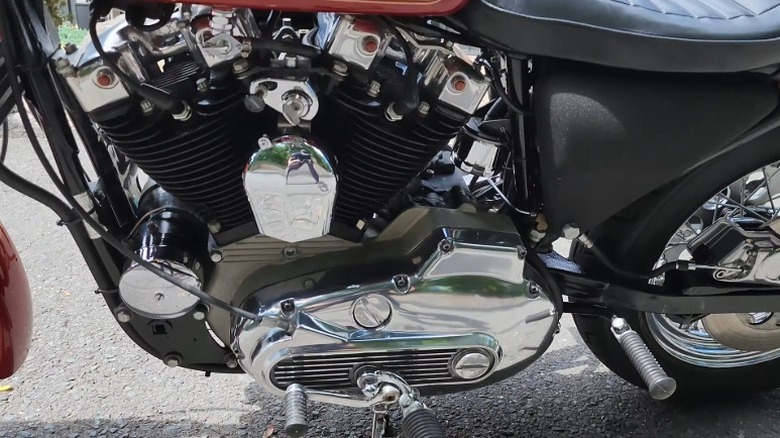
Debuting in 1957 with the 40-horsepower XL Sportster, the Ironhead engine got its name from its iron cylinder heads. The choice of iron instead of aluminum for the first Sportster's heads was deliberate – aluminum caused gasket problems Harley hadn't yet solved, making iron the safer choice, although Sportster based XR-750 racer of 1972 later switched to an aluminum-alloy engine. The original Ironhead engine had a 54-cubic-inch displacement that was later enlarged to 61 ci in 1972.
For years, the American Motorcyclist Association's (AMA) rules allowed Harley's favored side-valve engines up to 46 ci of displacement. The overhead valve (OHV) designs used by British manufacturers, however, were limited to just 30.5 ci of displacement. British manufacturers pushed back against this imbalance, prompting the AMA to level the playing field by allowing OHV designs to reach the same size as side valve designs.
Harley-Davidson answered with the XR-750 in 1970, a 46 ci model distinct from the XL Sportster line despite sharing its Ironhead roots. This engine might be the most celebrated of them all, winning 28 of 37 AMA Grand National Championships between 1972 and 2008 while also earning the trust of motorcycle hall-of-famer Evel Knievel during his legendary stunts.
Shovelhead (1966–1984)
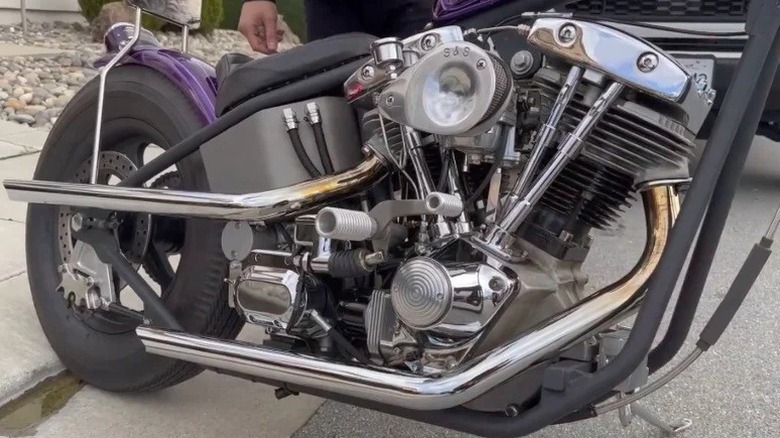
1966 saw the pairing of the then one-year-old Electra Glide model with an improved Panhead. This time, the rocker covers were reminiscent of upside-down coal shovels, giving it the name Shovelhead.
Discussing the Shovelhead is impossible without mentioning American Machine and Foundry (AMF), which emerged as a financial savior for a struggling Harley-Davidson in 1969. While AMF kept the Harley-Davidson brand alive, bike historians remember this era as the dark times since quality control slumped. However, the era's silver lining came in the form of the Willie G. Davidson-designed FX Super Glide, which was essentially a cruiser by virtue of a Sportster front end paired with a Shovelhead Big Twin.
The Shovelhead underwent major mechanical and styling changes between 1966 and 1984, including the adoption of electronic ignition, an alternator, upgraded Zenith-Bendix carburetors, a shift from chain to belt drive, and a five-speed gearbox. 1978, in particular, saw the original 74ci displacement increased to 80ci. At its peak, the Shovelhead put out 66 hp.
One of the major drawbacks of the Shovelhead was a persistent lubrication problem called wet-sumping, where oil failed to drain back into the tank and instead pooled in the crankcase, leading to drag, overheating, and power loss.
Evolution Engine (Evo) (1984–1999)
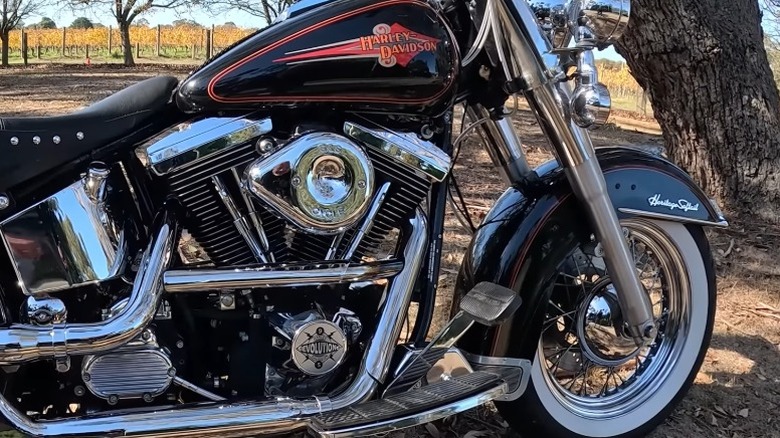
The Evolution is named Evo for short, although it is occasionally referred to as the Blockhead in a nod to the squared-off shape of its rocker covers and keeping with the tradition of the head nicknames. It famously used aluminum cylinders and heads to solve the heat-expansion and gasket-sealing problems inherited from the Panhead and Shovelhead. Speedy combustion in shallower chambers, shorter exhaust ports, and long threaded studs with better elastic properties than the short head bolts from previous engines helped maintain sealing as the engine heated and expanded.
The result was a more reliable and efficient air-cooled V-twin with an improved oiling system available in an 80-cubic-inch version producing 56 horsepower for the Big Twin engine, as well as in 54 ci, 67 ci, or 73 ci variants depending on which version of the Sportster it was installed in.
The Evolution powered Harley-Davidson models such as the Dyna, FXR, Softail, and Touring bikes during its heyday. However, unlike the Big Twin Evo's four-lobe single-camshaft arrangement, the Sportster Evolution used a single-lobe multiple-camshaft setup for its valvetrain.
Twin Cam Era (1999–2017)
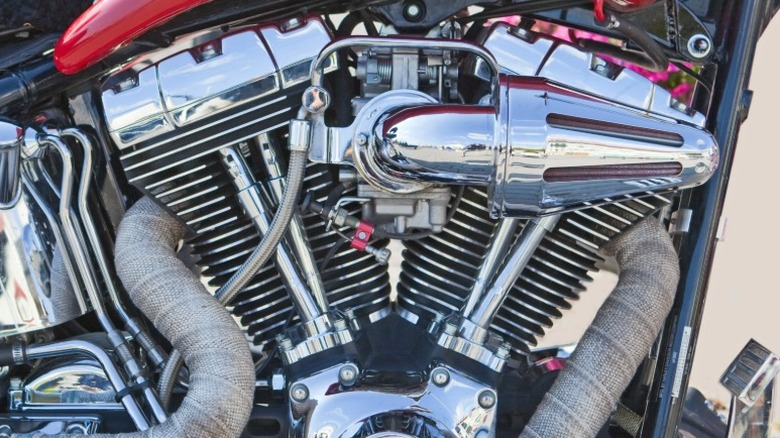
The Twin Cam, as its name suggests, moved away from the Evolution's single-cam design in favor of a dual-cam setup. There is no official alias for the Twin Cam, although some fans occasionally refer to it as the Fathead or Twinkie. The Twin Cam project began in the early 1990s, driven by the need for more power and a desire to match the endurance and reliability standards set by Honda and BMW. The Twin Cam was engineered with stronger crankcases, wider cylinder stud spacing, larger bearings, and significantly improved thermal management.
The new engine also introduced aluminum cylinders with cast-iron liners, piston-cooling oil jets, larger cooling fins, redesigned cam support systems, improved oil pumps, electronic fuel injection (EFI) options, and a stronger transmission mounting system.
Debuting in 1999 as the 88-cubic-inch Twin Cam 88, it first powered the Touring and Dyna families, producing around 65 hp and 86 lb-ft of torque. Softail models received the counterbalanced Twin Cam 88B a year later in 2000, while the Custom Vehicle Operations (CVO) models soon introduced larger 95 ci variants. Harley-Davidson continued refining the platform with Delphi fuel injection (2001), the Twin Cam 96 (2007), Twin Cam 103 (2009), and eventually the Twin-Cooled cylinder heads introduced during Project Rushmore in 2014. Both the 96 and 103 were names that reflected their engine displacement.
Although the Twin Cam dramatically improved power, refinement, vibration control, and durability over the Evolution, headaches with heat management remained a recurring criticism among riders and mechanics.
Milwaukee-Eight (2016–Present)
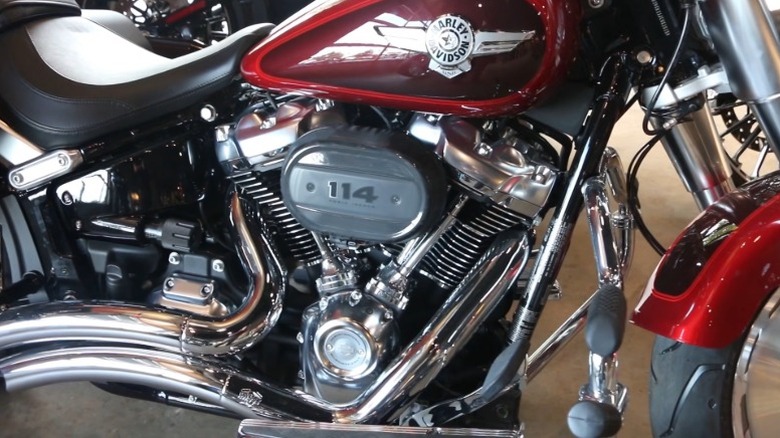
The Milwaukee-Eight gets its name from its four-valve-per-cylinder design, totaling eight valves across both cylinders. Depending on who you ask, it is also called the Wafflehead (for valve covers akin to waffle irons) or simply M8. The engine initially came in 107-cubic-inch and the 114 ci displacements upon its 2017 launch, to be joined by a 117 ci variant in 2018. In 2023, Harley introduced the range-topping Milwaukee-Eight VVT 121, which offered 115 hp and 139 lb-ft of torque compared to the 105 hp and 129 lb-ft of the 117.
As always, improved cooling remained the elephant in the engineering room. The Milwaukee-Eight had a clear brief: more torque, better cooling, and a valve drive quieter and simpler than the Twin Cam it replaced. To this effect, a single camshaft was used. Select models gained liquid-cooled cylinder heads, and across the range, exhaust gas temperatures dropped by around 100 degrees Fahrenheit.
In addition, internal counterbalancers are used to cancel out a significant amount of primary vibration. In rubber-mounted Milwaukee-Eight models, a single internal counterbalance reduces vibrations by 75%, with the remainder just enough to give riders that bump they recognize.