

How Did The Milwaukee-Eight Engine Get Its Name?
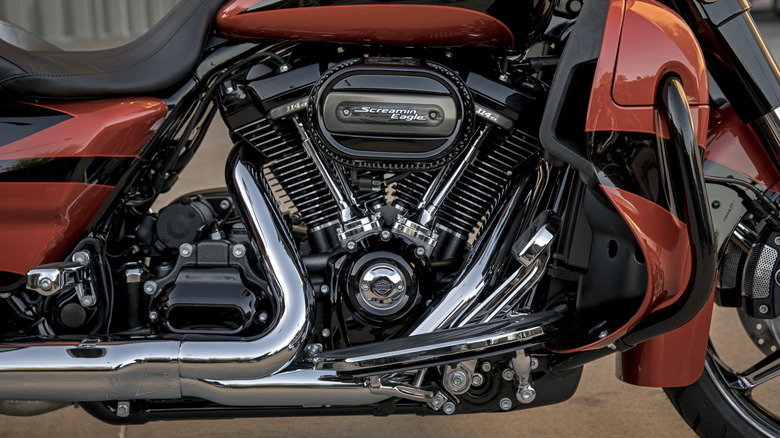
Harley-Davidson introduced the Milwaukee-Eight for the 2017 model year, making it the ninth generation of the bikemaker's signature "Big Twin" engines. It succeeded the Harley Twin Cam motor, which had been in production since 1998 and was getting a bit long in the tooth. The Milwaukee-Eight's engineering and design mandate was driven by the looming reality of stringent global emissions standards, along with the need to give Harley loyalists the performance they were longing for.
The name Milwaukee-Eight is pure, unadulterated marketing spiel. "Milwaukee" denotes the location of Harley-Davidson's corporate headquarters in Wisconsin, while the number "Eight" denotes the number of valves in the engine. That's four valves per cylinder, a massive departure from the traditional two-valve pushrod engine architecture that defined Harley-Davidson motors.
Mechanically, the Milwaukee-Eight retains the classic 45-degree V-twin Harley engine format. However, the valvetrain has been completely redesigned. While the outgoing Twin Cam used dual camshafts, the Milwaukee-Eight reverted to a single, chain-driven camshaft, as a single-cam layout reduces mechanical clatter and friction. The camshaft operated four valves via a system of forked rocker arms.
Harley initially launched the Milwaukee-Eight with two displacements -– a standard 107-cubic-inch (1750cc) and a massive 114-cubic-inch (1868cc) version reserved for its range-topping Custom Vehicle Operations (CVO) models which are a far cry from Harley Davidson's most affordable bikes. In 2019, the bikemaker came up with the larger Milwaukee-Eight 117 (1902cc), and in 2023, an even larger Milwaukee-Eight 121 (1,977cc) VVT that featured variable valve timing. Harley also offers a Screamin' Eagle 135 cubic inch (2,212cc) performance crate engine.
High-flow wizardry makes it the ultimate Hog Heart
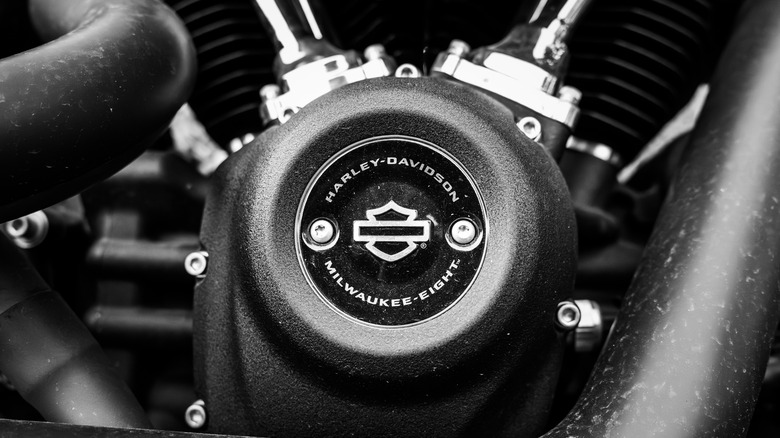
The Milwaukee-Eight is arguably Harley-Davidson's most advanced air-cooled engine, thanks to its significantly improved volumetric efficiency and effective thermal management strategies. The move to a four-valve cylinder head increased intake and exhaust valve air flow by a whopping 50% over the previous Twin Cam engine. This massive increase in flow capacity allowed the heavy cruiser engine to breathe more efficiently.
To ensure complete combustion across the massive bore of the giant twin cylinders, the Milwaukee-Eight engine also has a dual-ignition system thanks to two spark plugs per cylinder. The resultant dual flame fronts ensure a faster and more complete air-fuel mixture burn, which helps reduce emissions and also actively prevents pre-detonation or engine knock.
Cooling was a critical engineering focus during the development of the Milwaukee-Eight, so the engine uses targeted cooling in the cylinder heads, specifically focusing on the metal bridges around the exhaust valves, where temperatures can get pretty high. Depending on the engine, you either got "precision oil cooling," which routed oil through passages in the cylinder heads, or "twin-cooling," which routed liquid coolant through the cylinder heads from a small radiator hidden in the lower part of the fairing.
This approach to cooling allowed engineers to maintain a higher compression ratio of up to 10.5:1 without worrying about cooking the rider's legs. The motor also featured an upgraded charging system that delivered 50% more charge at idle than its Twin Cam predecessor. This was done specifically to support modern electronic accessories like massive GPS screens and heated seats.
Pros and Cons of the Milwaukee-Eight
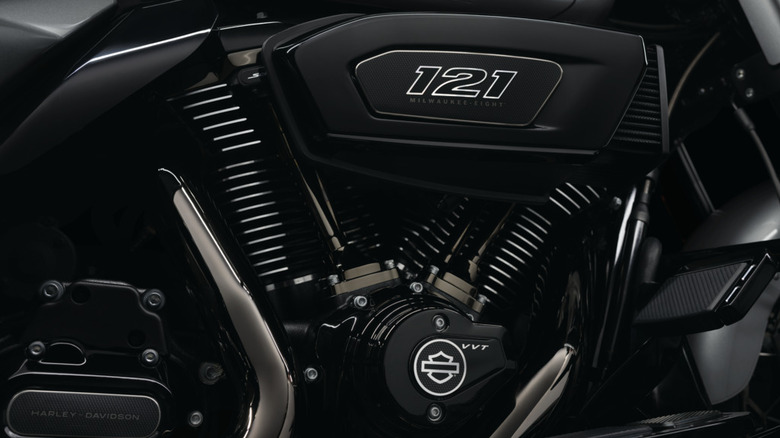
Harley-Davidson's modern V-twin engine has been around for a while, and while it is hailed for its performance and NVH levels, the Milwaukee-Eight still has some drawbacks. Let's start with the positives, of which the most significant is its high volumetric efficiency. The four-valve per cylinder layout offers better breathability, which in turn helps it offer higher power output and even an 11% improvement in 0-60 mph acceleration times over its predecessor.
The engine features an improvement in vibration management as well. It has an internal counterbalancer that cancels out 75% of primary engine vibrations at idle. This helps prevent the engine from shaking itself apart while retaining the good vibrations that Harley riders adore. The motor also gets knock sensors integrated on the engine cylinders, which helps the ECU to adjust spark timing dynamically based on the fuel quality. Then you have the precision cylinder head cooling that prevents hot spots and allows the engine to run at a more consistent temperature, and improves longevity.
The negatives start with the valvetrain complexity. The move to four valves per cylinder increases the number of moving parts in the cylinder head. This means added complexity, compared to the older engines that made old-school top-end rebuild in your garage a simple affair.
Early Milwaukee-Eight engines (2017 to 2019) were notorious for a mechanical flaw known as "oil sumping. It had a flawed oil pump design that caused oil to accumulate in the crankcase rather than return into the tank. This caused massive drag on the flywheel, causing the motor to lose power at high speeds. The early Milwaukee-Eight engines also had oil transfer issues, where transmission fluid would leak into the primary case.