

What It Actually Means When A Car Has A Low Drag Coefficient
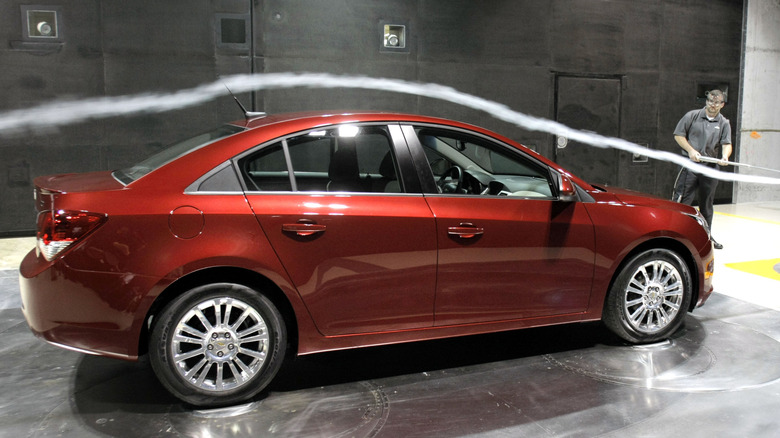
You may not know this, but a J40 Toyota Land Cruiser is less aerodynamic than a loaf of bread. Meanwhile, cars that you might assume to be fairly aero-efficient, like the wedge-shaped Lamborghini Countach or the original Volkswagen Beetle, happen to be less aerodynamic than a Tesla Model X. Looking at their drag coefficients (abbreviated as Cd) — a number that tells you how efficiently an object moves through a fluid medium — we can see why that's the case. Cd describes the influence of an object's shape on its aerodynamic drag. Objects with a lower Cd have more aerodynamic efficiency, allowing them to cut through the air better than objects with higher Cd numbers.
As Jason Camissa explains in one of Hagerty's Know it All episodes, a lower Cd number tricks the air into thinking it's passing over a smaller object. You can see how it influences the car's drag force (Fd) — how much resistance the car is being put under — in the equation Fd = ½ × ρ × v² × Cd × A. This force is influenced by squared velocity (v), the density of the medium (ρ), the drag coefficient (Cd), and the object's frontal area (A). All else being equal, as the frontal area increases, so does the drag force acting on the object.
The vehicle's shape (and by extension, its Cd) creates a meaningful difference between its actual frontal area and its effective frontal area. As Jason proceeds to explain, a Cd of 1.0 means the air sees the same thing as we do. Ergo, the actual and effective frontal areas are the same. But when the Cd is 0.25, for example, the effective frontal area becomes a quarter of the actual frontal area, effectively making the air act like it's going over a smaller object.
It's more about shape than size
To see why size doesn't determine aerodynamic drag, Jason compares a Tesla Model X to a Lotus Elise SC — two propositions sitting on different parts of the automotive spectrum. Despite the Tesla having a massive frontal area of 2.6 square meters, its Cd of 0.24 means it effectively manages to reduce its frontal area to 0.62 square meters. On the other hand, although the Lotus Elise has a smaller frontal area (1.6 square meters) than the Tesla, its relatively higher 0.41 Cd puts its effective frontal area at 0.66 square meters. In other words, more force is necessary to push the lightweight Lotus through the air than the near5,500-pound Model X.
If you consult another Jason (from YouTube's Engineering Explained), you'll find that — from the equation Power = Fd × v — the power required to overcome aerodynamic drag depends on both drag force and velocity. Cd directly affects drag force, consequently affecting the power required to move a vehicle around. That's another reason why optimizing a vehicle's aerodynamic shape can bring about significant efficiency gains, especially at highway speeds.
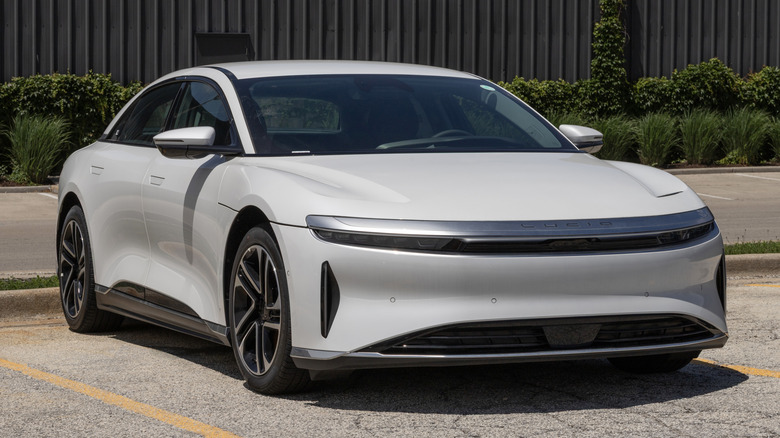
Take a look at the 2026 Toyota Prius, for example. Base trims have a 0.27 Cd, and with Toyota's clever engineering, the Prius managed to rank number one on Car and Driver's list of Cars with the Best Gas mileage. With a 0.197 Cd, the Lucid Air is also among the most efficient EVs out there, managing a consumption of 23 kWh per 100 miles according to the EPA's latest estimates.