

This Super Hard, Dense, Oily Wood Is Still Used For Bearings And Seals

These days, when people talk about bearings, it's often regarding cars and other complex machines, where bearings enable intricate moving parts to function with relatively little friction. You might think of a bearing and picture a precisely manufactured metal ring, like what you'd find in a ball bearing. But reducing friction is something engineers have been trying to do for thousands of years, and bearings are far from a new technology. In fact, any wheel using an axle requires a bearing, and we know wheels have been around for at least 5000 years. So when you spin an engine bearing and wonder if it can be fixed, you're really engaging in a time-honored engineering tradition dating back to Sumeria — or at least, you can tell yourself that.
Before high-precision machining was the norm, bearings were made of many materials, including wood. In fact, even today, one type of wood is still frequently used to make bearings and seals for use in ships, hydroelectric power plants, and even wastewater treatment. This wood is known as lignum vitae and comes from two slow-growing tree species of the Guaiacum genus: Guaiacum officinale and Guaiacum sanctum.
Colloquially known as the tree of life, lignum vitae only grows in a limited range in the Caribbean and is the national tree of the Bahamas. Far from being some antiquated technology still used only out of tradition, though, lignum vitae is actually better at its job and longer-lasting than many other materials one might think to use. Harvesting lignum vitae isn't without its issues, however, as the tree species is endangered and is listed as protected in Caribbean countries like Jamaica.
What makes lignum vitae so special?
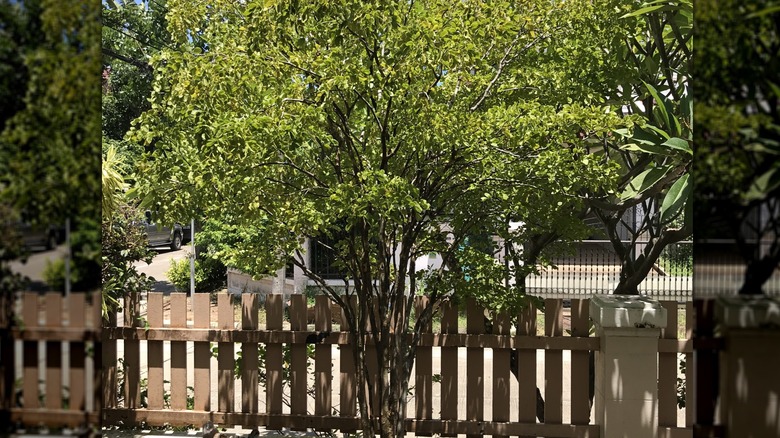
Lignum vitae is known for being super dense and highly durable. It's one of the densest woods on the planet, coming in at about 73 to 83 pounds per cubic foot, whereas trees like oak only measure 37 to 56. That's dense enough that a hunk of lignum vitae doesn't float when dropped in water, and it's probably too dense to be used to make an honest-to-goodness drivable wooden sports car that gets more than 0 mpg. This absurd density comes about as a result of the tree's snail-pace growth rates. It takes roughly 350 years for a single Guaiacum specimen to grow to a size where it's actually harvestable. We all know that trees add a ring of growth for each year, and because the tree of life grows so slowly, its rings are tightly packed, imparting that signature density and durability.
That's not all that makes this wood appropriate for grueling work as a hydroelectric power plant's bearing or the propeller shaft for a naval vessel. Yes, the above qualities mean that lignum vitae lasts about twice as long as plastic composite bearings in such applications, but lignum vitae is also self-lubricating. It secretes an oily substance known as guaiac gum that protects the wood from becoming water-logged and rotting while also reducing friction between the wood and whatever moving components it houses. This reduces the need for introduced lubrication to keep the bearing from overheating and becoming damaged during operation. This impressive wood is also now used to make face seals for ships, which may last longer and fail less frequently than other resin-composite seals.
The many other use cases of lignum vitae
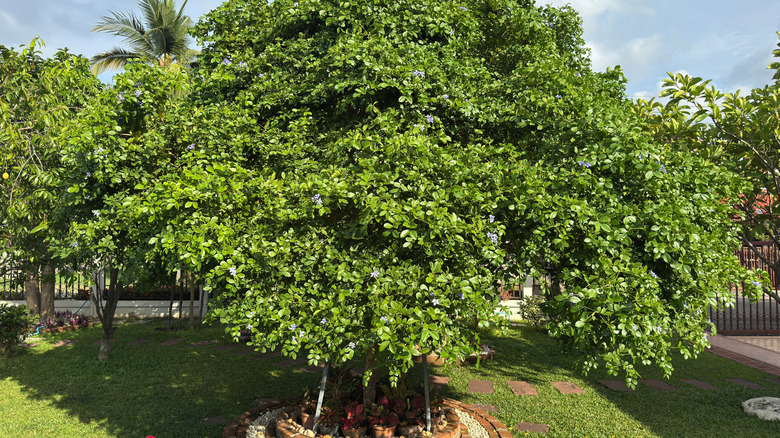
Engineers make all kinds of items out of all kinds of left-field materials, so maybe it shouldn't really surprise anyone that you can make world-class bearings out of a hunk of wood. After all, if engineers can create working, floating boats out of concrete, the sky's the limit, right? What if I told you the wonders of Guaiacum don't end at the wood's industrial utility? In fact, the trees' endangered status isn't even entirely due to their industrial uses. First, the tree of life can be used to make a surprisingly effective knife, as demonstrated by YouTube channel TWCDesign. It's impressive, but not exactly as useful or light as a steel knife, so that's probably not making a big impact on the tree's path toward extinction. Its use for bowling balls was probably more damaging, if we're being honest.
Lignum vitae has also long been used as a traditional medicine, and those seeking to sell its resin and bark for medicinal uses have also contributed to the overharvesting of the tree of life. Lignum vitae's medicinal properties have been used to attempt to treat pain from gout and arthritis, and it may also be used as an expectorant to help with congestion and respiratory issues, and even syphilis (via St. John Historical Society).
Lignum Vitae North America, one of the major companies currently manufacturing industrial tools from the tree and the only company with permission to harvest it, claims to be taking the proper steps to repopulate areas where they harvest the wood from. However, it takes over 100 years for the tree to grow to its maximum height of just 30 feet tall, which makes any restoration and rejuvenation projects difficult, especially while the plant is still being actively harvested commercially.