

If Safety Tech Isn't Most Responsible For Increasing Car Prices, What Is?
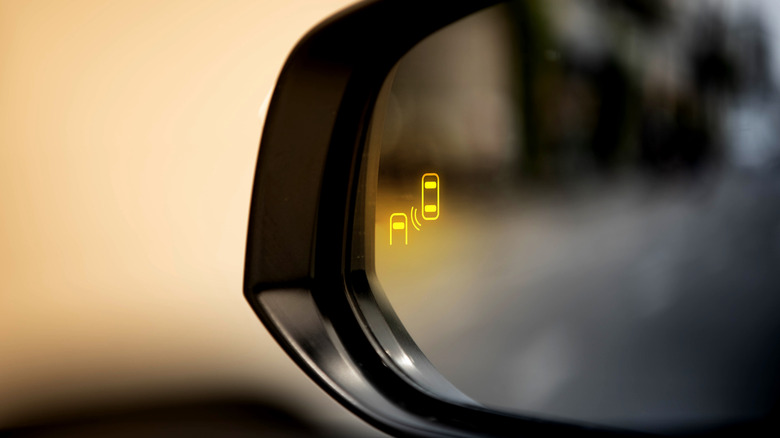
High-tech advanced driver-assistance systems (ADAS) have proven to help save lives and reduce injuries, but they aren't always cheap. In fact, many people think they're a major factor behind the high costs of cars today — and it's not only because a given technology can be expensive for a company to research, develop, and implement. One big complaint about ADAS features is that automakers don't always offer systems à la carte. Instead, customers often have to invest in expensive packages that may bundle in-demand safety features with equipment/upgrades a specific driver may not be interested in.
For example, the 2027 Chevrolet Silverado debuted with new V8s and a passenger-side infotainment screen, but there's no reason to believe Chevy has changed its thinking about blind-spot monitors. They're not standard on the 2026 lower-level trims, like even the Silverado LT. Despite a starting price of $53,700 with a destination freight charge of $2,795, you still have to add two separate packages if you want a blind-spot system. You have to fork over $1,065 for the safety package, but you can't get that unless you add the $565 convenience II package as well.
True, you get much more than just a blind-spot system when ordering those packs, but that doesn't change the fact that the truck's price has increased by $1,690 at the same time. Nor is Chevrolet alone in resorting to such a tactic. That said, there are a couple of other notable contributors to the high prices of cars today, as we'll discuss next.
Customers and dealers both play their parts in raising car prices
Now, you do have to consider the source, but David Harkey, president of the IIHS-HLDI –- the organization behind the Top Safety Pick program — flat-out claims that "safety features aren't the main thing pushing up prices." According to Harkey, the real issues are two-fold. First, consumers are opting for more non-ADAS upgrades, with Harkey calling out such equipment as hands-free tailgates and power-folding mirrors. He also points out that drivers in recent years have preferred big trucks and SUVs to smaller, less-expensive rides, and those upsized vehicles come with upsized MSRPs.
The good news is that both of those trends seem to be slowing down, with America perhaps becoming too woke for big pickups and sport-utilities and flocking to reserve the upcoming bare-bones, low-bucks entry from Slate as an alternative. On the other hand, although the average purchase price of a new vehicle slipped slightly in May versus April at $49,220, it's still up 1.2% on a year-over-year basis. Taken together, the two factors are more evidence of how the rich are propping up new car sales on one side of the ledger, while many less fortunate folks are now seeking out cheaper ways to get around.
Of course, then there's the elephant in the room: Regardless of what customers and automakers do to impact pricing, let's once again remember that dealer "middleman taxes" are also adding nearly $5,000 to the price of every new vehicle (via International Center for Law & Economics) — and that's before we get to massive $8,000 markups on mainstream rides like the Toyota 4Runner.