

This May Be The Most Infuriatingly Located Oil Filter In Automotive History
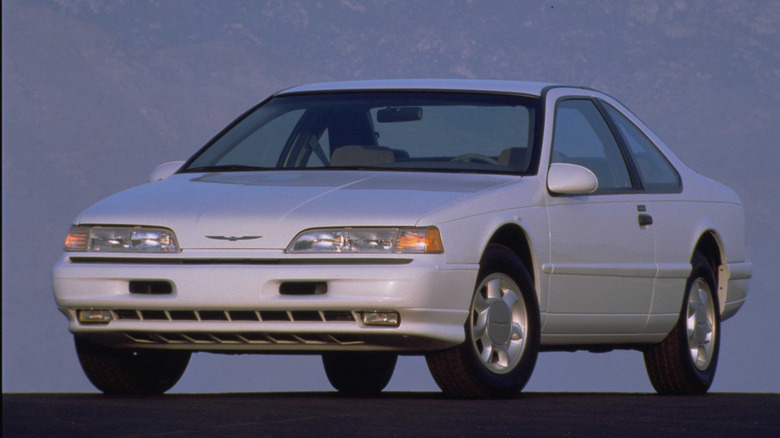
Americans are living through a crisis of affordability, facing inflation on practically everything under the sun. Combine our current economic situation with the fact that Americans are keeping their old cars on the road longer than ever, and you've got a perfect recipe for people doing their own wrenching instead of taking their car to a professional shop. If you're still out there driving a 4.6-liter 10th-generation Ford Thunderbird in 2026, you probably found out the hard way that your oil filter is in an infuriatingly difficult-to-reach part of the engine compartment.
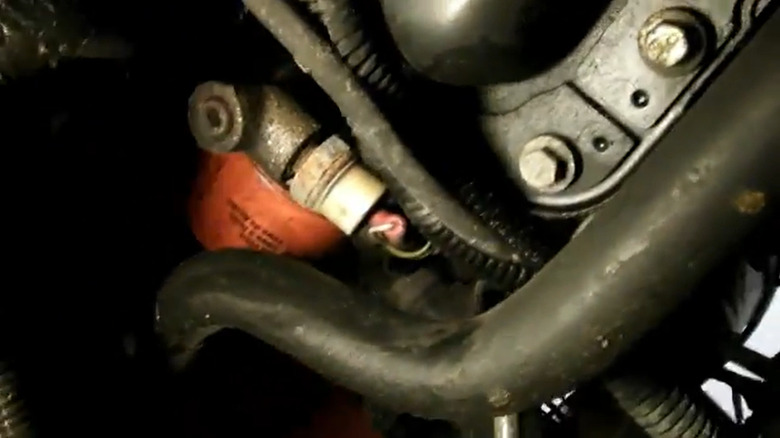
Ford's 4.6-liter "Mod Motor" engine mounts its oil filter on the driver's side about halfway up the block. In a Mustang or F-150 the filter is relatively easy to reach by hand, with plenty of room around the filter to get proper tools in and loosen it without issue. In the Thunderbird, however, removing that filter requires finessing your tools in from the wheelwell with a variety of extensions and swivels. You can't go in from the bottom because the sway bar is in the way, which makes it extra difficult to do this job cleanly without getting spent oil all over everything. Check out this DIYer's struggle in this how-to video on YouTube.
By comparison, check out how much easier it is to reach the oil filter in this Mustang with the same 4.6-liter engine.
To make matters worse, because the filter is located so high up on the block, it's in close proximity to the engine's exhaust manifolds. That makes this a pretty high-heat environment for a filter to live in, and if it wasn't properly lubricated or was over-torqued on install, it could be difficult to remove it from its now-semi-permanent position.
Why would Ford do this?
In the late 1980s, Ford was trying to push the Thunderbird upmarket. According to Paul Ingrassia and Joseph B. White's 1995 book "Comeback: The Fall & Rise of the American Automobile Industry," the Thunderbird was trying to deliver "a BMW at the cost of a Ford," targeting the 635CSi as its competition. Ford even worked with Porsche to develop an all-wheel-drive version of the coupe, but cut it at the last minute. Despite its sales and critical success, the Thunderbird died off after this generation because it was too technologically advanced to turn a serious profit, and came in heavier than Ford hoped.
In 1989, the car launched a high-performance Super Coupe version, packing a supercharged V6 with 210 horses and 315 pound-feet of torque. It immediately won Motor Trend's coveted Car of the Year. Internal turmoil and demands from higher-ups put the unprofitable BMW-beater in hot water, though, and public demands for a V8-powered version led to Ford cramming a modified 5-liter into the car for the 1991 model year.
Because the MN12 was designed around the Essex 3.8-liter V6, stuffing two more cylinders under the hood was difficult. The 5-liter heater required downsizing the intake, and an abysmal exhaust routing to fit, robbing the car of horsepower. The same 5.0 V8 in a Mustang made 225 horsepower, while the Thunderbird was detuned to 200 ponies.
For the 1994 model year Ford finally got around to engineering a solution for the MN12 chassis to get the now-standard 4.6-liter Modular Motor under the hood. This engine had already been in Ford's Crown Victoria since 1992. It seems Ford was unwilling to go to the expense of remote-mounting the oil filter, or engineering a different stand for the filter to make it easier to reach.