

6 Abandoned F1 Tracks You Can Still (Kind Of) Explore
Formula 1 is nothing if not a spectacle. The races roll into town like a staggeringly expensive circus, sponsored by the likes of Louis Vuitton and TAG Heuer, and they leave behind not just an empty field where questionably safe amusement park rides used to sit, but entire racetracks. Some are purpose built as racing venues, others are country roads or city streets briefly commandeered for the occasion. Some tracks only hosted a single F1 race before being surrendered back to the community, maybe leaving cool decaying grandstands behind. In a few cases, long after the starting lights have gone dark and the roar of ultra-complicated turbo V6s in cars that cost more than a modest neighborhood fall silent, you can still explore what's left.
F1's history is still lying around in some surprisingly accessible places: beside French country roads, buried in forests, folded into city traffic, or fenced off behind waterfront redevelopment projects. Some are not "tracks" anymore in the way a person raised on modern Tilkedromes may expect. They are public roads, cracked service lanes, old pit buildings, municipal infrastructure, and the occasional ghost of a grandstand. F1 still loves a street circuit, but the old version of the sport was willing to race in places that now seem absurd: public roads through Champagne country, high-speed blasts through Berlin, and long, dangerous loops that made modern safety standards look like science fiction. Today, we're talking about the F1 venues you can still (kind of) explore — not always by buying a ticket and walking through a gate, but by following the roads, ruins, and remaining structures where the cars once ran.
Circuit de Reims-Gueux — France
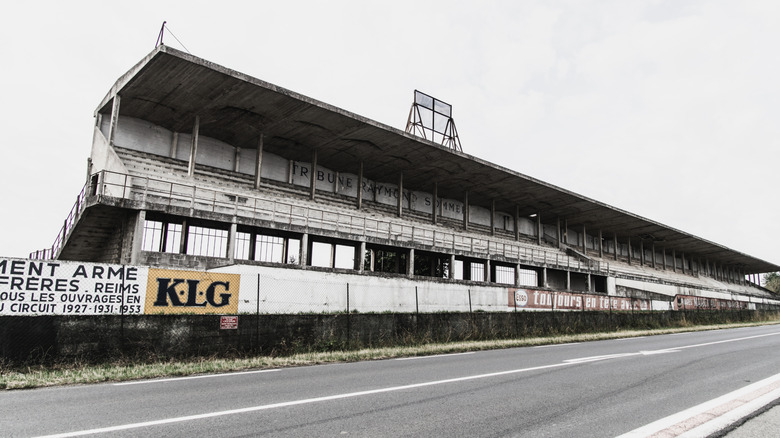
Reims-Gueux is almost too perfect for this list. It looks like the setting of a Scooby-Doo episode about an old racetrack where the ghoul turns out to be Jean Alesi. The circuit itself wasn't a modern permanent facility, but a very fast snake of tarmac running through France's Champagne region. Just off the public roads you can still drive today, you'll find the old pit buildings and grandstands, restored and maintained enough to feel less like a ruin than a motorsport ghost town with fresh paint.
That's what makes Reims-Gueux such a clean entry point into abandoned F1 history. This was a time when the sport was still perfectly happy sending drivers down long rural straights punctuated by hairpins, creating one of the fastest tracks of the day that also happened to send cars whizzing by grandma's house close enough to make her rose bushes bounce. Today, the racing is gone, but the roads are still roads, and the surviving structures make the old start-finish area feel weirdly preserved. They make for a poignant bit of early racing history, from the place that helped plant the seed of motorsport's love of sparkling wine. Exploring Reims-Gueux isn't about sneaking through a fence. It's about standing beside ordinary French traffic while your brain tries to overlay Fangio-era Grand Prix cars onto the scenery.
Pescara Circuit — Italy
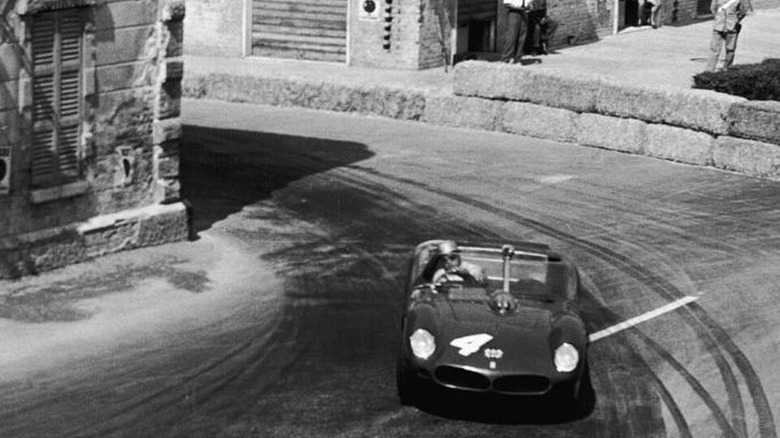
Pescara was what happens when someone looks at a reasonably large chunk of Italy's Adriatic coast and says, "Yes, that is a racetrack now." The circuit was actually absurdly long by F1 standards, running nearly 16 miles through the area around Pescara on public roads that swept from the seaside toward the hills and back again, complete with a multi-mile straight shot along the coast. Formula 1 only made it part of the World Championship once, in 1957, but that was enough to give the place a permanent claim to lunacy. Modern F1 talks about track limits. Pescara had villages, railway crossings, roadside buildings, that preposterously long straight we already mentioned, and the occasional animal crossing at the portions that weren't already lined with fans and bystanders.
From a modern lens, the course didn't exactly disappear when motorsport's nascent safety-consciousness of the early 1960s deemed the circuit too dangerous to continue, but instead, it was reabsorbed into the community and surrounding terrain. The roads remain, which means you can still hop in your favorite Italian car and trace the old route through Pescara, Cappelle sul Tavo, and Spoltore, just like they did in the old days. Only, you know — slower.
Rouen-les-Essarts — France
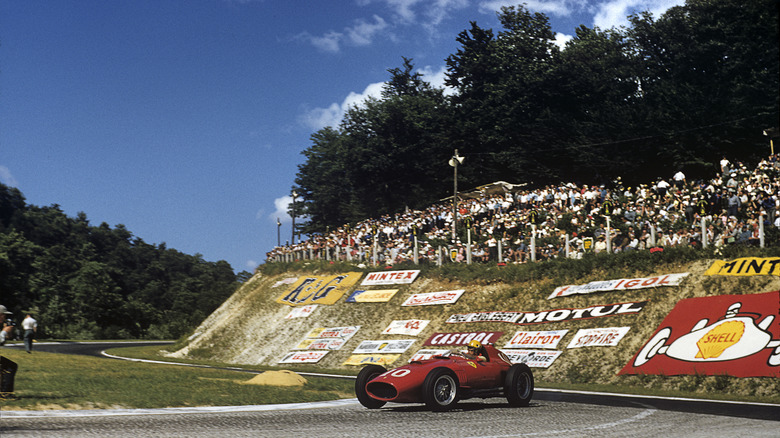
While Reims proved that France is crazy enough to start an endurance race at midnight, Rouen-les-Essarts demonstrated that the spirit of French automotive insanity wasn't limited to Champagne country. In Normandy, the local vintage came with elevation changes, trees, and the Nouveau Monde hairpin waiting at the bottom of a hill. Formula 1 used Rouen for the French Grand Prix in the 1950s and 1960s, before advances in downforce application reached a point where the cars were simply too fast for the track and F1 discontinued its use in 1968.
Unlike Reims-Gueux, Rouen does not greet you with an obvious row of restored pit buildings screaming "historic racetrack" at passing tourists. Its remains are subtler and a little sadder. Some pieces of the old layout have been altered, swallowed, or erased, and the famous cobbled Nouveau Monde hairpin has since been paved over. Still, you can find the occasional cobblestone peeking out of the aging asphalt, and the route remains partly legible if you know what you are looking for: stretches of road, changes in grade, and the sense that this bit of Normandy once asked Grand Prix cars to do some deeply unreasonable maneuvers at speed.
Circuit de Charade — France
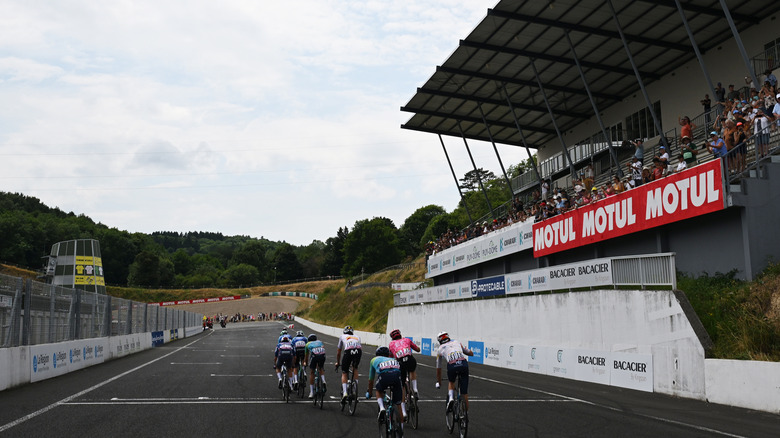
The Super Bowl Ram volcano jump wasn't the first instance of brands pushing their automotive luck around volcanoes, and Charade was the French road circuit that promised to make molten lava the least of your concerns. Close to Clermont-Ferrand, in the volcanic terrain of central France, the original layout wrapped around the slopes near extinct volcanoes and turned public roads into a riveting and technical white-knuckler. The track hosted the French Grand Prix a handful of times, and its reputation was basically "the Nürburgring, but make it more French and more nauseating." There were almost no proper straights, just corner after corner, rise after drop, and a strong enough propensity for flying volcanic rock kicked up from the roadside to make it feel like the mountain itself had an interest in slowing you down.
Charade also gives this list a slightly different version of abandonment. Unlike Reims, it didn't simply leave its old start-finish area sitting there like a movie set. A shortened modern circuit still exists, but the full old road course is gone as a racing venue. The unused sections, including the old Gravenoire portion, were returned to ordinary public-road duty, which means the original F1 layout survives in pieces rather than as a single preserved attraction. You can still visit the modern circuit and trace pieces of the old route nearby, but the old-school F1 fever dream remains as dormant as the surrounding volcanoes.
AVUS — Germany
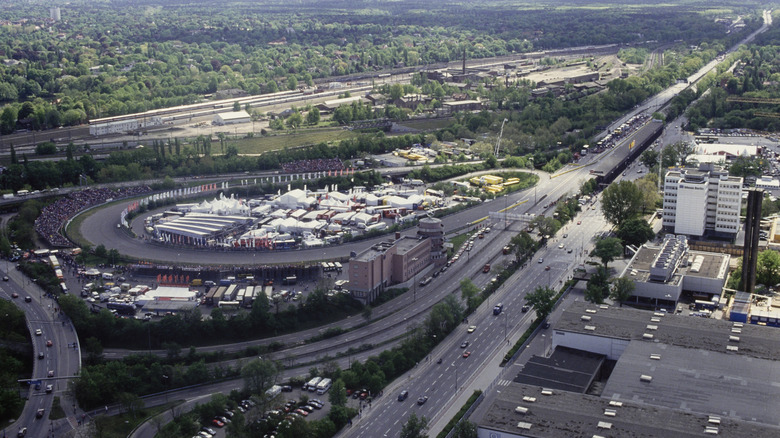
Less a racetrack than two high-speed straights separated by a strip of grass, AVUS was actually a good racetrack. The name came from Automobil Verkehrs und Übungs Straße, which loosely translates from German to "automobile traffic and training road" and neatly underscores the point that this thing was certainly not made for modern F1 racing. By the time Formula 1 showed up for the 1959 German Grand Prix, years of brutal use and shortening of the course had left a simplistic loop that bordered on deranged: two long carriageways, a hairpin at one end, and a steep banked north curve at the other. The surface didn't help, with poorly wearing tar that was unpredictable and bumpy with some undulations reaching almost a foot high. Tony Brooks won that 1959 race for Ferrari, but the weekend's reputation is darker than a results sheet can capture. Jean Behra was killed in a support race, and Hans Herrmann survived a horrifying crash after brake failure at high speed.
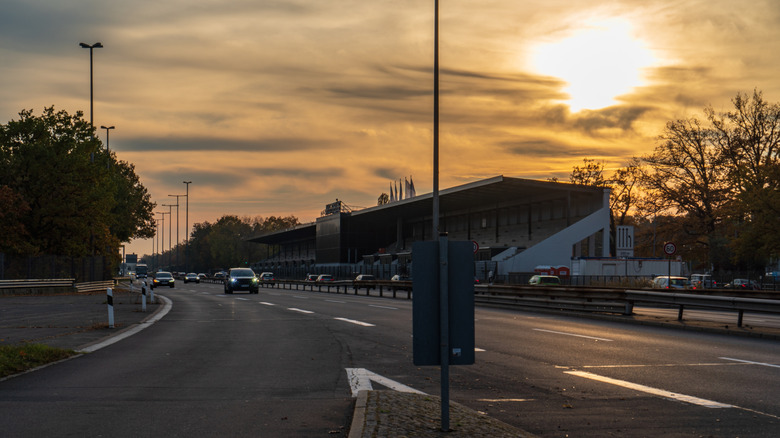
Today, AVUS is not hiding in a field somewhere. It is hiding in traffic. The old circuit was folded back into Berlin's road network, with much of the route now part of the A115 Autobahn. That makes "exploring" AVUS a strange proposition: You are not wandering around a quiet ruin so much as recognizing that a piece of everyday infrastructure once doubled as one of the fastest and most alarming circuits in Grand Prix history. Some physical reminders remain, including the old control tower and grandstand area at the north end. Most of it, though, is just packed with commuters. They're no-nonsense German autobahn commuters, to be sure, but commuters, nonetheless.
Valencia Street Circuit — Spain
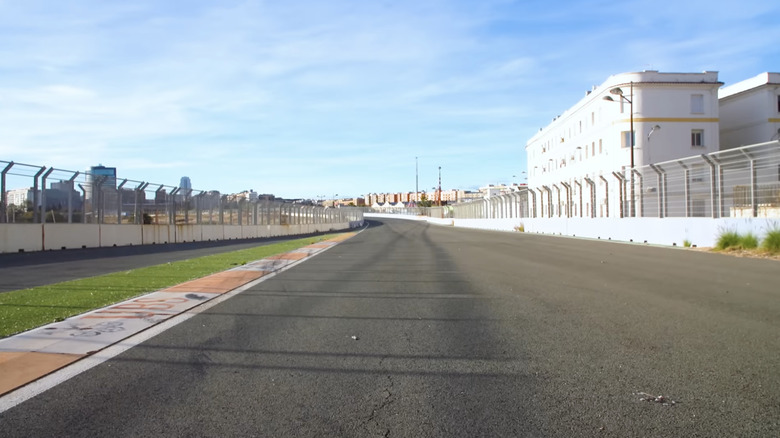
Valencia is what happens when Formula 1 stops being a rural death wish and starts being a waterfront redevelopment strategy. The circuit was built around the city's harbor for the European Grand Prix, using a mix of public roads and purpose-built sections meant to turn Valencia into the sort of glamorous Mediterranean F1 postcard Monaco had been getting away with for decades. It hosted five Grands Prix events from 2008 through 2012, which is plenty long enough to generate a few memories, including a great Fernando Alonso victory and those iconic photos of Mark Webber flying through the air upside down.
That is what makes Valencia different from the old road-course ghosts. Reims, Pescara, and Rouen feel like relics from a time when danger was part of the furniture. Valencia feels like a modern civic hangover. After F1 left, the temporary parts were not simply packed away into neat little FIA-approved storage bins. Sections were fenced off, buildings sat empty, the track surface deteriorated, and nature started doing what it does. You can still find pieces of the old circuit around the harbor. We're not saying you should hop the fences, just that whoever vandalized the place apparently didn't have much trouble.
And that is probably the cleanest way to think about abandoned F1 tracks: not as one kind of place, but as the sport's leftovers in whatever form history, money, and local government happened to leave them. Sometimes, that means restored pit buildings beside a French road. Sometimes, it means a 16-mile Italian fever dream reabsorbed into traffic. Or, it means a waterfront circuit falling apart in plain sight barely a decade after the circus left town. F1 always moves on. The weird part is how long the evidence can stay behind.