

How The 1957 Racing Ban Killed American Factory Race Teams Overnight
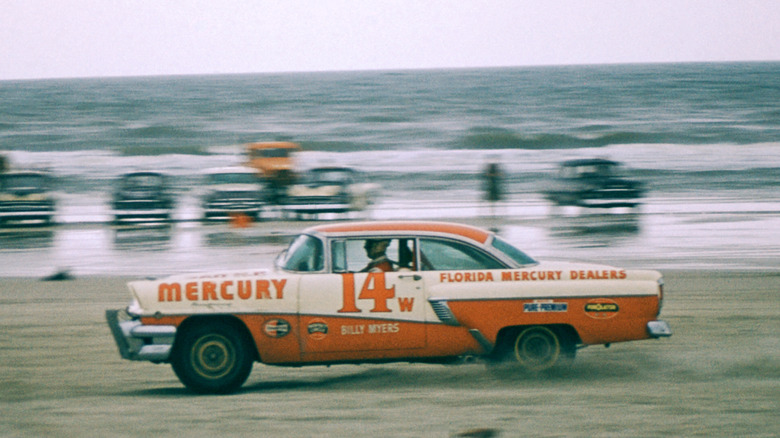
The 1950s were a tumultuous time for motorsports, a perfect storm of rapidly increasing speeds, larger crowds, and minimal safety standards. The 1955 Le Mans tragedy — the worst crash in racing history, which saw a factory-backed Mercedes 300SLR crash into a crowd of spectators — killed 84 people. Fifteen Formula 1 drivers met their demise behind the wheel across the 1950s, while NASCAR had seen numerous drivers die in that timeframe.
The public was hitting its breaking point with the dangers of motorsport, and the automotive companies that participated were noticing. It was the Marquis de Portago's Ferrari crash at the 1957 Mille Miglia, killing him, co-driver Edmund Nelson, and nine spectators (later vividly depicted in Michael Mann's 2023 movie "Ferrari"), that caused the Automobile Manufacturers Association to impose a racing ban on its members, effectively killing factory-supported American racing efforts overnight.
Following a unanimous vote of the association's members, a voluntary ban was placed on all performance-oriented promotions, beginning July 1, 1957. The ban meant that American manufacturers would no longer allow any mention of speed contests or competitive driving events of any kind in advertising.
These auto manufacturers knew that speed sold cars, evidenced by Chrysler's NASCAR dominance in 1956 with Tim Flock, Buck Baker, and Herb Thomas directly contributing to incredible sales of the hopped up 300 sedan. Nevertheless, the American public was getting more vocal about the dangers of fast cars, and Congress was threatening to legislate automakers into withdrawing from the sport. So the automakers retreated from racing to focus building economy cars and improving safety.
Factory-backed racing goes underground
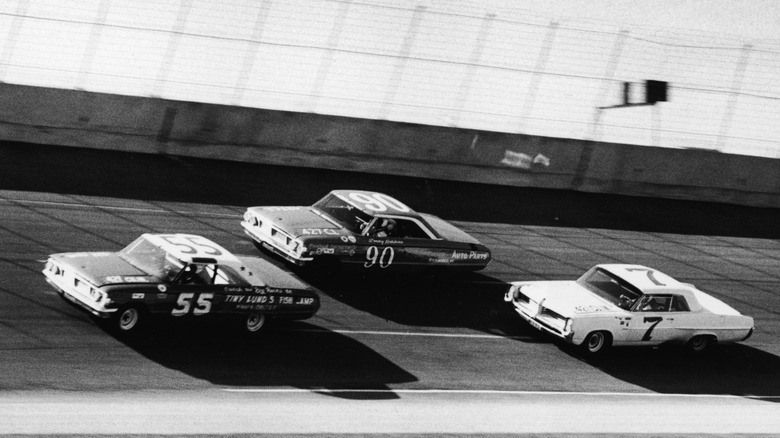
NASCAR had been allowing experimental go-fast parts like superchargers, fuel injection, and trick multi-carburetor intake manifolds, but with the manufacturers bowing out the series put an immediate kibosh on those to cut operating costs for struggling private teams. With their Big Three factory-backed coffers empty, NASCAR teams retreated and participation declined. The growing sport was effectively kneecapped back to its pre-factory-support days. The "win on Sunday, sell on Monday" days were gone.
Well, sort of. While Ford, General Motors, and Chrysler all shuttered their official racing programs, the teams they supported were still active in NASCAR. Buck Baker won his second consecutive title, taking 10 of 40 races in 1957. And across the late 1950s and early 1960s the Big Three still provided clandestine support for their favored teams.
NASCAR legends like Smokey Yunick with his hot vapor engine, Bunky Knudsen, Bill Stroppe, Bud Moore, Holman-Moody, the Wood Brothers, and the Petty family all got factory backing in this period, they just had to be hush-hush about it. Meanwhile, American Motors Corporation (AMC) kept to its end of the bargain, and, per Hagerty, ran an advertising campaign saying, "The only race Rambler cares about is the human race!"
There was still pressure from the more puritanical side of the American public, but the facts of the case started playing out in dealer showrooms. AMC sales were on a downward trajectory as it simply wasn't seen at the race track week after week, despite probably having the fastest car in its class. As the Big Three continued to build faster cars with bigger engines, AMC began to get a bit of a dorky reputation for proudly sticking to the rules.
How factory racing made a comeback
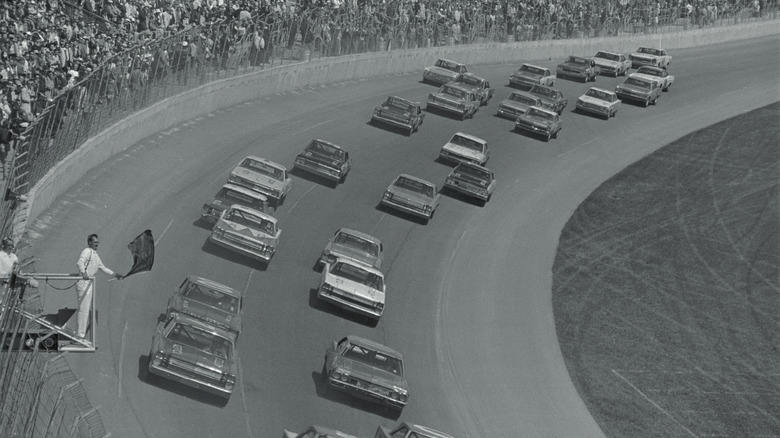
After about five years of supporting motorsport from behind the scenes, Ford decided it had enough and tore up the manufacturers' agreement. In June of 1962 Henry Ford II decided the racing ban was bunk because none of the other automakers abided by it anyway. Shortly thereafter Ford announced its Total Performance program and immediately got back into racing in a big way. Chrysler quickly followed Ford back into the crucible of competition.
General Motors, at least for a few more years, doubled down on its racing ban alongside AMC, though it still operated a few skunkworks backdoor racing deals it never talked about. GM did put all of the engineers who had been working on motorsport into developing performance-oriented street cars, however. In spite of not acknowledging motorsport publicly, GM built a reputation for big power and go-fast across the 1960s. The street speed Pontiac GTO and Chevelle SS 396 were soon joined by big-block-powered Camaros and Corvettes — among the most popular cars of the 1960s.
By the end of the 1960s both General Motors and AMC had pushed back into motorsport in a big way, joining Chrysler and Ford at the track. It was a relatively quiet decade or so for American racing, but the long national nightmare was finally over.