

What Does A Green Cap On A Car Tire Valve Mean?
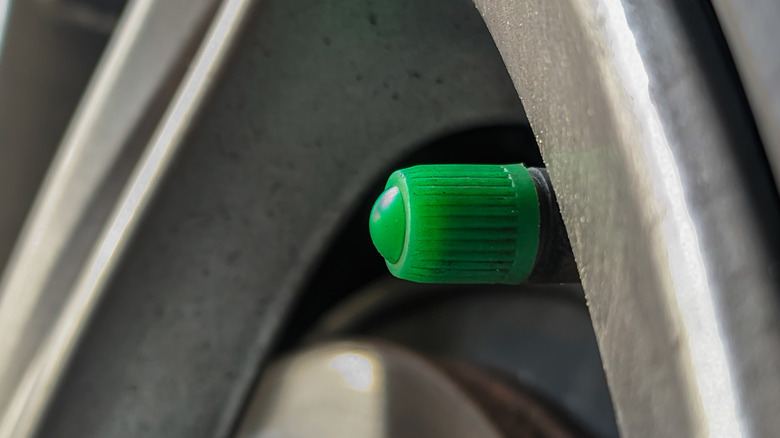
The last time we took my partner's vehicle to Costco for a tire swap, it came back with bright green plastic valve stem caps. She hated how they looked, and frankly, so did I, so we promptly turned around, walked into the shop, and asked for her factory silver caps back, which we put back on in the parking lot. If you happen to be standing beside your car at the tire center right now and are wondering why your valve stems (which also need to be replaced) suddenly have green caps, you've found the right article.
Green valve stem caps mean the tires were filled with nitrogen rather than plain old air. And no, the green caps don't serve any functional purpose other than that. They aren't specially formulated to be compatible with the nitrogen within, you can indeed swap them back out with any color stem cap you like without worry — despite what that annoyed tire shop employee may be trying to tell you to avoid the chore of fishing out your old caps.
Why use nitrogen in car tires?
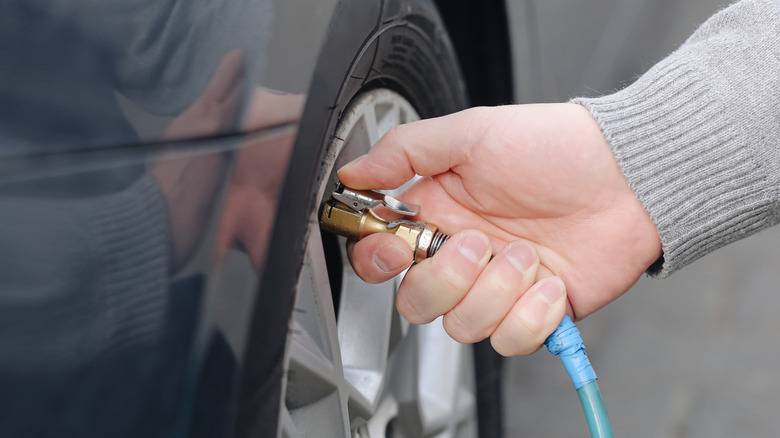
But why fill tires with nitrogen at all? The chief benefit of choosing nitrogen is that, everything else being equal, it maintains optimal tire pressure longer. Tire rubber is inherently porous, which means there are microscopic holes in the material that gradually let air escape over time. However, because nitrogen molecules are slightly bigger than oxygen molecules, they have a harder time fitting through the tires' pores, resulting in slower pressure loss and helping you get more miles out of your tires.
While the theory is sound, the real-life difference is frankly marginal. When Consumer Reports ran a study on the subject, it found that regular air-filled tires only lost an additional 1.3 pounds per square inch (psi) of pressure over the course of a year compared to nitrogen. For reference, normal car tires are typically filled to about 30 psi.
At this point, tire salespeople will likely note that nitrogen expands and contracts more predictably with extreme temperature changes and since it's a dry gas, nitrogen-filled tires are less prone to moisture buildup. There's scientific merit to those claims, but CR says that unless you're running a high-performance car, a heavy-duty commercial truck, or a literal airplane, regular air is more than fine.
Nitrogen-filled car tires are fairly common and accessible now, but that wasn't always the case. Around 2010 is when they really started becoming available for mainstream cars, and I still remember seeing reviews of the original R35 Nissan GT-R back in 2007 that pointed to nitrogen-from-factory tires as one of that car's obsessively futuristic details. Fast forward to today, and you can get your Toyota RAV4's tires filled with nitrogen at Costco. And if you do, you'll probably get the green valve stem caps to show for it.