

Compression Testing Vs Leak-Down Testing: What's The Difference?
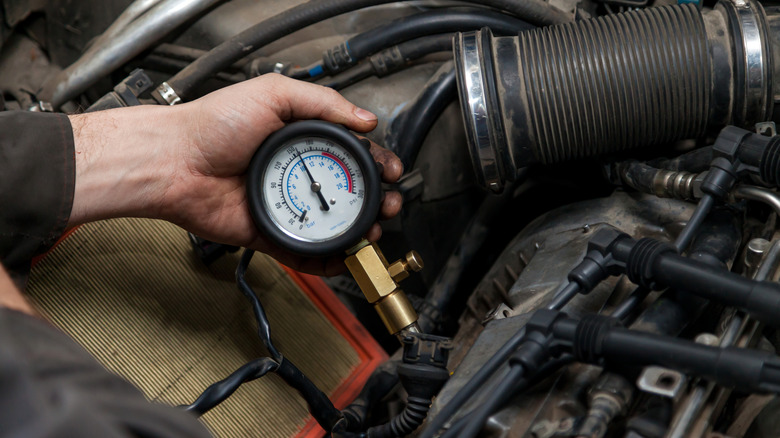
A healthy engine is a precision piece of machinery. When its tolerances are within spec, seals are tight, spark is ample, and components are well-oiled, it's reliable and operating with utmost efficiency. Sealing in particular is especially important, and properly keeping track of it means more than ensuring head gaskets keep coolant and oil solely where they should be. Properly sealing piston rings and valves is also essential, allowing for combustion to be well-contained while peak power is achieved – and keeping engine healthy, too.
However, as engines tack on runtime and mileage, rings and valves inevitably wear down, causing a drop in compression. Some drop is fine — the engine will continue to run healthy. However, low compression could be a sign of a failing cylinder head or some other issue that requires substantial work to remedy. If the issue isn't fixed, it can destroy the engine. Therefore, it's a good idea to run a compression test, leak-down test, or both. The former is easier and involves simply plugging a gauge into the cylinder and turning the engine over. The latter is a hair more involved, but you'll get more information out of it — and a lot more confidence about what exactly is the problem.
Compression testing isn't complex
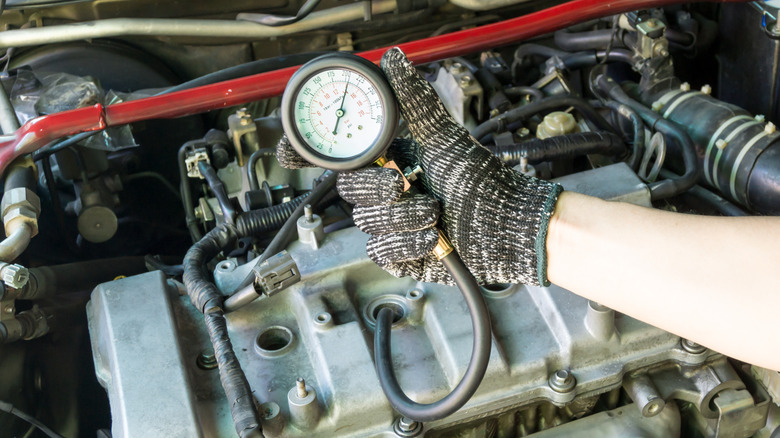
Before digging too deeply, it's a good idea to perform either (or both) tests in several situations. Maybe you've bought a used car and want to determine its health. Or, your engine is showing signs of running rough, whether due to a lack of power, a weird noise, misfires, a mysterious coolant loss, or some other sign of poor health.
A compression test is the easiest test to perform, and it can tell you a lot. Remove the spark plugs, then take a compression tester, thread it into a cylinder's spark plug hole, and crank over the engine (without it firing up — so, disable the fuel pump, too). Keep an eye on the gauge, wait until it's maxed out, then stop and jot down the reading. From there, rinse and repeat on every other cylinder. The readings should all be within a reasonable range of each other. Any cylinder that's clearly low is going to be a problem; 130 PSI is considered ideal, and the cylinders should be within 10% of each other.
However, certain variables must be accounted for to get the most accurate readings. The battery must be healthy, and — ideally — a charger should be hooked up to its terminals. The starter shouldn't be too hot, either, as it might not turn the crankshaft as fast as it's supposed to. Air density and valve lash can have an effect on results, too, so keep those aspects in mind as you perform your tests. This test isn't quite as involved as a leak-down test, but it still requires a good amount of preparation, and it might not tell you everything you need to know.
Leak-down to avoid weep-down
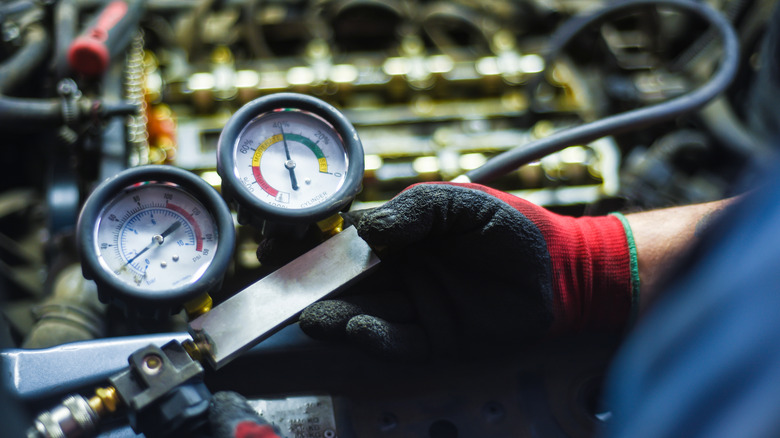
The leak-down test is more accurate and controlled ; no cranking the engine over required. Though, it does require more equipment and prep. An air compressor is necessary to feed air into a leak-down tester, which is then fed into the cylinder. For the best results, you'll also need to make sure that each piston is at top dead center (TDC). The air being fed from the compressor to the tester must be tightly sealed, as well.
Here's a quick overview of this method: Set the piston to TDC, turn on the compressor to build up air pressure in the first bit of the tool, plug the other end into the cylinder, and open the valves to see the variance. Leak-down testers have both a compressor gauge and cylinder gauge, and the difference between them will give you a percentage of leak-down. Additionally, listen for any air escaping out of the engine, and look for bubbles in the coolant reservoir. As pointed out by Gareth Foley of FCP Euro, these signs help pinpoint what the problem is that's causing a compression leak. Foley also notes what's considered healthy, acceptable, and poor leak-down. Under 5% indicates excellent health, 10% is good, 15% is decent, and 20% or higher means major work must be done to fix the problem.
It's never a bad idea to perform both tests with the proper equipment. Compression testing takes less equipment and time, though, so it's easy enough to do in a pinch. That being said, leak-down testing offers a better overall picture of what's going on, so that's the method you'll want to jump to if you can't afford to let any issues slip through your notice.