

Here's How Many Rovers NASA's Landed On Mars (And How Many Are Still Active)
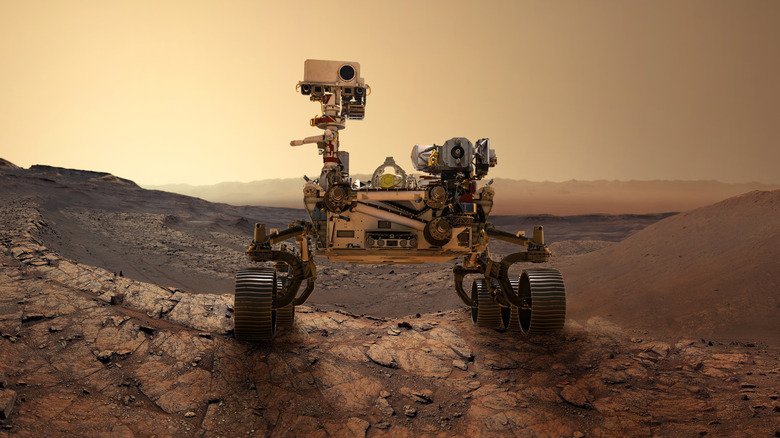
The prospect of getting humans to Mars (perhaps via lithium-plasma engine) has hit more than a few roadblocks over the years. While plenty of experts remain bullish on the feasibility of Mars colonization somewhere down the line, the once-breathless optimism of landing humans on the Red Planet in our lifetimes seems to have waned a bit.
This doesn't mean in-depth exploration of Mars is any less important — or fascinating. Over the past 30 years, NASA's management-challenged Jet Propulsion Laboratory has nonetheless succeeded in landing five big-wheeled robots, dubbed "rovers," on the Red Planet's surface. And despite being subjected to constant abuse via radiation storms and wheel-shredding terrain, two of the five rovers are still rolling across the desolate Martian landscape, dutifully conducting experiments and sending data back to safely Earthbound scientists.
From the pint-sized Sojourner — the first rover to hit Mars' surface, in 1997 — to the markedly chonkier Perseverance that landed on the Red Planet in 2021, all five of NASA's rovers have served their NASA masters well. So what exactly have these high-tech (and presumably quite dusty) mobile science labs accomplished over the years? And what are the two remaining fully operational Mars rovers up to these days?
Sojourner, Spirit, and Opportunity: the O.G. Mars rovers
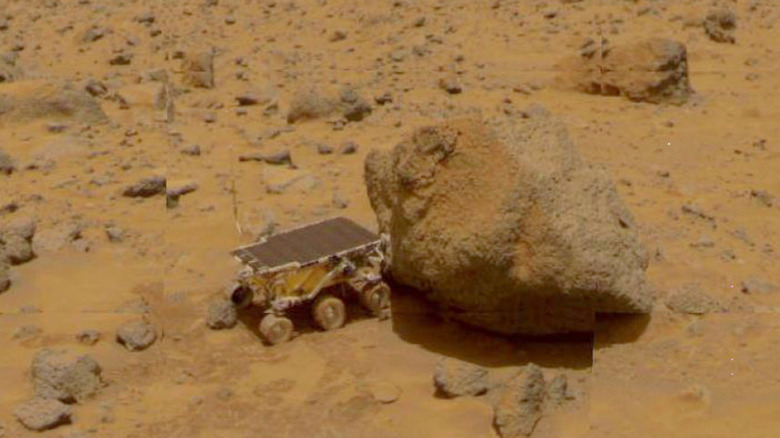
Let's start with the first Mars rover, Sojourner. Launched in December 1996 as part of NASA's Pathfinder fact-finding mission, this toaster-sized six-wheeler touched down on July 4, 1997 at the flat, rock-strewn Ares Vallis site. This 'roided-out space Roomba took over 550 pictures of the planet's surface, collected data on the chemical composition of Mars rocks and dirt, and collected info on the planet's buck-wild atmospheric conditions. After 83 days of sending invaluable data back to Earth, Sojourner's last successful transmission back to NASA took place in September 1997.
The Pathfinder mission uncovered some pretty spectacular evidence — most notably, that Mars was once likely partially covered with water, and used to have a markedly higher surface temperature than it does now. To learn more, in 2003, NASA sent two more rovers — Spirit and Opportunity — to further investigate the existence of H2O on Mars in the past. Weighing 374 pounds each, these rovers dwarfed the 23-pound Sojourner, and were equipped with more robust and advanced equipment.
Spirit and Opportunity touched down on opposite sides of the Red Planet — the Gusev Crater and Meridiani Planum, respectively — in 2004. Each spent the next several years collecting more data on the Mars climate and the presence of water, including evidence of sub-surface geothermal pools that possibly existed millions of years ago.
Perhaps even cooler, these findings gave greater credence to the idea that Mars, at least at one point, had all the right ingredients to sustain life. While these rovers completed their missions and long outlasted their expiry dates, Spirit conked out in 2010 and Opportunity in 2018.
Curiosity and Perseverance keep living up to their names
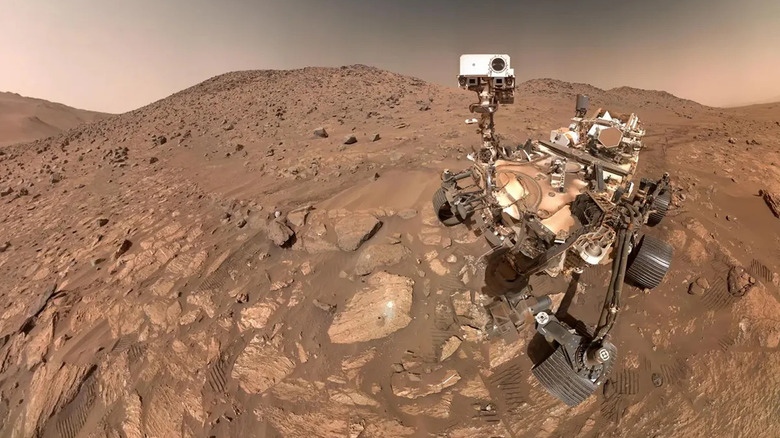
The most recent rovers sent to Mars, Curiosity and Perseverance, are still in operation as of 2026. Curiosity, which was sent up in November 2011 and plopped down in August 2012, is about the size of a Mini Cooper, and appropriately sports car-like 20-inch wheels (Sojourner's wheels rang in at 5.1 inches in diameter, and the twin Spirit and Opportunity rovers had 9.8-inch wheels).
Sporting 17 cameras and a wealth of investigatory tools, Curiosity was the first rover to locate what NASA dubs "organic carbon." As that might suggest, this uncovered matter — at Mount Sharp, a mountain located in the Gale Crater — was the best evidence yet of microscopic life on Mars. Unfortunately for would-be Mars colonizers, Curiosity also has provided proof of colossal, extremely non-human-friendly levels of radiation on the Mars surface. And just look at what Mars has done to Curiosity's wheels. Yikes.
Last, but far from least, Perseverance is NASA's most sophisticated Mars rover to date. It was launched in 2020, and landed in 2021, as part of the multi-vehicle Mars 2020 project tasked with looking for proof of former life on the planet. It's being used to see if oxygen can be purified from the air on the carbon-dioxide-heavy planet for potential Earth-born visitors to breathe.
Yes, we're definitely still a way off from landing people on Mars. But with the work accomplished by these five rovers — along with the many stationary landers, satellites, and drones NASA and other agencies have assigned to the planet — the possibility of manned Mars landings looks a tiny bit brighter with every intergalactic data burst from our robot pals on the Red Planet's surface.