

Could NASA's Lithium-Plasma Engine Be The Key To Getting Humans To Mars?
Buckle up, kiddos, we're goin' to Mars! Okay, so no one is actually going to Mars anytime soon and SpaceX's Starship rocket keeps exploding. However, extra-long-distance space travel is inching closer to becoming a reality, as NASA continues to work on alternative means of propulsion outside of typical rockets. And its Jet Propulsion Laboratory (JPL) just had a massive breakthrough in electric thruster technology, one that could be the beginning of the propulsion technology that puts the first human on Mars.
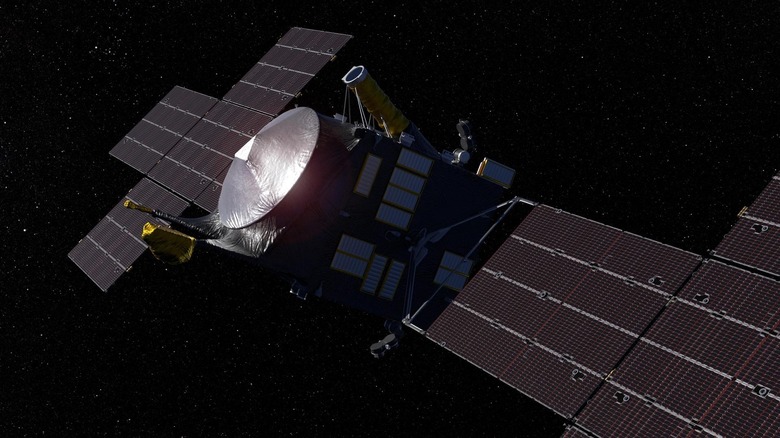
NASA's Psyche spacecraft just recently flew past Mars and it's still going, thanks to a similar type of electric thruster. While Psyche's electric thruster accelerates slowly, without any atmospheric drag in the vacuum of space, there's nothing to slow it down. So it will eventually allow Psyche to reach astonishing speeds of 124,000 mph (it's currently cruising at just over 12,000 mph). Yet JPL's new magnetoplasmadynamic (MPD) thruster operates at up to 120 kW of power, which is 25 times more than Psyche's thrusters. Just imagine what it can do.
What is an electric thruster and how does it work?
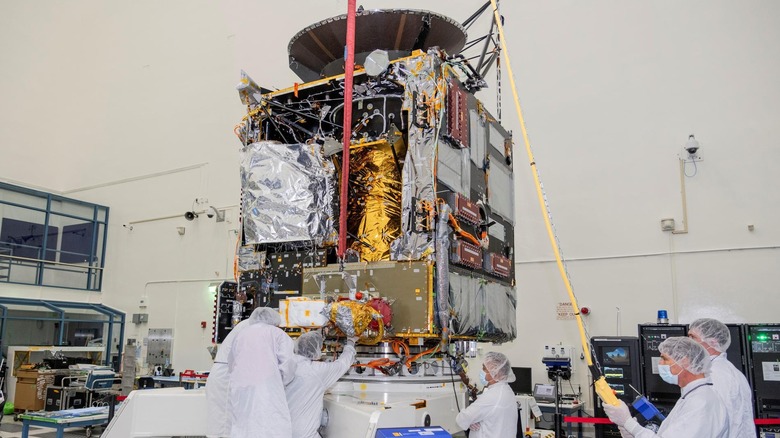
In theory, the physics of propulsion is simple: you must accelerate something in one direction to move in the opposite direction. Traditionally, propulsion is achieved chemically through rocket combustion. However, that requires a lot of fuel and rockets can burn through it quickly, making them heavy and inefficient. As a result, chemical rockets don't make the best deep space travel engines. That is why NASA began working on different methods of thrust, and came up with the electric thruster.
Electric thrusters work by using electrical energy — created by either solar panels or a nuclear reactor — to ionize inert gases, like xenon or krypton. When those gases are ionized, electromagnetic fields accelerate those ions and push them out of the thruster, thus leaving something behind and causing propulsion. NASA's typical electric thruster creates less than one pound of thrust, but that compounds over many hundreds of thousands of miles to accelerate a small spacecraft to incredible speeds. And since electric thrusters use roughly 90% less fuel than chemical rockets, they allow spacecraft to be much lighter.
However, there are limitations to that level of thrust. While it can eventually help a small craft reach absurd speeds, it takes years. Psyche launched in 2023 and has only just now reached 12,333 mph (it even streamed a cat video to Earth along the way). Plus, it's only a small, satellite craft. Something much larger, with several astronauts and all of their equipment, would require much more than just one pound of thrust. So how does NASA make a thruster without heavy chemical fuel on board?
Lithium-fed magnetoplasmadynamic thrusters are key (duh)
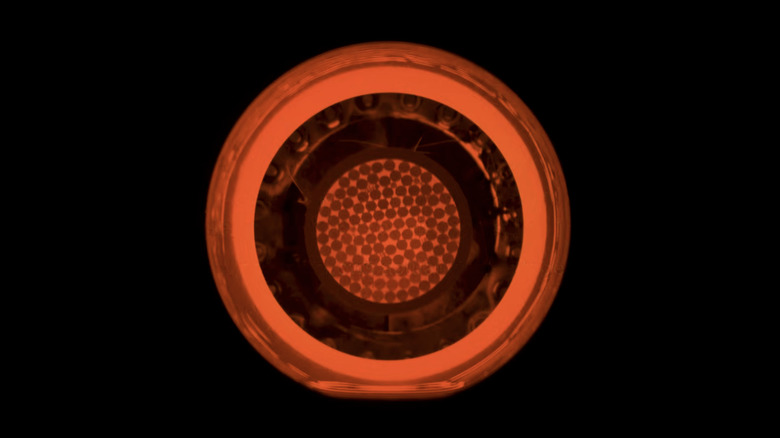
NASA has been tinkering with MPD thrusters since the '60s, and this new one is its latest breakthrough. JPL's new MPD thruster is similar to Psyche's electric one, but it uses much higher current and a different fuel source. Unlike Psyche's solar-powered thruster, this MPD would use nuclear power for space travel. All of its current interacts with a magnetic field to accelerate lithium plasma. While it currently maxes out at 120 kW of power, NASA's JPL wants to reach between 500 kW and one megawatt per thruster.
If NASA can manage to hit its one-megawatt goal, it would still need multiple MPD thrusters for a mission to Mars. Sending humans to the Red Planet would require around two to four megawatts of power. However, keeping them cool and working well is an even bigger issue. During ignition, the tungsten electrode at the thruster's center can reach up to 5,000 degrees Fahrenheit. Managing heat and durability for a 23,000-hour trip to Mars sounds tricky.
However, NASA seems confident that it can meet the challenge, develop these thrusters, and potentially put humans on Mars at some point, even if it currently seems focused on executing a twice-yearly flurry of missions to build a Moon base. "Designing and building these thrusters over the last couple of years has been a long lead-up to this first test," said James Polk, senior research scientist at NASA's JPL. "It's a huge moment for us because we not only showed the thruster works, but we also hit the power levels we were targeting. And we know we have a good testbed to begin addressing the challenges to scaling up."