

How The 1955 Chevy Cameo Carrier Invented The Lifestyle Pickup Truck
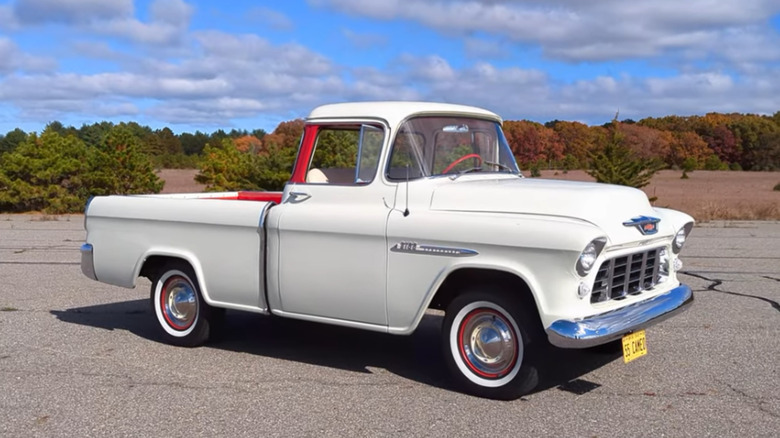
We're not here to judge, but there's no getting around the fact that a lot of pickup owners don't take full advantage of their truck's greatest strength: towing. So why are these machines so incredibly popular? Part of it is no doubt an image thing, but it's just as important that people can tap into the pickup vibe without sacrificing comfort or aesthetics. For that, we can thank Chuck Jordan's 1955 Chevrolet Cameo Carrier — a true game changer that helped transform the pickup from bare-bones workhorse to lifestyle accessory.
The Cameo Carrier had its roots in Chevy's more traditional truck lineup of the time, although even those models didn't actually look all that traditional. Introduced in 1955 and styled by Jordan — who would become GM's VP for Design in 1986 — the so-called Task Force trucks were already modernizing the segment with their appearance. They make pretty cool-looking restomods, too.
Yet Jordan's initial sketches for the Task Force trucks show that he originally wanted to push the design envelope even further. Now, GM execs didn't entirely agree with Jordan's vision for the full truck roster, but they did greenlight the Cameo Carrier as sort of a test bed for the advanced styling. Unfortunately, the truck would fail that test, ringing up only 10,305 sales during its four years on the market.
What made the Cameo Custom so stylish?
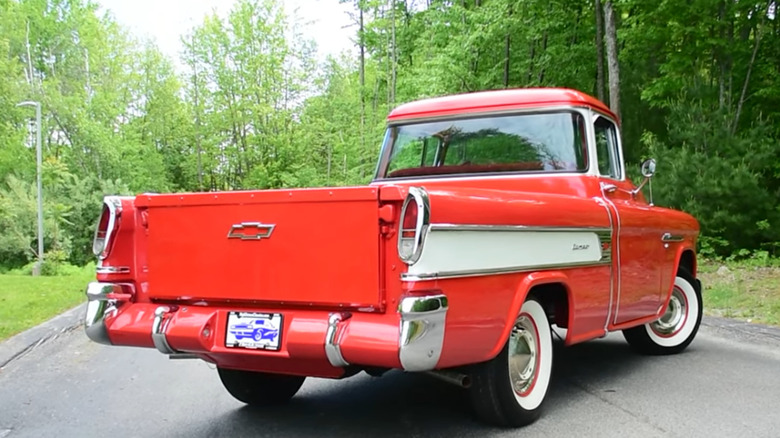
One of the biggest changes to the Cameo Carrier was its fresh, smooth-sided appearance — setting the template for the transition from stepside to fleetside pickups. Jordan, though, wanted the bed and cabin to look like one long flowing and sophisticated piece. Unable to pull that off for the Cameo Carrier — because it couldn't handle the twisting forces of the chassis – Chevy used chrome trim to disguise that space. This was another advanced design touch for a truck of that era, and the Cameo Carrier additionally showed off a large chrome front bumper, an ornate chrome grille, and chrome door handles. The wraparound windshield and hooded headlights combined with that grille to help the pickup make an appealing first impression.
Smaller chrome overriders were mounted near the rear bumper as well. They did double duty by helping to hide release points for the flip-down bumper. That, in turn, allowed access to the Cameo Carrier's clever underbed spare-tire carrier, which was made of fiberglass. So were the truck's rear quarters and tailgate cover, emphasizing its smooth body.
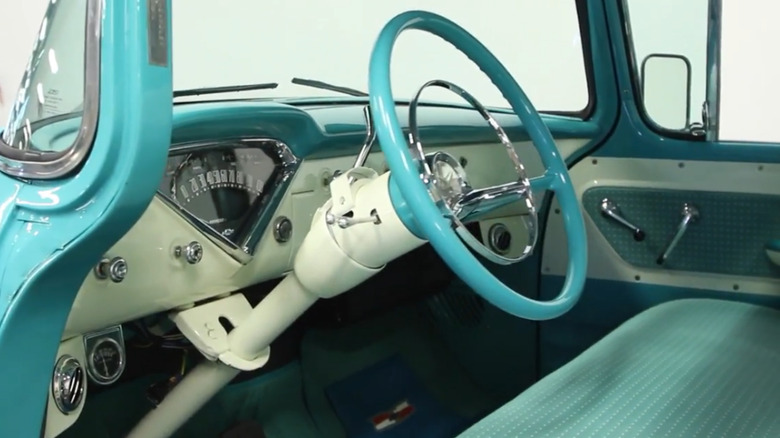
The first batch of Cameo Carriers capped it all off with a striking two-tone appearance, first backed by Bombay Ivory as the main color, set off by Commercial Red trim and highlighted by Commercial Red interior bed walls. The two-tone approach then carried over into the interior, where Chevrolet provided more relatively upscale details. Equipment like an AM radio, a heater, armrests, padded door panels, a cigarette lighter, and carpeting were all considered high-end accoutrements in the 1950s, yet they were standard for Cameo Carrier customers.
Could the Chevrolet Cameo Carrier still do truck things?
On the one hand, the Cameo Carrier was indeed competitive with its rivals when it came to towing and hauling. On the other, no light-duty pickups of the time were especially known for the latter.
Let's start with payload, which is essentially the amount of additional weight — beyond the truck's curb weight — the vehicle can safely handle. This came to 1,650 pounds for the Cameo Carrier, giving it almost the same maximum payload as a comparable 1955 Ford F-100 (1,718 pounds). Both also have the exact same maximum gross vehicle weight rating (GVWR) of 5,000 pounds. As truck and RV owners could likely tell you, that lowered the payload cap significantly. After all, the GVWR includes the curb weight of the truck, and for the Cameo Carrier, that came to about 3,495 pounds. Add in a few passengers and gear, and the truck's weight could easily top 4,000 pounds before you put anything in the bed — leaving less than 1,000 pounds of payload capacity.
It's a similar story in terms of off-road credibility. Pickups back then were primarily rear-wheel drive, with the first mass-produced 4x4 truck — the Dodge Power Wagon — not arriving until 1946. Moreover, the first four-wheel-drive GM trucks had to be converted by an outside supplier called NAPCO. The 1955 Task Force would feature the first Chevy ½-ton models capable of the conversion, including the Cameo Carrier. That said, the number of those trucks actually receiving the 4x4 setup was extremely small. Yet as one spin in the luxuriously styled and equipped 2026 Chevrolet Silverado High Country will prove, the Cameo Carrier's impact on the pickup world was huge.