

The Modern Car Era All Started With The Mercedes 35 PS
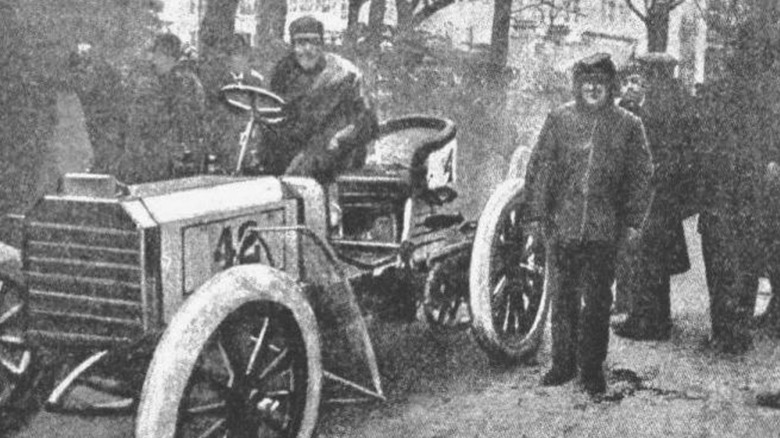
Mercedes introduced the 35 PS in 1900, or rather, the 35 PS introduced the world to Mercedes, as this was the first official model from the now-storied brand. Just to throw in some context, this was only 14 years after Carl Benz and Gottlieb Daimler separately invented the world's first automobile in 1886.
Despite arriving on the scene so close to the dawn of the automobile, the 35 PS would go on to shape the future of all automobiles, leaving a legacy that can still be seen today. It emerged as a revolutionary response to the limitations posed by other efforts at the time – essentially motorized carriages – and was driven by the demands of one Emil Jellinek. A successful entrepreneur, Jellinek required a powerful and safe vehicle. His demands were fueled by Wilhelm Bauer's fatal accident in the 1900 Nice Race Week.
Wilhelm Maybach and his team delivered, introducing a vehicle that broke away from the traditional carriage layout. The 35 PS was designed to impress both in racing and touring disciplines, with a high-performance four-cylinder engine, honeycomb radiator, low center of gravity, and a long wheelbase — all innovations that signaled a shift in automobile design at the time.
The vehicle was delivered to Jellinek later that year and quickly proved itself by dominating the 1901 Nice Race Week, finding victory at the Nice-Salon-Nice race and Nice-La Turbie hill climb. The engineering that went into creating this successful automobile would last a lifetime, shaping what would eventually become the modern car era as we know it.
Drivetrain innovations continue to shape modern machines
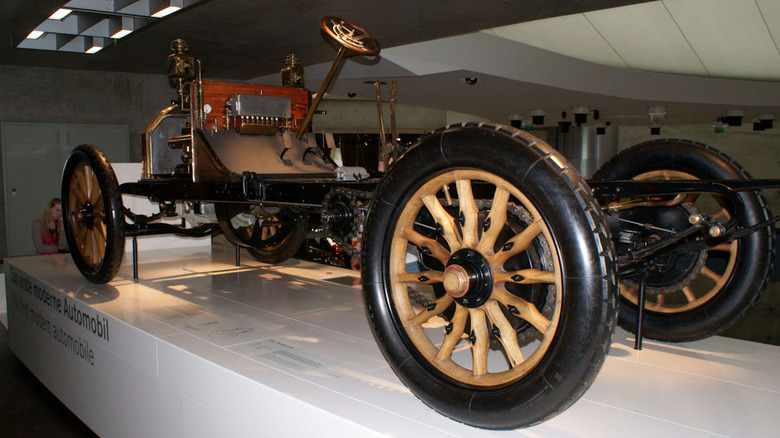
The car as a whole was innovative, but the drivetrain was a real highlight. Josef Brauner was the engine designer, and his finished product was a 5.9-liter inline-four. It produced 34 horsepower, or 35 Pferdestärke (PS), hence the name. This grunt was delivered at just 950 rpm, and as would become apparent when the model took on Nice's various races and rallies, that oomph was more than enough to impress.
However, a car with oodles of power is no good if it's unreliable, and one of the more difficult challenges to overcome in the early days of motoring was cooling. Here, Wilhelm Maybach had a solution in the form of an all-new honeycomb radiator. This new design allowed the engine to maintain performance and stay within appropriate operating temperatures over extended periods, which is no doubt how the 35 PS managed to race so competitively. To demonstrate its effectiveness, the 35 PS required just 9 liters of coolant, and then eventually 7, compared to the typical 18. Of course, grilles have evolved from honeycomb to high tech over the years, but the basic design principles of Maybach's innovation remain prevalent even today.
Initially, the honeycomb design was driven by a hunger for reliability, but later it became a defining visual feature for the brand. Upright radiators became an industry norm for decades. Fast-forward to today – similar grille designs are still commonplace in the current Mercedes-Benz range.
Other aspects of the 35 PS were just as influential
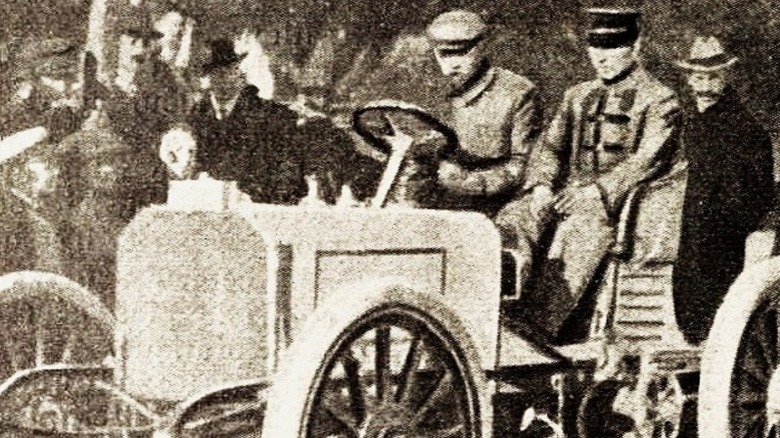
In addition to the honeycomb radiator and powerful engine, the 35 PS introduced a smattering of other influential innovations. For starters, it boasted an angled steering column, plus a foot-operated clutch. These sound like small tweaks in comparison, but they demonstrate a huge step forward in terms of ergonomics. And although they may be taken for granted, such features still exist to this day.
The 35 PS chassis architecture is also worthy of note. It abandoned the old motorized carriage system that was severely limiting in terms of comfort and stability in favor of something purpose-built for automotive applications. A low center of gravity, a wider track, and a longer wheelbase were employed — that's a basic blueprint that modern vehicles still adhere to.
It's wild to think that aspects of the very first Mercedes from 1900 can still be seen in modern cars today, but even brand-new models — like the GLC — boast the honeycomb radiator motif first introduced on the 35 PS. Principles such as stability, safety, and indeed comfort are at the core of car design to this day, and a low center of gravity is still very much a desirable trait in a sports car. Prior to the 35 PS, automobiles were still essentially adapted carriages with some form of motorization — it wasn't until the designers and engineers behind Mercedes' first car came along that the game would change forever.