

Toyota Prius Vs Camry Hybrid: How Do Their MPGs Compare?
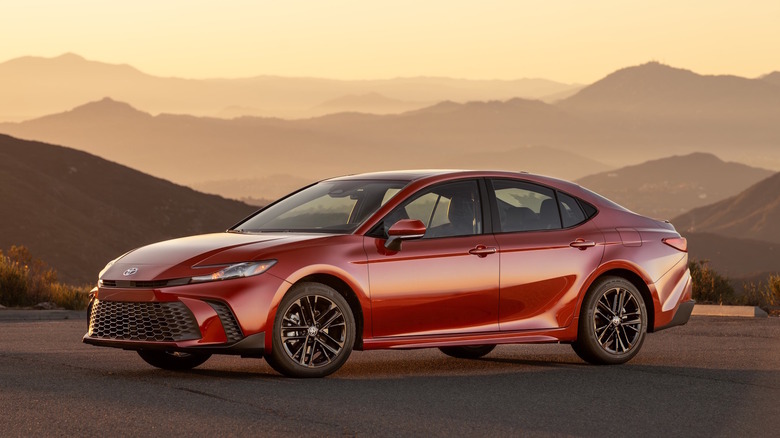
With gasoline prices at their highest in almost 4 years, better fuel economy can take on new importance. If the idea of getting more miles per gallon (mpg) with a hybrid vehicle comes to mind, you're not alone. Sales of hybrids have spiked by 37% in the 2 months following the start of the Iran War. And when talking about these electrified vehicles, the conversation has to include Toyota, which owns almost half the market. The majority of the company's models that still rely on gasoline have a standard or available hybrid powertrain.
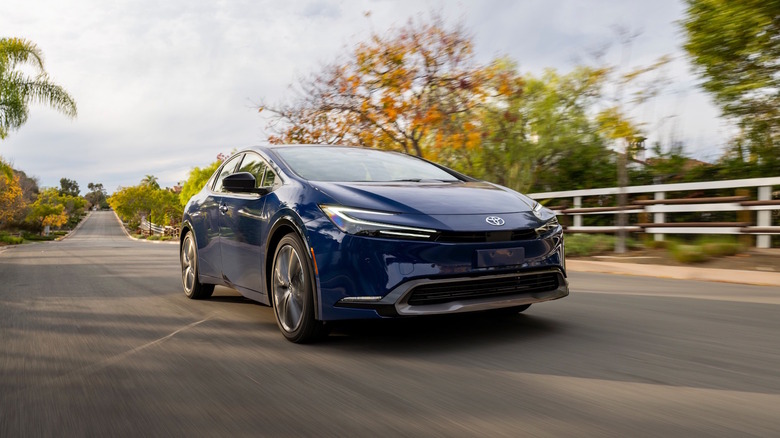
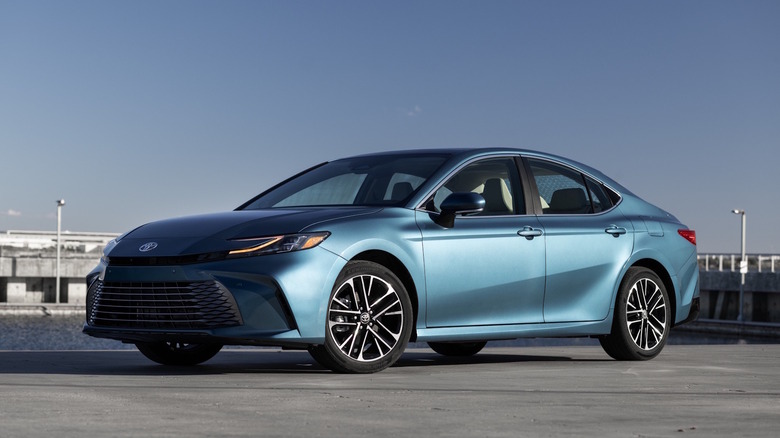
If you haven't been car shopping in a while, the Camry became hybrid-only with the launch of the ninth generation in 2025. While the Prius has always been hybrid powered, the hatchback underwent its own transformation when Toyota brought svelte looks and more power.
Comparing America's favorite sedan with the benchmark Prius makes sense. The base trims are separated by just $750, and fuel economy isn't radically different. The 2026 Camry's combined fuel economy is 51 mpg, and the 2026 Prius' is 57 mpg. However, the mileage gap narrows once all-wheel drive or higher trims are factored in. We'll explain those contrasts and focus mostly on combined fuel economy for simplicity. The Environmental Protection Agency (EPA) calculates combined mpg as a blend of city and highway fuel economy (weighted 55% city to 45% highway). We also drop in Consumer Reports' mileage data as a real-world cross-check.
By the numbers: Toyota Camry and Prius fuel economy
Crossing the 50 mpg threshold matters for buyers watching fuel costs. In 2024, the average new vehicle had a rating of 27.2 mpg. With the average American driving 13,476 miles annually, that works out to 495 gallons of gas purchased. In April 2026, the average price of a gallon of gas was $4.23. Crunching the numbers puts yearly fuel costs at about $2,094. But at 50 mpg, total cost at the pump drops to $1,140. When looking at combined fuel economy, the base Camry LE (in front-wheel or all-wheel drive) meets or exceeds 50 mpg. The same applies to most Prius trims and drivetrains.
Stepping up to a higher Camry trim (SE, Nightshade, XSE, or XLE) with front-wheel drive drops combined fuel economy to 47 mpg. Adding all-wheel drive comes with a 1 mpg penalty on most grades (3 mpg with the XSE). Consumer Reports' test of a FWD-equipped Camry SE yielded 48 mpg overall, 1 mpg better than the EPA's combined 47 mpg. CR also reported 54 mpg on the highway, compared to the EPA's 47 mpg estimate. The government's mpg ratings don't always match reality.
Unsurprisingly, the Prius gets better fuel economy than the Camry, thanks to its smaller size and reduced output. The combined 57 mpg rating for the LE trim with FWD is the best among both vehicles. Mileage drops to 54 mpg with AWD. The XLE, Nightshade, or Limited trims with FWD are rated at 52 mpg combined. The Prius only drops below 50 mpg (49 mpg) with a non-base AWD trim. Consumer Reports' overall mileage with a FWD-equipped Prius XLE was 51 mpg, 1 mpg below the EPA rating. However, highway mileage reached 59 mpg, a 7 mpg improvement over government testing.
How do the Camry and Prius compare in other areas?
If the sole reason for choosing between these hybrids is fuel economy, the Prius is the hands-down winner. Those few extra mpgs could make all the difference. And a Prius set the world fuel-economy record at 93.2 mpg. However, if the Camry versus Prius decision is still a toss-up, other factors may break the tie. Let's start with price (all MSRPs include destination charges). The Camry LE costs $32,120 – adding AWD costs another $1,525. Its counterpart, the Prius LE, stickers at $29,845 (AWD is an extra $1,400). If you prefer the top-level AWD trims with all the bells and whistles (although the equipment isn't the same between the two models), a Camry XSE costs $42,230, while the Prius Limited costs $40,370.
In terms of power, the Camry uses a 2.5-liter four-cylinder hybrid engine that produces 225 total horsepower with FWD (232 hp with AWD). The Prius's 2.0-liter four-cylinder unit produces 194 horsepower (196 hp with AWD). However, the output differences don't translate into better straight-line performance. Car and Driver reports a 0-to-60-mphtime of 7.0 seconds for Camry and 7.1 seconds for a Prius (both with FWD). Perhaps the extra 300 to 400 pounds the Camry carries slowed it down.
Admittedly, there haven't been huge separators so far, but that changes with body style. The Camry is strictly a sedan, and the Prius only comes as a five-door hatchback. There's also a difference in interior space. The Camry has 42.1 inches of front and 38.0 inches of rear legroom, versus 43.2 inches (front) and 34.8 inches (rear) for the Prius. The Camry also offers up to 99.9 cubic feet of passenger volume, compared to 91.2 cubic feet in the Prius.