

The Largest Plane You Can Fly On In 2026 Is Indeed Quite Large
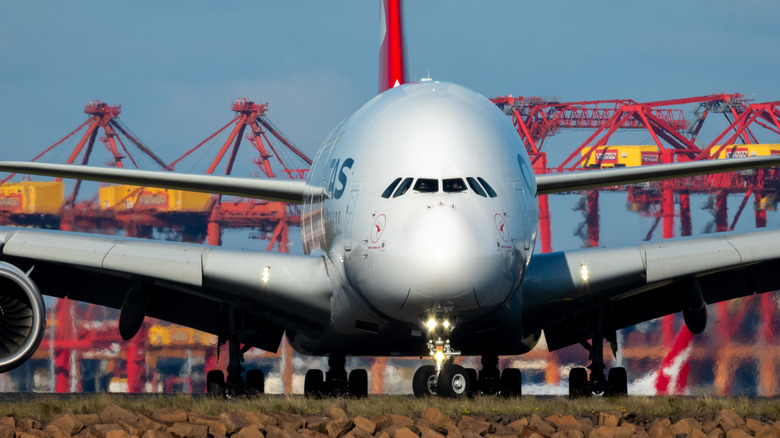
Sometimes size really does matter. When it comes to long distance flights, cruising in a bigger plane is usually more enjoyable than a smaller one. The extra elbow space alone in many large aircraft can make a huge difference in flight comfort, but larger planes are also typically better at dealing with turbulence, making flights feel smoother. So if you're planning a trip and making sure to only fly big, there's one plane that's bigger than the rest: the Airbus A380, which is 240 feet long, 262 feet wide, and still in service in 2026.
Since Boeing's 777X was delayed to 2027, the trusty old A380 is still the largest commercial aircraft currently in use. Due to its size and enormous passenger capacity, the A380 is usually used for long-distance and international flights. Think of it as the grand tourer of the skies; it takes you long distances in comfort, speed, and style (or about as much style as a commercial plane can have). While the A380 is no longer in production, plenty of its models are still being used by major airlines. That's because the world's biggest plane has also been one of the most reliable and trustworthy fliers since Airbus first rolled one off the assembly line in 2005.
How big is the Airbus A380?
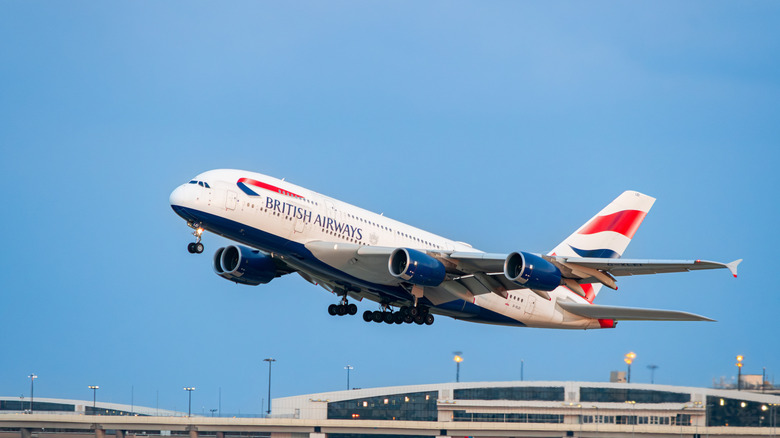
At over 240 feet long, the Airbus A380 isn't too far off from the size of a football field. Its wingspan of 262 feet spreads out further than the length of its body, too. And since it's a double-decker, its fuselage is extra tall to support two floors of passengers in addition to its underbelly cargo area. So, on top of being the world's biggest plane, it's also the most spacious.
The A380 is capable of holding a whopping 850 passengers, and — according to Airbus — every window seat has a window. That way, there's no chance that you'll get screwed with just a quarter of a window while the row in front of you has the portion with the slide handle. All that being said, the A380 admittedly isn't the longest plane. The only commercially-used passenger plane longer than the A380 is the Boeing 747-8, but the A380 is bigger than it in every other way. The enormous Antonov An-225 was longer than both, but that was strictly a cargo plane — and it's only able to be flown in simulators now.
Why does size matter (aside from being able to carry more people)?
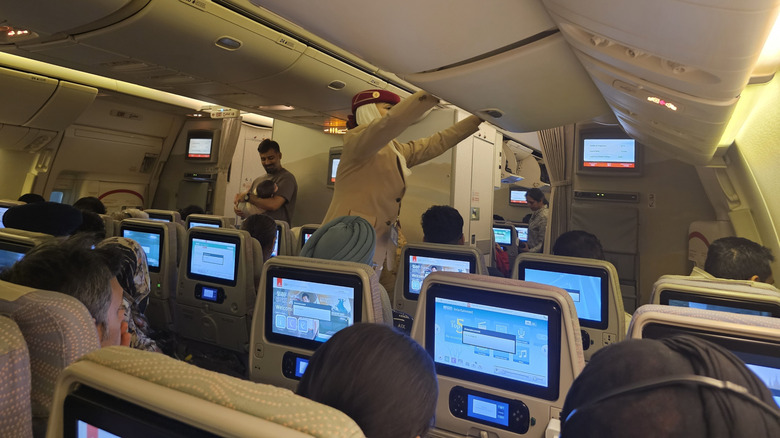
So why does Airbus brag so much about having the biggest plane? Aside from being able to carry more people — which makes it more valuable for airlines — is there an advantage to a bigger plane? In addition to being impressive in terms of engineering, larger planes are more desirable for passengers. It's pretty simple physics: Larger planes are heavier, and therefore harder for turbulence to move, which makes them feel smoother in the air. Less turbulence and a smoother ride makes passengers more comfortable.
Additionally, the larger plane usually brings about more passenger space. That isn't always the case, as airlines can try to pack as many seats in as possible, which reduces the amount of room available. But typical widebody planes like A380 and the Boeing 787 Dreamliner (the smaller A350's competitor) do have more elbow and legroom than their not-as-massive siblings. And if a plane makes you feel less like a sardine while flying, you're more likely to choose it again in the future.
Like automakers, aircraft manufacturers use their biggest planes as their flagships, so they often have the company's latest and greatest tech for both avionic and cabin technology. For example, Boeing's Dreamliner provided improvements in cabin pressure at cruising altitude. That improves comfort and humidity, making the flight that much more enjoyable and reduces post-flight fatigue. In other words, the biggest planes are often the most enjoyable to fly in. And it's just fun to know that you're in the biggest and bestest. Put simply, the 21-year-old A380 is still the biggest plane you can fly on — and still one of the very best.