

The 2000 Ford Excursion Was Built To Be The Biggest, Heaviest SUV On Earth
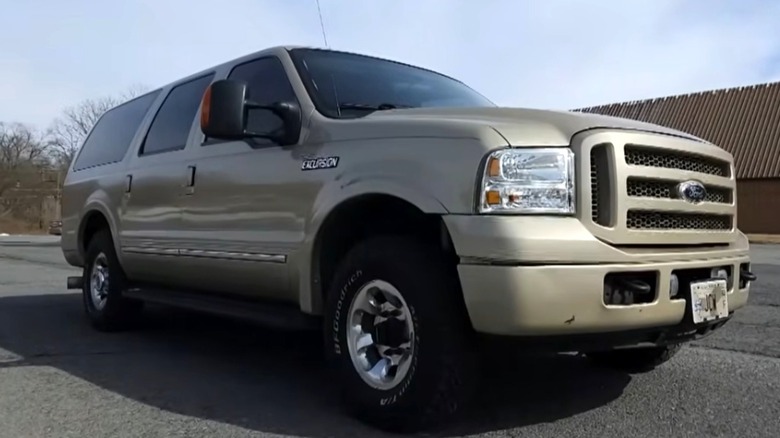
Ford has been a key player in the SUV sweepstakes for years, of course, but the company faced a bit of a problem in the year 2000. Its massive three-row Expedition, which debuted in 1996 and stretched 204.6 inches at the time, just wasn't big enough for some buyers. Now, the automaker could have built — and eventually did — a stretched wheelbase version for a little extra room. But instead, Blue Oval engineers took the maxim "go big or go home" to the next level by introducing the Ford Excursion — a mighty monster of a machine built on the same chassis as the Ford Super Duty trucks.
In Ford's words (PDF), the Excursion was "what the other SUVs want to be when they grow up," and that claim was more than supported by its dimensions. The super-sized SUV, taking up 226.7 inches of pavement, was nearly 2 feet longer than the Expedition, with an additional 18-inch advantage in terms of wheelbase. Moreover, even though GM offered its own HD-based SUVs in the form of the Chevrolet Suburban 2500, for example, that model was still 7.4 inches shorter in length with a 7-inch shorter wheelbase.
Nor did Ford seem all that worried about the Excursion's curb weight. The massive SUV clocked in at 6,660 pounds in its lightest configuration — with RWD and a 5.4-liter V8 — and could reach 7,688 pounds with four-wheel drive and an optional 7.3-liter turbodiesel Power Stroke V8. At that stage, it was about 650 pounds heavier than a 2000 Hummer. It still undercuts the 2026 GMC Hummer EV, which can break the 9,000-pound barrier in some versions.
The Excursion has big engines and big muscles
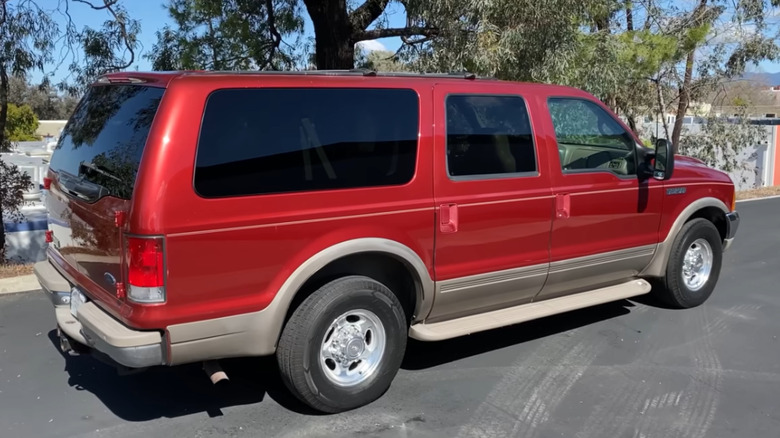
The Ford Excursion offered its share of high-displacement engines as well, helping owners take advantage of the SUV's high-strength frame. For instance, that 7.3-liter turbodiesel — possibly hinting at the 7.3-liter Godzilla V8 engine to come — could provide 325 hp and 560 lb-ft of torque by 2005. The result was an impressive 11,000-pound tow rating. These are again numbers that the Suburban 2500 can't match — although that's partly because the Bowtie brand no longer offered a diesel powerplant for the HD Suburban by then.
In the gasser category, the Excursion sets the tone with a 6.8-liter V10. And while ten-cylinder engines have their pros and cons overall, the one in the Excursion would eventually be good for 310 hp and 425 lb-ft of torque, allowing it to also handle trailers of up to 11,000 pounds. The biggest gas engine for the Suburban 2500, by comparison, was an 8.1-liter V8 pushing 340 hp and 455 lb-ft of torque. Despite its smaller cylinder count, the extra displacement in the Chevy did give the Suburban 2500 a higher tow rating of 12,000 pounds. As for their EPA ratings, well, since both are considered heavy-duty vehicles, neither had to report fuel-efficiency numbers for any of the motors.
If you're curious about the Expedition, the 2000 model is limited to a 7,900-pound towing maximum with the optional 5.4-liter V8 rated at 293 hp and 350 lb-ft. A diesel Expedition was not on the menu.
Living large inside the Excursion cabin
As we've said in the past, typical minivans are usually a better play for families than a great three-row SUV, and a lot of that's because minivans generally offer more room for both passengers and cargo. Yet the Excursion is the exception that proves the rule. As proof, we can look at how it stacks up to the 2026 Toyota Sienna.
The Excursion gets things started with more headroom and legroom in all three rows than the Sienna. As a highlight, the third row of the Excursion lets adults ride relatively comfortably with 38.6 inches of headroom the former and 39 inches of legroom while the Sienna measures 37.4 and 38.7, respectively.
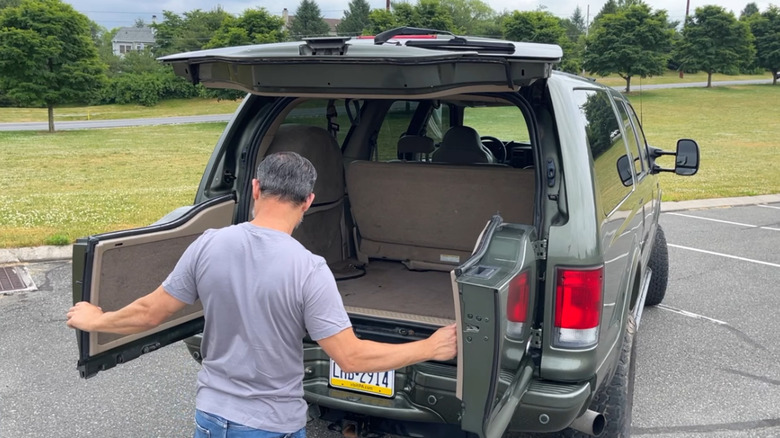
The Excursion's huge footprint also gives it a massive lead when it comes to room for gear, groceries, and other cargo. To be exact, you can stuff approximately 45% more stuff behind the first row of the Ford — with a total capacity of a whopping 146.4 cubic feet — than you can in the Sienna, which has 101 cubic feet of cargo space with its rear rows folded flat.
And while we joked about sliding barn doors on the Sienna, the Excursion has the automotive equivalent of the real thing. The available Rear Tri-Panel Doors combined a flip-up rear glass atop horizontally opening swing-out cargo doors to get the most out of the SUV's capacious cargo space. Perhaps the smallest thing about the Excursion was its production run. It lasted only a single generation, from 2000 to 2005, before Ford pulled the plug.