

Is Cleaning Your Car To Improve Fuel Economy Myth Or Mythbusted?
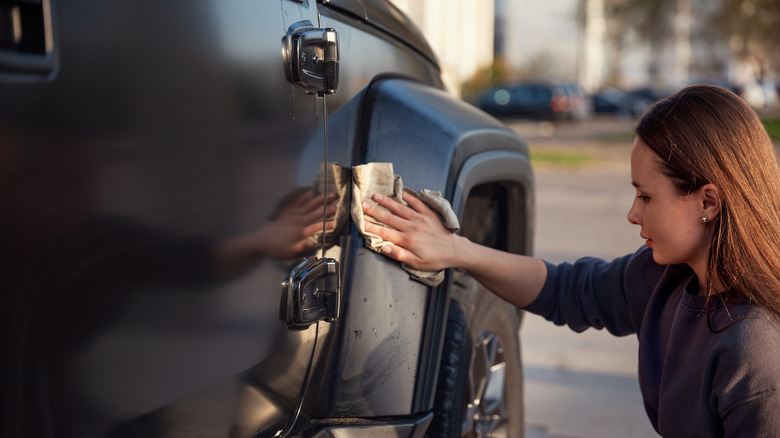
Whether talking about a cheap and cheerful Mitsubishi Mirage or the recently updated Mercedes-Benz S-Class luxury sedan, nothing beats the feeling of a freshly washed car. Is there something about a clean car that somehow makes it drive better, or is it all about the shine and prestige that makes a clean vehicle stand out among the dirtier herd? Lest you believe that a dirty car conveys carelessness and a general lack of attention to detail, while a clean car suggests financial stability and discipline, the real message is clear: a clean vehicle is more pleasant to drive and makes the driver (and passengers) feel good, too.
As it turns out, cleaner cars will also help save gas, and the myth about dirty cars being more aerodynamic and efficient than clean cars was busted many years ago by our favorite science-preaching folks from the MythBusters. Adam Savage and Jamie Hyneman took an old sedan (which appears to be a fourth-gen Ford Taurus), covered it in dirt and mud, and ran it on an empty track to measure its fuel economy. The car got 24 mpg, which is pretty decent for an early 2000s family sedan.
Next, they cleaned the car and ran it on the same track, and it got 26 mpg. It doesn't seem like much, but with average gas prices hovering close to $4.30 in today's war-ridden economy, the clean car would have saved around 38 gallons of fuel over 10,000 miles. That's $163.40 saved just by having a cleaner car. So, yeah, clean cars rule.
Dimples made the car more fuel efficient

The reason behind the myth of dirty cars being more fuel efficient had something to do with golf balls, particularly their dimpled surface, which enables them to travel twice as far through the air as golf balls without dimples. After the initial test that measured the clean car's fuel economy against that of the dirty car, the MythBusters did the next best thing by covering the Taurus with clay, but with a twist. They did separate runs, measuring the car with a smooth, clay surface against the same car with dimples pressed into the clay to resemble the pockmarked surface of a golf ball.
The results were somewhat eye-opening. The smooth surface yielded 26 mpg, the same as their first experiment when they ran a clean car versus a dirty car. However, running the same car with a dimpled surface produced 29 mpg, a 3-mpg difference over a smooth surface. This begs the question: Why aren't we driving cars that look like golf balls? The answer is speed. Cars can maintain higher speeds than golf balls, and studies have shown that the aerodynamic advantages of dimpled surfaces are significantly reduced as speed increases, which led a team from the Massachusetts Institute of Technology (MIT) to look into "morphable surfaces" that can change between smooth and dimpled in 2014.
Clean airplanes save more on gas

Clean cars can save their owners gas money, but airline companies are taking the clean route to save on jet fuel, too. Aerodynamics is everything for airplanes, and clean aircraft can save around 0.5% or about half a ton of jet fuel. Maintaining a clean exterior is particularly important for aircraft that fly in harsh weather, as such conditions make surfaces prone to dirt buildup. With existing jet fuel prices at around $141.64 per barrel, saving even just half a percent is money in the pockets of airline operators.
To summarize, cleaner cars (and cleaner airplanes) are more fuel efficient. The good news is that, unlike airplanes that cost anywhere from $350 to $10,000 for a basic wash or full exterior treatment, you don't need to spend that much to maintain a clean car. We don't recommend washing a car too often for fear of dulling or ruining the paint, but giving it a thorough clean with water, car shampoo, and clean microfiber towels twice a month is enough to make your ride sparkle and line your pockets with gas savings in the long run. Oh, and try to avoid automatic car washes with abrasive brushes to avoid the risk of damaging the paint.