

Here's Why Turbocharger Development Was Held Back For Years
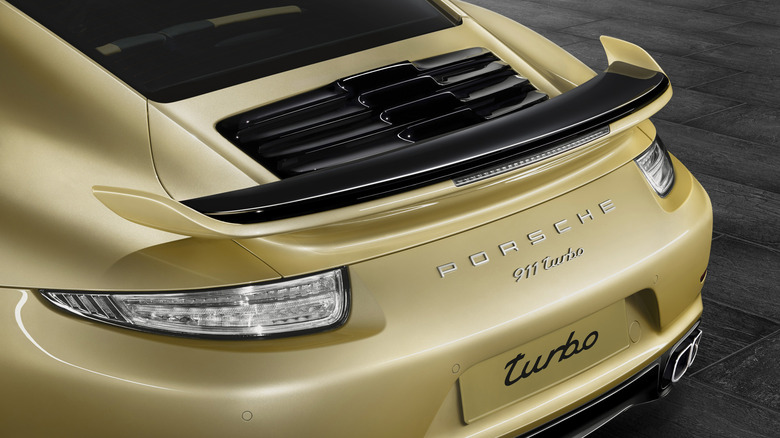
It's hard to believe it took 57 years for the first turbocharged production car to arrive after the technology's patent in 1905, yet it's true. The wait isn't a story of slow progress — it's the saga of an innovation that outpaced the materials needed to make it work.
Alfred Büchi's 1905 patent described a compressor driven by exhaust gases that forced air into a diesel engine to increase power output. Getting that initial idea to function took the Swiss engineer nearly 20 years. The advancement of turbos was largely stagnant because of weak materials that couldn't withstand the heat and pressure being applied.
As early as 1918, a turbocharged Liberty V-12 motor was demonstrated 14,000 feet up in Pikes Peak and proved — despite material weaknesses under prolonged use — that forced induction can combat the power loss from the reduced air pressure at elevated altitudes. Just two years later, a LePere biplane equipped with a turbocharged and supercharged Liberty 12-cylinder climbed to a then world-record 33,114 feet . This was, of course, long before the feat of twin-charging had a name.
Turbocharger technology proved it had a future
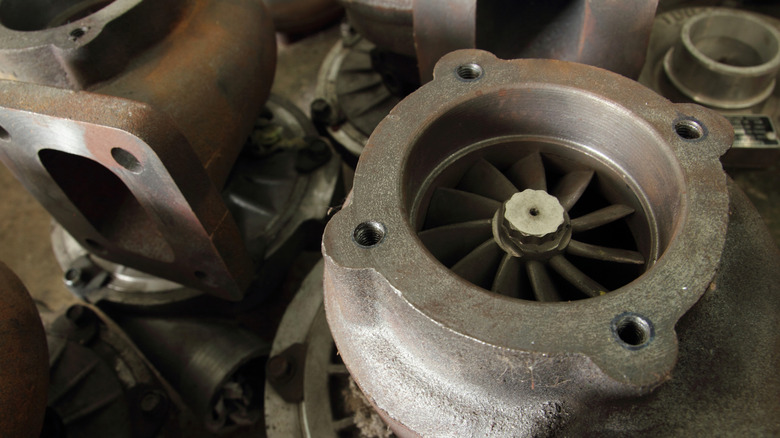
The first public application of Büchi's patent appeared in 1925, in two diesel-powered German passenger liners. The normally 1,750-horsepower power units now produced an additional 750 horses with the turbo. Although metal and bearing technology were largely futile, this marine installment showed that big power was possible and compelling enough to push the technology toward locomotive engines and even applications in the growing automotive space.
The true catalyst for the turbocharged boom in the second half of the 20th century was WWII-era metallurgical research. The wartime accelerated materials development enough to make turbos compact and durable for truck use by the 1950s. Real-world applications demanded austenitic stainless steel housings capable of surviving sustained extreme heat, while titanium-aluminum turbine wheels offered lower rotational mass and a faster response.
While modern turbochargers can comfortably spin at up to 350,000 rpm, these would have destroyed any material Büchi had available in 1905. Although he never lived to see his patent in production cars, his concepts were always sound. They just needed time to catch up.
When turbos finally won over the road
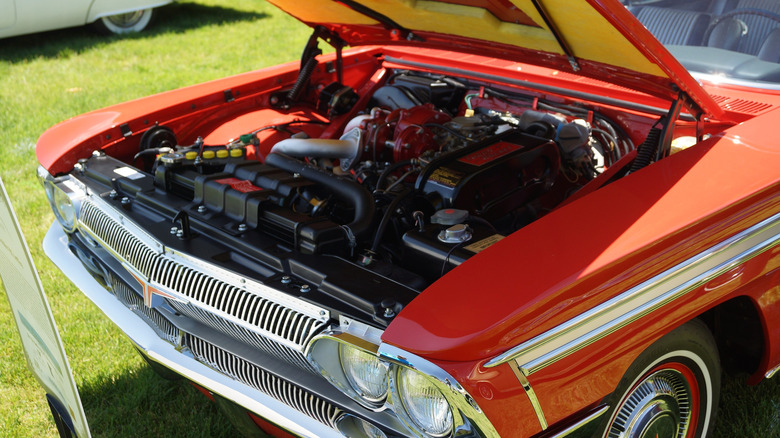
Oldsmobile became the first automaker to take a crack at production boost with their 3.5-liter turbocharged V8 Jetfire followed by the Chevrolet Corvair shortly after. The Jetfire's turbo V8 was the largest of the two GM turbo offerings and produced 215 horsepower. The V8 required a complex cooling system with a distilled water and methanol mixture to maintain engine temps. As revolutionary as the Oldsmobile Jetfire seemed on paper, most of the 9,000 units were eventually recalled due to severe persistent reliability troubles.
The turbocharger made an emphatic comeback in 1973, this time on the tarmac with the Porsche 917/30. The track demon ran a twin-turbo 5.4-liter flat-12 that produced upwards of 1,100 horsepower and dominated the American Can-Am until the series folded at the end of the '74 season. Many credit the series' demise to the dominance of the turbocharged 917/30.
Porsche's first turbocharged production leap came in 1975. The Stuttgart-based firm would give their prized 911 the boosted treatment in the form of the 930. Porsche's turbocharged "widowmaker" marked the beginning golden age of road-going turbo performance through the '80s and '90s that birthed such icons as the Ferrari F40, Buick Regal Grand National and even the Toyota Supra Turbo.
In an automotive landscape that's been taken over by turbocharged technology, it's hard to think that turbos have only been in cars since the 1960s. As metals became gradually resistant to pressure and heat, turbos became more common, and it's safe to say the 57-year wait was worth it.