

To Visualize How Diesel Fuel Detonates, Here It Is Igniting In Slow Motion
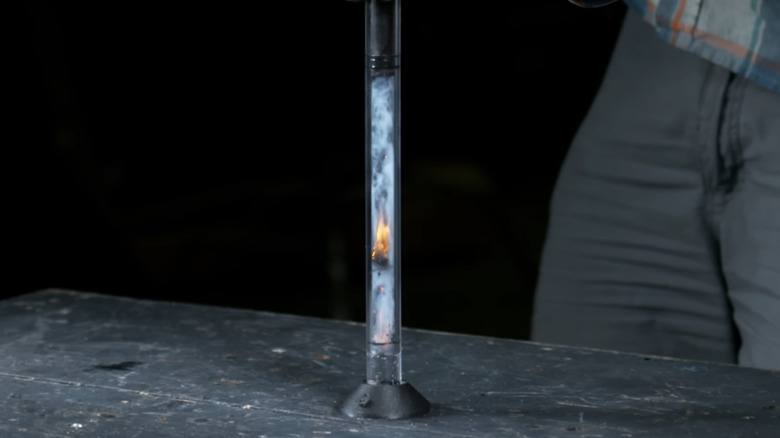
If you're a bit of a visual learner and can't wrap your head around how a diesel engine works, the YouTube channel Warped is here to help. The presenter, using a transparent fire piston (something that looks a lot like a syringe), demonstrates the concept of compression ignition, which, as you may know, is the principle behind a diesel engine. The video kicks off with him explaining the setup — a see-through fire piston capable of a 25:1 compression ratio, which is not too far off from actual diesel engines.
Since oxygen is readily available and heat is generated through compression, the only missing piece to achieve combustion is the right kind of fuel. What's interesting is that the presenter's idea of using char cloth as a fuel source is loosely reminiscent of Rudolf Diesel's early experiments with coal dust, which eventually led to the modern diesel engine. Similar to what the inventor did, the YouTube presenter can later be seen switching to diesel fuel for his experiment.
While he initially couldn't quite achieve char-cloth combustion, adopting a smaller fire piston (to introduce more pressure) and using a sledgehammer did prove successful, which you can see around the four-minute mark. Although his first attempt with diesel didn't quite deliver the same slow-motion footage as he had hoped, his second attempt successfully captured the principle behind diesel ignition in action. A flame front, similar to the char-cloth test, can be clearly seen in the video, around the 5:53 mark.
Understanding diesel fuel
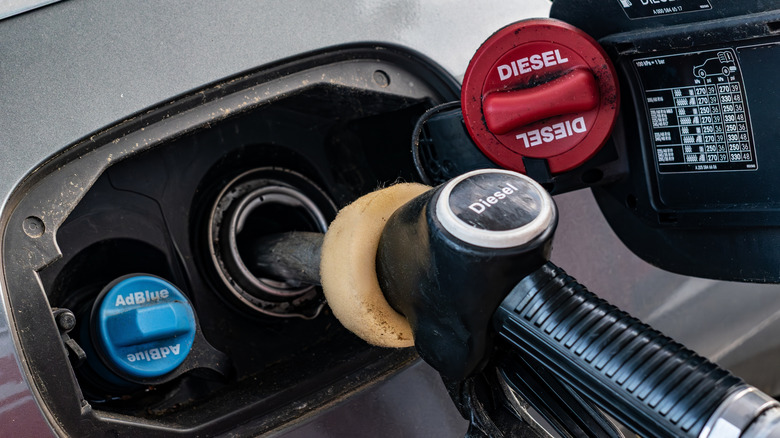
The reason diesel engines use compression ignition and gasoline engines use spark ignition has a lot to do with the fuels themselves. Diesel is far less volatile than gasoline and has a higher flash point, which means it doesn't vaporize as quickly at room temperature as gasoline. This is why a trail of gasoline ignites much more easily than a trail of diesel, as demonstrated in this MythBusters video.
However, diesel is still a combustible fuel, meaning it will ignite once there is enough heat. If we consider their auto-ignition temperatures, defined as the minimum temperature at which they can ignite without requiring an external source, we find that diesel fuel generally auto-ignites at a lower temperature than gasoline.
So a chamber of hot, highly compressed air is enough for diesel to ignite, which explains Warped's YouTube video. Technically, you could also use gasoline and it may self-ignite, provided temperatures get high enough, but that's not how an actual gasoline engine works. More importantly, auto-ignition is not something you'd want in a gasoline engine, which is why high-compression gasoline engines recommend using high-octane fuels.
However, that's not to say people haven't tried using gasoline in the compression ignition context — Mazda's Skyactiv engine tech is a good example. That said, unlike a diesel compression-ignition engine, Mazda's solution is kind of a hybrid. Known as SPCCI, or Spark Controlled Compression Ignition in Mazda speak, it uses a spark plug to help initiate a compression-ignition event, effectively blending both elements of spark- and compression-ignition engines.