

Trump Wants American-Made Cars To Be More American-Made
Good morning! It's Monday, June 1, 2026, and this is The Morning Shift, your daily roundup of the top automotive headlines from around the world, in one place. This is where you'll find the most important stories that are shaping the way Americans drive and get around.
In this morning's edition, the Trump administration wants more "American-made" cars to use parts from the U.S., United Auto Workers union members are on strike at a General Motors axle supplier in Michigan, BYD finally shook off its losing streak and Honda is recalling nearly 100,000 cars for an airbag issue.
1st Gear: Trump wants to make American cars more American again or something
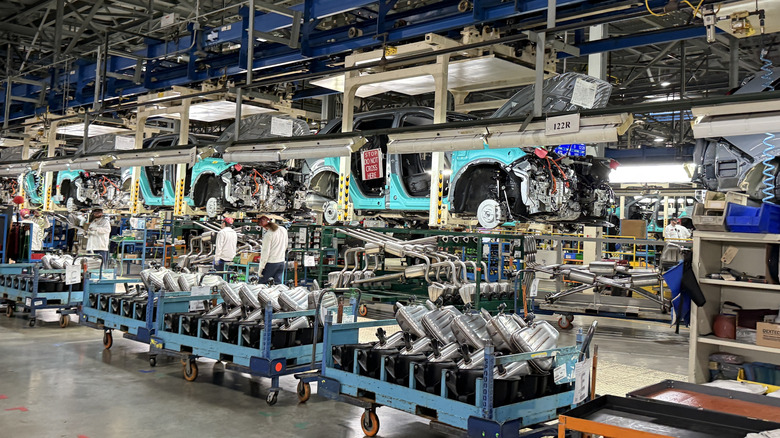
The Trump administration, always a fan of keeping folks on their toes, has issued a sweeping demand to Mexico to raise the level of regional content in North American-built cars and trucks to 82% in order for them to qualify for preferential trade deal access. On top of that, half of that value has to be produced in the United States, according to four people familiar with the U.S.'s negotiations.
The proposed new thresholds were revealed to automakers during two days of bilateral talks to revise the U.S.-Mexico-Canada Agreement on trade last week. Because we live in a world that makes a lot of sense, Canada was excluded from the Mexico City-based negotiations, and there was no provision for counting any parts contained from Canada. Ya know, I'm not an expert, but I'm not quite sure just how feasible an ask like that is. From Reuters:
The shift, if accepted, would be a major break from the current USMCA, which requires 75% regional content to qualify for preferential tariff treatment.
USMCA also now requires that 40% of the "core parts" value of North American passenger vehicles be produced in high-wage jurisdictions, effectively the U.S. or Canada. That threshold, covering engines, transmissions, major body parts and EV batteries, is 45% for pickup trucks.
The U.S. demand and lack of accommodation for Canada are consistent with Trump administration officials' frequent criticism of Canada's exports of vehicles and auto parts to the U.S. and requests to move that production to the U.S.
Auto industry officials said that there was a high likelihood that U.S. Trade Representative Jamieson Greer would seek to negotiate the new rules of origin with Mexico and then present them to Canada as a take-it-or-leave-it proposition. Greer has been evasive about whether USMCA would continue as a trilateral trade pact or be broken into separate bilateral agreements.
USMCA was first launched back in 2020 to replace the 1994 North American Free Trade Agreement. It maintained a duty-free trade zone that served as the backbone of nearly $1.6 trillion in annual trade between the three countries. Unfortunately for everyone involved, President Trump woke up bored one day and decided to uproot the entire system — imposing a 25% tariff on Canadian and Mexican-made vehicles and components, as well as a 50% duty on steel, aluminum and copper from the countries.
Now, there's a new ask.
Reuters first reported on Thursday that U.S. negotiators were pursuing a U.S.-specific automotive content requirement. U.S. trade officials briefed industry lobbyists on the proposal for 82% regional content, but it was not immediately clear how that figure, or the 50% U.S. value requirement, would be calculated.
USTR also has proposed raising regional value content for heavy trucks to 75% from 70% in the current USMCA, a source familiar with the U.S. proposals said. The source added that the U.S. also wants to incorporate its stricter calculation method for the local content of high-value components after a dispute panel announced in January 2023 that Mexico and Canada won in a ruling that effectively allows more non-North American parts in those components. The U.S. trade agency said in a statement that the Mexico City negotiating round also covered steel and aluminum trade and economic security provisions, which are aimed at keeping China and other countries from taking advantage of USMCA.
"The United States concluded discussions with the goals of reducing the trade deficit with Mexico and strengthening American supply chains," USTR said, adding that both countries will also seek to enhance regulatory compatibility on sectors including medical devices, pharmaceuticals and cosmetic products.
A Mexican official who was familiar with the negotiations said there were "no surprises" and no one expects the U.S. to pull out of this latest accord. Talks are expected to continue later this month in Washington, D.C., focusing on agriculture and "a level playing field." There's a third round on the books for the end of July as well, but so far, nothing is set to get Canada involved.
2nd Gear: UAW on strike at GM axle supplier
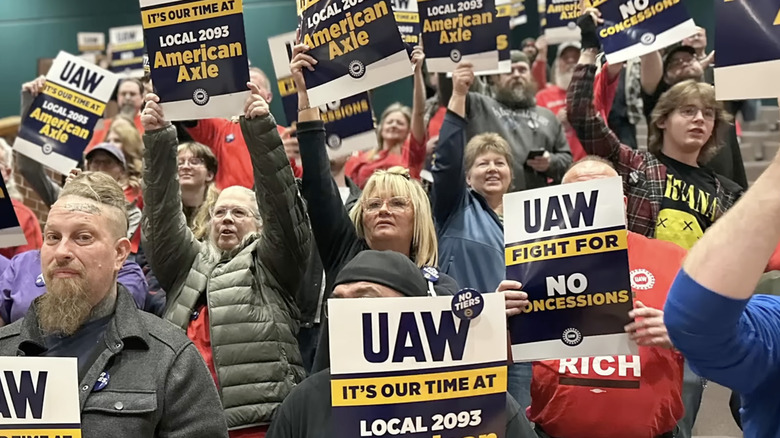
United Auto Workers union members at the American Axle plant — a Tier 1 supplier for General Motors — in Three Rivers, Michigan, went on strike at midnight on June 1. That specific plant is one of nearly 75 facilities in 15 countries operated by American Axle.
UAW Local 2093 members voted in May to authorize a strike when their contracts expired on May 31. The union says many of their workers actaully actually still feeling the impact of the Great Recession of late 2008, when hourly wages for some workers were cut in half. The UAW says they're looking to restore those wages some 18 years later. From CBS News:
"No contract, no axles," the union said. "In 2008, workers at American Axle took major sacrifices to save the facility from closure during the Great Recession. Many long-time workers who were making as much as $29 an hour in 2008 saw their wages slashed to $14.50. Today, eighteen years later, workers are still yet to make up all that lost ground, with wages at American Axle currently topping out at $22 an hour after a five-year progression, with inflation-adjusted wages cut in half from their pre-2008 levels."
The workers at this plant make axles for the GMC Sierra and Chevy Silverado, according to the Detroit Free Press, and they're then assembled at GM's Flint plant using American Axle-produced parts.
The strike of nearly 1,000 workers officially began at 12:01 a.m. on Monday, and additional pickets began at 6 a.m.
3rd Gear: BYD skaes sales losing streak
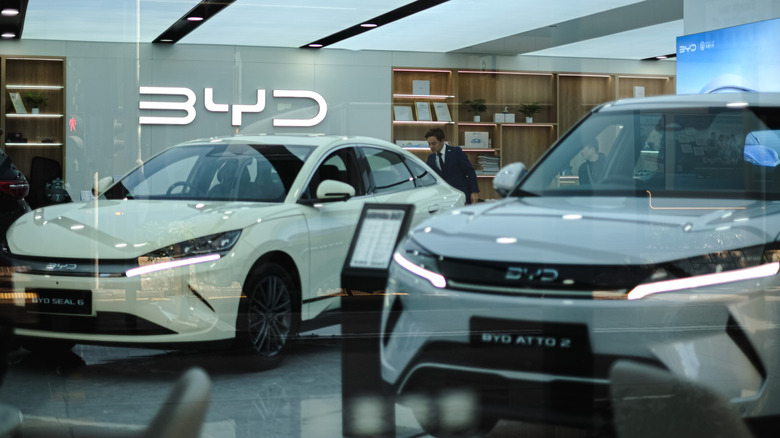
After an unpleasant handful of months, it seems BYD finally got its groove back. The Chinese automaker's total vehicle sales rose for the first time in nine months in May, thanks mostly to strong international demand caused by a spike in oil prices. From Bloomberg:
The Shenzhen-based automaker delivered 383,453 vehicles last month, up 0.3% from a year earlier, according to a statement Monday. Of that, 160,644 were sold in overseas markets, underscoring the importance of BYD's global expansion as demand at home cools. The company is aiming to sell 1.3 million cars outside China this year, around 25% more than in 2025.
The data helps lift investors sentiment after BYD reported a steep profit decline in the previous quarter, as it continues to struggle with the phase-out of government subsidies and mounting competition from rival Chinese automakers.
BYD is counting on a raft of new models and fast-charging batteries to drive sales for the rest of the year. Facing pressure from a domestic price war, the firm has been aggressively expanding abroad, with sales soaring in Europe. The company is negotiating with Stellantis NV and other European automakers to take over underutilized factories in the region earlier.
There may be even more good news on the horizon for BYD, as early signs suggest its cars could soon make their way over to Canada. Right now, the government is still trying to figure out just how to allocate a new low-tariff quota for Chinese-made EVs, but it could end up being a hell of a big deal for the automaker.
4th Gear: Nearly 100,000 Hondas have airbags that could go off without warning
Honda is recalling just about 100,000 vehicles across its lineup because of a biff-up with the airbags, according to the National Highway Traffic Safety Administration. Apparently, they can deploy without reason or warning, and in a world where we're trying to cut down on the number of in-car distractions around the driver, a random pyrotechnical explosion isn't exactly what you want to have happen. From NBC News:
Honda said the defect is in the front passenger seat's weight sensor. A capacitor inside the sensor's printed circuit board can crack after exposure to humidity and could lead to a short circuit, the recall notice said.
"In the event of a crash, the front passenger frontal and knee airbags may deploy" even if the occupant is an infant in a child seat, a child or a person below a certain size limit "for whom deployment should be suppressed, increasing the risk of injury," Honda said.
Most of the models affected include the Accord Hybrid, the Honda Acura TLX and specific 2022 Accord vehicles, 2016-2022 Honda Civic, 2016-2022 Honda Accord, 2017-2022 Honda Accord Hybrid, 2017-2021 Honda Civic Hatchback, 2017-2018, 2021 Honda Civic Type R, 2017-2022 Honda CR-V, 2017-2022 Honda Pilot, 2017-2021, 2023, 2025 Honda Ridgeline, 2017-2020, 2022-2026 Acura MDX, 2018-2026 Honda Odyssey, 2018-2020 Honda Fit, 2018-2021, 2023 Acura TLX, 2019-2021 Honda HR-V, 2019-2021 Honda Passport, 2019-2022 Honda Insight, 2019-2024 Acura RDX,2020-2022 Honda CR-V Hybrid.
I think that's every Honda and Acura.
In any case, the company has gotten 228 warranty claims, but it hasn't gotten any reports of injury or death. Registered owners will be contacted by mail and instructed to bring their car to the dealership, where the busted part will be replaced.
Reverse: All news, all the time
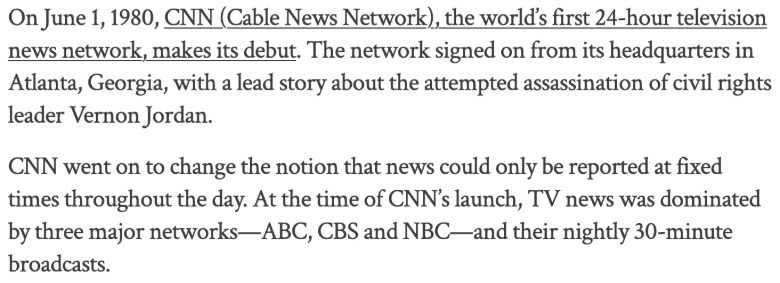 History.com
I don't know if I'm equipped to say if CNN has been a net positive or net negative for the world. On one hand, I think it's a good thing people are able to be as up to date as possible on what's going on in the world. On the other hand, it (and other 24-hour news services) have pretty much turned the news into entertainment, and that's a very bad thing. One thing I know for sure, though, is that Ted Turner was the last sick-as-hell billionaire. Anyway, if you want to learn more about the launch of CNN, head over to History.com.
The Fuel Up
How about we start June with some good-ish news when it comes to gas prices? They've continued to come down, though they're still nowhere near where they were before the U.S. and Israel's war with Iran broke out at the end of February. Still, WTI Crude Oil futures and Brent Crude prices are also holding steady at slightly lower prices, currently sitting at $93.21 and $96.50, respectively, at the time of publication.
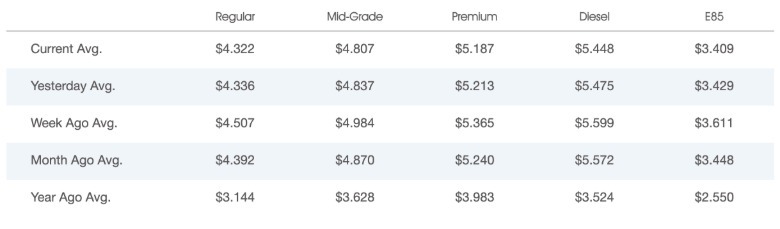
Here's where national average prices stand right now, according to AAA:
 AAA
AAA
What this all means is that the average price of a gallon of regular gas dropped another cent overnight, so it's currently sitting at $4.32, according to AAA. We're now down 24 cents from the 2026 record that was set back on May 21, when gas hit $4.56 per gallon.
On the radio: The 1975 - It's Not Living (If It's Not With You) Live at MSG
Over the weekend, my fiancée and I had our engagement party in Central Park with our loved ones. Of the many things we share and love, The 1975 is near the very top of the most important things. She was a fan long before me, but that changed after she brought me to their "At Their Very Best" tour at Madison Square Garden in 2022. I was in the crowd for this performance. Since then, they've been so incredibly huge for us. Anyway, I've been thinking about that a lot lately. Enjoy the song.