

Consumer Reports' Emergency Handling Tests Look Super Fun
As car buyers, we put a lot of trust in automakers. After all, whatever vehicle we choose has the task of getting us from point A to point B as safely and reliably as possible. That's why testing is so important. Sure, an automaker will test and retest its own new car, truck, SUV, or minivan long before selling it to the public. But other agencies, organizations, and publications put new vehicles through various testing to make sure that they're up to snuff. For instance, when talking about crashworthiness, there's the federal government option: the National Highway Traffic Safety Administration (NHTSA). You know, the same agency you'd check with to see if your car has a recall out.
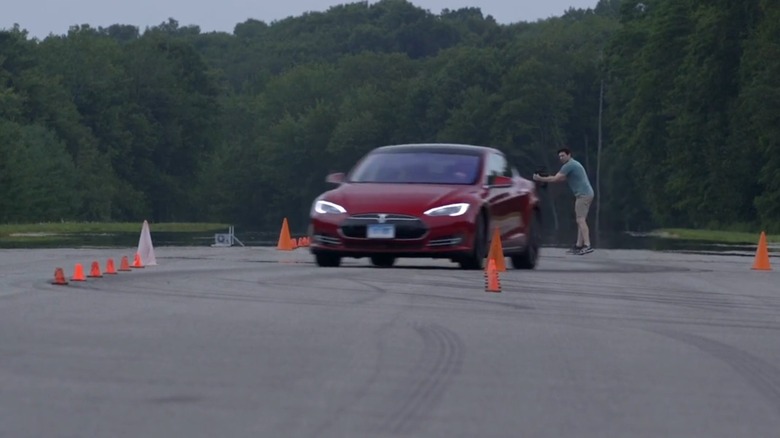
Then you've got Consumer Reports. The independent nonprofit organization maintains a 327-acre testing center in Connecticut for the express purpose of evaluating new vehicles — about 50 new ones per year. Now, some of that formal testing is pretty tame: ride comfort testing, ergonomics, EV charging, and the like. But other tests, like the organization's emergency handling tests, look like a good time — a real good time. Unlike some of the more sober, slow-speed tests, the battery of emergency evaluations includes handling tests, avoidance maneuvers, and braking tests under multiple conditions. It's a lot of cornering, hard braking, acceleration testing, and driving at the limit.
Consumer Reports' emergency handling tests are serious, but they look like a blast
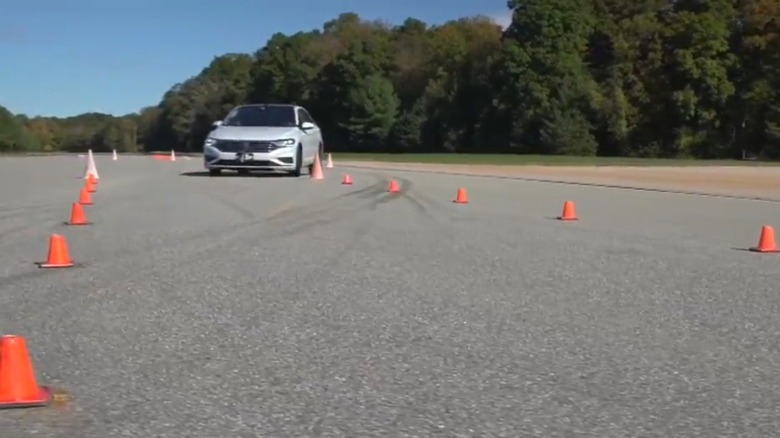
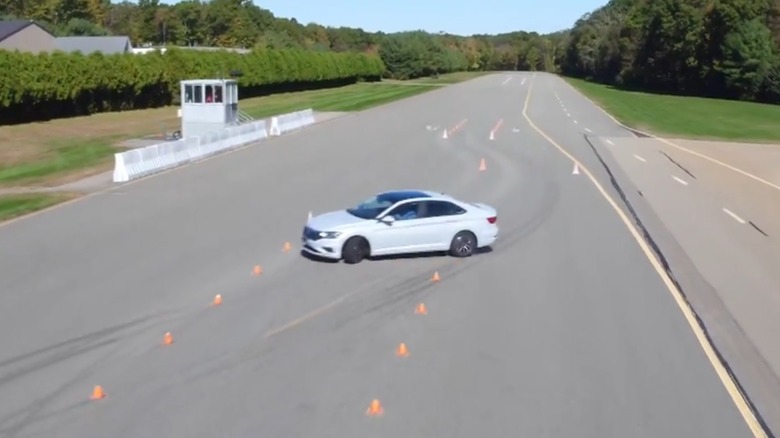
327 acres is no small space. It's certainly enough land for evaluators to test out new cars, SUVs, trucks, and minivans on around 6 miles of paved test roads, a curvaceous 3,500-foot handling course, and a 4,400-foot main straight. And some of the most serious, if also awesome, evaluations are the emergency handling tests. As part of the tests, evaluators put cars through avoidance maneuvers. The test driver will flog a new vehicle through a lane of cones, snaking left and right through the dividers. If that isn't fun enough, the tester is expected to weave through the course at increasing speeds until the vehicle can't navigate the course without hitting cones — not a bad way to spend a work day.
Consumer Reports uses that slalom-style test to simulate and evaluate a vehicle's at-the-limit ability to avoid an obstacle in the road and then return to its lane to avoid a head-on collision. Beyond avoidance maneuvers, evaluators subject new vehicles to the organization's 3,500-foot handling course, strictly to test road-holding, suspension, and steering by pushing them through the corners.
Then there's braking. As part of the testing, evaluators will speed up to 60 mph and brake with everything they've got to determine that vehicle's stopping distance. They'll do that test on dry and wet pavement, using precise equipment to gather metrics. But, for the driver, it's an opportunity to make some new cars' brakes positively bleed. Don't think that's enough? Consumer Reports also tests the best tires by torturing them on the track in dry and wet conditions, as well as braking on an ice rink.
The emergency handling tests reveal the best and the worst
Consumer Reports has been evaluating cars for quite some time. All said and done, the organization has been reviewing cars for 9 decades, dating back to the Consumer Reports magazine's first issue in 1936. And, while these tests seem like an absolute riot for the drivers, there's a point beyond the sheer smile factor.
For starters, the tests generate empirical data about how well a vehicle can contend with emergency situations like hard braking and obstacle avoidance. Consumer Reports even says that acceleration testing like 0-to-30-mph, 0-to-60-mph, and quarter-mile runs helps determine how safely a car can merge onto the highway. See? This is important stuff. Honest.
The data also, as it often does, gives evaluators a ranking of how well new vehicles perform in high-speed, kinetic testing. For instance, in 60-to-0 mph braking tests, the driving experience-first Porsche 718 Boxster that Consumer Reports evaluated managed to stop in 108 feet. That's 3 feet shorter than a comparable G29 BMW Z4 and 5 feet shy of the Chevrolet Corvette Stingray. The 718 Boxster also came out just ahead of the Corvette in the avoidance maneuver testing, besting the Kentuckian by just 0.5 mph. Results notwithstanding, punishing cars like the 718 Boxster and the Corvette on the track is a pretty sweet day at the office.