

The Subaru Telescope On Mauna Kea Shares Its Name With Your Car For A Reason
Automakers have their names plastered across buildings throughout the world, and not just on dealerships and manufacturing plants. Stadiums are also a popular choice: think Ford Field in Detroit, Houston's Toyota Center, and Mercedes-Benz Stadium in Atlanta.
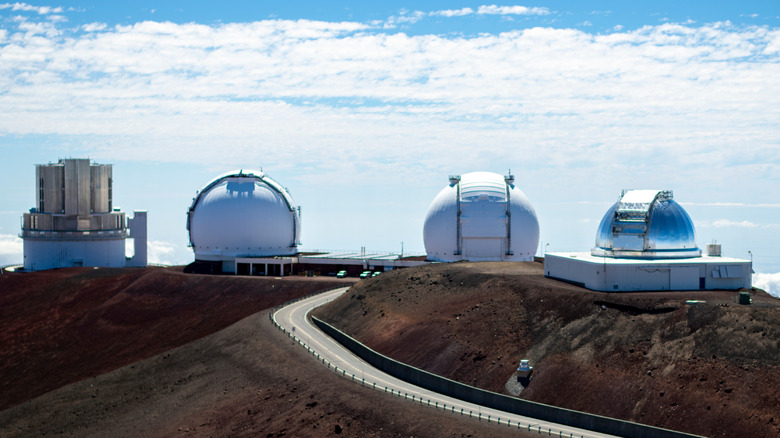
But then there's the Subaru Telescope atop Mauna Kea on Hawaii, which obviously shares a name with the Japanese automaker known for its outdoorsy branding and super cute dog commercials. Run by the National Astronomical Observatory of Japan, the Subaru Telescope discovered the farthest known galaxies in the early 2000s and has recently been working to expand our knowledge of planets orbiting other stars. For automotive marketing, though, an observatory is a steep departure from high-visibility buildings like stadiums, so if you're skeptical whether Subaru paid to have its name on the telescope, you'd be on to something.
The automaker and the nearly 27-foot telescope share a name for a reason, but not because of a branding deal or marketing ploy. As it turns out, their names are both inspired by a star cluster that's called "subaru" in Japanese. Most stargazers are likely to recognize the cluster, but its stunning connection to ancient human history is what really sets it apart from other constellations.
Seven sisters, but only six stars

Mauna Kea is home to several telescopes and observatories, and was the proposed site of the Thirty Meter Telescope before years of protests by native Hawaiians and their supporters halted telescope development atop the mountain spiritually significant to the islands' indigenous inhabitants. That the Subaru Telescope sits atop such a long-revered mountain seems almost poetic when you consider the star cluster it's named after.
In English, the star cluster that both Subarus take their name from is known as the Pleiades, or Seven Sisters. It's a tight formation of stars that sits in the Taurus cluster, close enough to the celestial equator that it can be seen with the naked eye all the way from Australia to northern Europe.
The cluster's easily recognizable shape and high visibility mean that stories of the Seven Sisters abound in oral traditions from around the world. You'll find tales of these stars in Aboriginal Australian traditions, in Greek mythology, and in Iroquois oral histories. However, despite the prevalence of the titular seven sisters, savvy stargazers will note that only six stars in the cluster are visible, depending on the conditions. Those six stars are represented on Subaru's logo, and, for the automaker at least, they also represent the six companies and investors that merged to form Subaru in 1953. That's the story behind Subaru's logo, but it's not where the story of the sisters ends.
The sister Subaru left out

If there are seven sisters popping up in stories thousands of years old across the world, then why did Subaru only use six, and why is it that most people only see six stars in the cluster now? In many of the stories something happens to that seventh sister. Sometimes she gets lost. Sometimes she's too young to venture out with her other sisters. And sometimes tragedy strikes. But all across the world, people tell stories of seven sisters who become six, just like the six visible stars of Pleiades.
Like every good story, this one has a twist. No, not the folk tale of the sisters; the story of the Pleiades cluster itself and humans' relationship to it. It's already strange that such a similar story is told across disparate parts of the world in cultures that had been disconnected for thousands or tens of thousands of years. Some scholars posit an theory that suggests the story of the Seven Sisters is over 100,000 years old. What if the story comes from before the human exodus from Africa, and the story spread with migration across the planet?
You see, today, two stars in the cluster — Atlas and Pleione — are so close together that the naked eye doesn't distinguish them as separate stars. But extrapolated data from the Gaia space telescope shows that 100,000 years ago, before the cultures of the world today had moved so far apart, Pleione and Atlas would've been far enough apart to be seen as distinct stars. Sisters.
The Subaru Telescope isn't as famous as telescope superstars like the James Webb Space Telescope that is bringing nearby Super-Earths into focus. But with a backstory so mind-bendingly ancient and its contributions to our understanding of the universe since the early 2000s, it's hardly forgettable.