

Cars Are Among The Leading Causes Of Wildfires
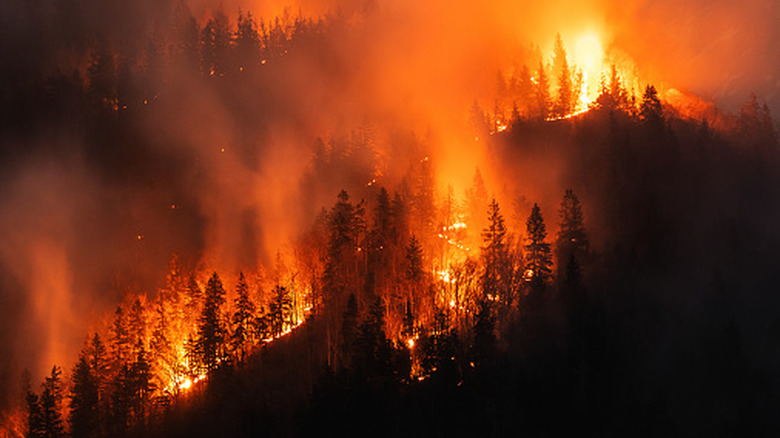
The country is in a weird spot today when it comes to the intersection of science and the automobile: The U.S. Secretary for Health & Human Services has become known for researching roadkill genitalia, while the president seems to think vehicle emissions don't make a difference to the environment. The U.S. Forest Service on the other hand — and more specifically, the team at the Chattahoochee-Oconee National Forest in Georgia — is pretty clear about the close connection between cars, wildfires, and human health. The first is a leading cause of the second, which in turn harms the third. And those final health effects are especially harmful to people who may already have respiratory and/or cardiovascular disease.
Moreover, we're stuck in a bit of a vicious circle. Changes to the earth's climate — in the form of drought and high temps, for example — increase the likelihood of wildfires. But wildfires themselves can be a key contributor to climate change by emitting so much carbon dioxide. According to NASA, more carbon was released in five months by the massive Canadian wildfires of 2023 than the full-year 2022 totals from entire countries like Russia and Japan. Meanwhile, by the end of May 2026, almost 30,000 fires had already been reported across the United States for the year, including a huge one that burned through some 600,000 acres in Nebraska — becoming the largest fire ever recorded in the state.
The good news is that following a few simple rules can greatly reduce the likelihood of a car-related conflagration. After all, in the immortal words of Smokey the Bear, "Only you can prevent wildfires."
How to prevent you car from starting a wildfire

As our Stone Age ancestors discovered, one simple way of starting a fire is by applying a spark to some sort of dry kindling. In fact, it can be so simple that even accidental sparks thrown off by dragging tow chains or other low-hanging metal can cause dry grass to catch fire. The same holds true for sparks caused by driving on exposed wheel rims after a flat tire or those caused by bad brakes — which can create sparks from metal-on-metal contact if the pads are worn out. It's another reason you should remember that not all aftermarket brake pads are built to OEM specs.
In all those cases, a little preventive maintenance goes a long way. Keeping tow chains secured at their proper length, making sure tires are inflated to their proper pressure, and knowing knowing when you need new brakes can all help eliminate unwanted sparking. Of course, so can using spark arrestors on "off highway vehicles." These are typically mounted on a vehicle's exhaust outlet and engineered specifically to trap/destroy hot sparks before they can do their damage. Requirements vary by state, but many parks and trails require spark arrestors on a variety of rides that include ATVs, motocross bikes, and dune buggies.
Plus, even when they're not throwing off sparks, some vehicle components can be a cause for concern due to their heat. A catalytic converter, for instance, can reach 1,000 degrees Fahrenheit during regular operation. With that in mind, you should avoid parking and driving in areas where there's tall grass, leaves, or other brush that's dried out and ready to go up in flames. Overall, the important thing to remember is that driving should spark joy, not wildfires.