

Before Hemi And Viper-Powered Rams, These Two Pickups Were Modern Muscle Truck Pioneers
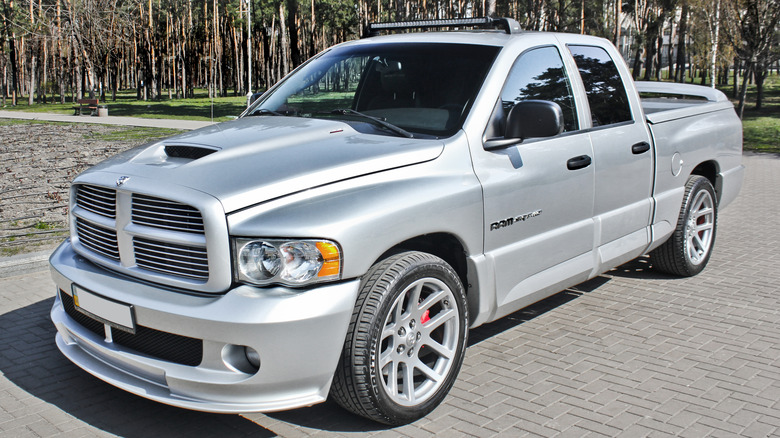
With the new Hellcat-powered 2027 Rumble Bee grabbing headlines, it's worth remembering that the idea of a muscle truck is nothing new in Mopar land. Its predecessor, the 2004 Rumble Bee – although perhaps not as crazy as the V10-powered Dodge Ram SRT-10 – still made quite an impression as a homage to the old Super Bee, pairing flashy paintwork and a 5.7-liter Hemi V8 with a truck chassis. But to be fair, when the modern performance truck battle began, Mopar wasn't even competing, if we set aside the limited-run 1989 Shelby Dakota.
The mainstream movement really kicked off in the early '90s, with GM spearheading things by launching the 1990 Chevrolet 454 SS and 1991 GMC Syclone, before Ford joined the party a couple of years later with the 1993 SVT Lightning. That said, Chrysler deserves some credit: the 1964 Dodge Custom Sports Special and the 1978 Li'l Red Express are two examples of how Mopar reimagined the pickup concept from a workhorse to a crazy speed machine with a truck bed.
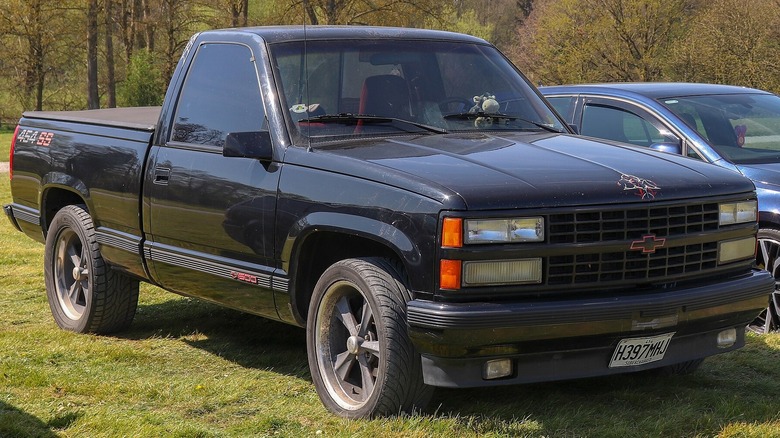
But let's keep our focus on the '90s. The Chevy 454 SS was a factory performance truck based on the single-cab, short-box C1500 platform. It packed a 7.4-liter big-block V8, initially offered with 230 horsepower and 385 pound-feet of torque — that later got bumped to 255 hp and 405 lb-ft of torque. The rear-wheel drive truck debuted with a three-speed automatic, though it was replaced with a four-speed unit a year later. At the other end of the muscle truck arena stood the '93 SVT Lightning, with a 5.8-liter V8 putting out 240 horsepower and 340 pound-feet of torque, driving the rear wheels via a four-speed automatic.
Chevy 454 SS vs. Ford SVT Lightning
It's worth noting that while the 454 SS was only available until 1993, Ford kept the SVT Lightning alive for two generations — 1993 to 1995 and 1999 to 2004. Ford's Special Vehicle Team was responsible for the Lightning's development. Not only did the truck's 351 Windsor receive a 25-horsepower and 15 pound-feet bump over regular non-Lightning models, but SVT also lowered the suspension and tuned the truck for sharper handling through stiffer sway bars and springs. Cosmetically, a body-colored grille and air dam, along with "Lightning" decals, were all part of the package, while embroidered headrests with the Lightning insignia stood out inside the cabin.
Chevy gave the 454 SS more responsive steering, stronger sway bars, and Bilstein shocks, in addition to a red interior and a whole lot of 454 SS badges, with later models (featuring the four-speed auto) getting the 4.10 rear axle, replacing the earlier 3.73. Performance-wise, Car and Driver reports the 454 SS managing a 0 to 60 mph sprint in 7.1 seconds with the four-speed box. The less-porky '93 Lightning — although down on horsepower versus the 454 — was apparently only a tenth slower. In terms of 0 to 100 mph, the Chevy clawed back, reaching the milestone in 22.5 seconds, about three seconds faster than the SVT Lightning.
Quarter-mile times for both trucks are in the late fifteens, which, for context, is roughly 1.5 seconds behind muscle cars of the era, such as the 1993 Ford Mustang Cobra and Chevy Camaro Z28. While the muscle truck genre enjoyed a resurgence in the early 2000s, only to die out a few years later, fans had to wait a bit longer until Ford unveiled the Raptor lineup and Dodge introduced the TRX to reignite the spark.