

The First Turbocharged Engine To Ever Race At Indy Was A Semi-Truck Engine
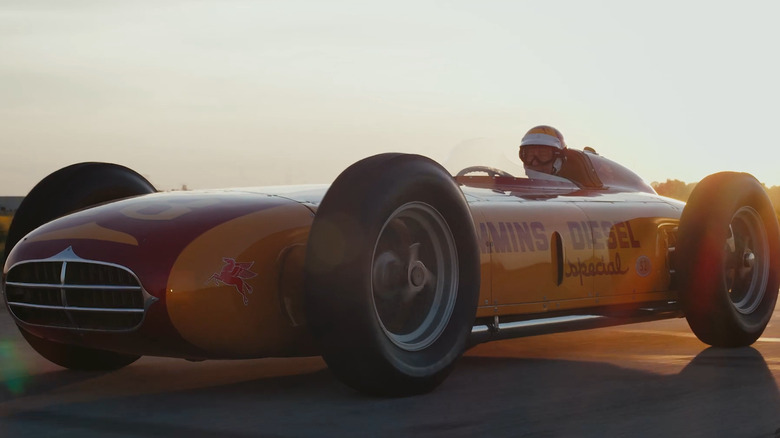
A lot of legendary engine builders have tried to turbocharge their way into victory lane at the Indianapolis 500. The very first one, however, wasn't a name that today's gearheads typically associate with the race or any motorsports, for that matter. That honor belongs to Cummins, better known around here for building reliable diesel truck engines that just won't quit.
Nor was this a case where the Cummins driver was merely a backmarker for the more serious contestants. With driver Freddie Agabashian at the helm, the #28 Cummins Diesel Special hit the track in 1952 and claimed that year's pole position with a then-record lap of 139.104 mph. Agabashian set the four-lap record as well by running at an average of 138.010 mph. In fact, the car was so fast, it literally ripped the tread off one of its tires during qualifying. That was a sign of things to come, though. During the competition, loose rubber on the track clogged the engine's turbo inlet, forcing Agabashian out of the race.
As for the engine itself, the racecar carried a 6.6-liter JT-600 I6 with 24 valves and Cummins' then-new PT fuel system setup to deliver some 430 horses — more than doubling the output of the production JT-600 truck motor on which it was based. It's further worth noting that the racing mill was mounted a few degrees off horizontal, resulting in a car with a wider stance, better handling, and a revised lubrication system. Cummins even fine-tuned the racer's aerodynamics in a wind tunnel, setting another Indy car first.
The Cummins/Indy connection
The decision to use the Indy 500 as a test-bed for truck technologies may seem odd in hindsight, but Cummins' founder was no stranger to the Brickyard. When Ray Harroun took the race's inaugural checkered flag in 1911, at the wheel of a Marmon Wasp, Clessie Cummins was part of his pit crew.
The first Cummins car to enter the race came in 1931, when the company wanted to prove its diesel truck engines had the strength and efficiency to withstand up to 500 miles of all-out racing. You can consider that mission accomplished since the Cummins car was the first to complete the entire distance without stopping, while averaging 97 mph and finishing 13th -– all while sipping a mere $1.40 worth of furnace oil for fuel.
Cummins came back to Indy in 1934, this time with a pair of racecars aimed at comparing the performance of the company's two- and four-stroke engines. Now, two-stroke gas motors would go on to become the dominant performance engines for motorcycles, but the diesel-drinking two-stroker from Cummins just couldn't cut it at the 500. It's likely no coincidence that Cummins gave up on two-stroke engines for its production trucks soon after.
Forced induction found its place in the Cummins racing family for 1950. The Cummins Green Hornet had a supercharged I6 of its own with an aluminum block and 345 horsepower in the stable. The car had mixed results at Indianapolis, yet it would go on to set six U.S. and international speed records the same year. As for modern diesel racers, they're now usually limited to the dragstrip — where they may be quicker than you think.