

The 12 Most Powerful Porsches To Ever Leave The Factory
For decades, the Porsche horsepower hierarchy was relatively straightforward — buy the 911 Turbo and you'd probably be pretty close to the top of the pile. Yes, there were some paradigm-shifting models, like the sci-fi Porsche 959. But that was also a sports car based on the 911, not an SUV or EV. And yet, there's only one model with no electrical assistance among the 12 most powerful Porsches ever made. In fact, ten of these cars were introduced in the last two years, and none were produced before 2013.
If you haven't noticed, Porsche has been on a horsepower bonanza lately, so don't act surprised if you see four-figure numbers packed in a practical family car. This is probably not a list for Porsche purists, but really, who could resist a car that reaches 60 in the two-second range and beats racecars at the Nürburgring? These Porsches push the performance envelope at an accelerated pace, and enthusiasts should take notice.
2024-Present Porsche Panamera Turbo E-Hybrid (670 hp)
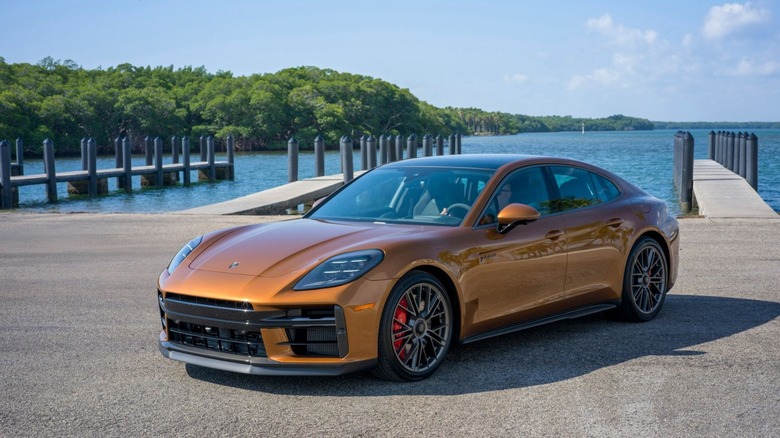
Although it packs 670 horsepower, the Porsche Panamera Turbo E-Hybrid isn't even the top dog in the Panamera lineup, let alone Porsche's full range of cars. But it's still frantic in a straight line, reaching 60 miles per hour in just three seconds and boasting a top speed of 196 mph. Most of that potency comes from the 4.0-liter twin-turbo V8, which produces 512 horsepower and 567 pound-feet of torque. The electric motor fills in with an additional 187 horsepower and a meaty 331 pound-feet of torque. Power goes through all four wheels via a snappy eight-speed automatic.
The Panamera Turbo E-Hybrid's duality might be even more impressive, though. Thanks to the 22 kWh battery, Porsche's sedan can become silent in the city. It has an EPA-rated range of about 28 miles, though Car and Driver achieved 48 miles of highway driving, which should be enough for most daily needs. Oh, and the Panamera Turbo E-Hybrid can still reach a top speed of 87 mph when relying only on electricity.
While the power train has some impressive figures, it's the Porsche Active Ride suspension that sets the new Panamera apart from its predecessors. The system can control body roll, acceleration squat, and brake dive to enhance performance and comfort. It can also raise the car when you open the door for easier ingress/egress. Crucially for a long-distance cruiser, the system provides a very smooth ride — and it probably should, considering its price of $210,150 (including destination fees).
2025 Porsche 963 RSP (671 hp)
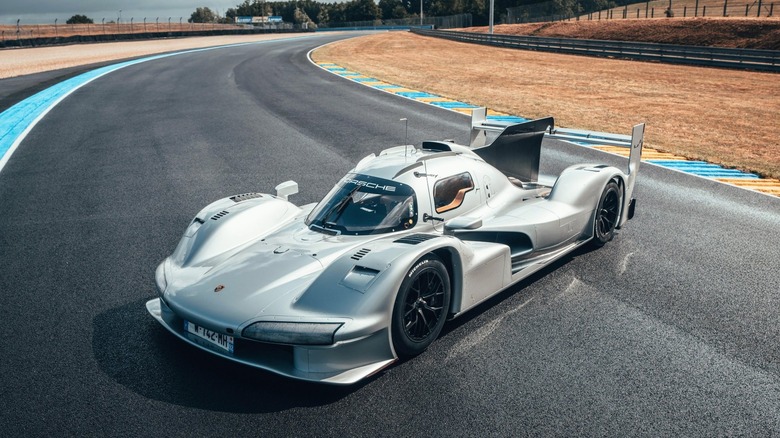
Porsche Penske Motorsport launched the 963 LMDh prototype endurance racer to compete at racing events, with the main objective of winning the 24 Hours of Le Mans. The team failed reaching the ultimate goal, but with second place at the 2025 edition and a historic three-peat at the Rolex 24 Daytona, the 963 is one of the most formidable endurance racers in recent memory.
What made it on this list, however, is a road-legal version of the racecar. It's a one-off made specifically for Roger Penske, so you probably won't ever see it in person. Still, it's a stunning machine that uses as much hardware from the racecar as possible, including the hybrid power train. That combines a 4.6-liter twin-turbo with a rear-axle electric motor generator unit for a maximum of 671 horsepower. Heck, it even comes with a pneumatically-actuated seven-speed racing transmission.
Still, to comply with road regulations, Porsche had to cover the wheel arches, paint the car in Martini Silver, and add the necessary lighting features. The 963 RSP also has a raised ride height to work better around the city and softer dampers for more comfort. Despite that, it still weighs under 2,500 pounds. It's not the most powerful Porsche, but in spite of official figures, that light weight will certainly keep its acceleration times low.
2024-Present Porsche Taycan GTS (690 hp)
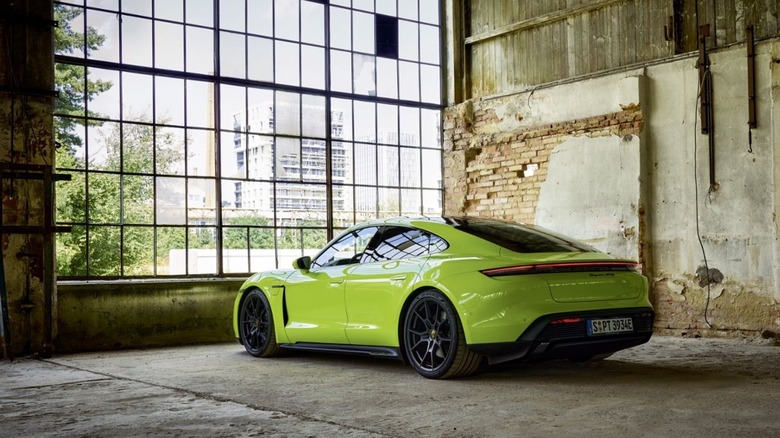
With 690 horsepower and 582 pound-feet of torque on tap (with launch control activated), the Taycan GTS isn't even close to the most powerful Porsche sold today. Still, it's arguably the gold standard of performance EVs. The Taycan GTS can still reach 60 in a brisk 3.1 seconds, but during our reviewer's time with the car, he felt that it pulled harder than the number suggests. Oh, and it has a two-speed transmission, so it doesn't hit a wall at higher speeds like other EVs.
The Taycan GTS is also designed to tackle corners like a real Porsche, so it comes standard with the Porsche Torque Vectoring Plus system and a rear differential lock. The optional Porsche Active Ride system — the same one as in the Panamera — further adds to the dynamic abilities of the Taycan GTS. In our review, we were also impressed by the direct, communicative steering, which felt exactly as it should in a Porsche sports car.
The Taycan GTS is also decently practical for such a performance machine, packing four seats alongside both a trunk and a frunk. Porsche also offers the model in an even more practical Sport Turismo wagon guise, which provides a bit of extra storage space in the rear. With a base price of $159,250, the Taycan GTS is expensive, but it's still significantly more affordable than the Turbo variants.
2018-2019 Porsche 911 GT2 RS (690 hp)
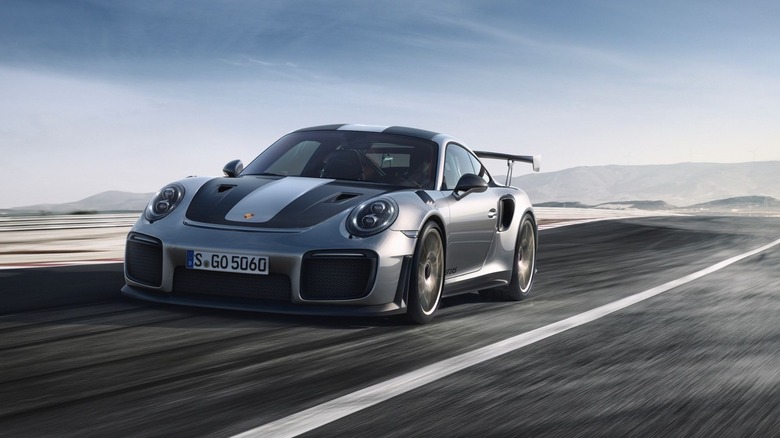
Thanks to the improved acceleration traction, modern AWD sports cars make easy work of the increasingly high horsepower figures. However, the 991.2 generation 911 GT2 RS offers no such easiness. Here, you'll have to handle all the 690 horsepower and 553 pound-feet of torque with the rear wheels only. Because it's so finely tuned, the GT2 RS is intuitive, but the engine is still powerful enough to overwhelm the rear tires.
This is essentially a 911 Turbo without the AWD system, more power, and suspension and aero bits from the GT3 RS. Porsche already made things funny by choosing the 3.8-liter turbocharged flat-six from the 991.2 Turbo S, but it also slapped a larger turbocharger that provided 22.5 extra psi of boost. Forged pistons were also part of the GT2 RS deal, as were new main bearings and a wider exhaust manifold. For the transmission, Porsche went with a seven-speed dual-clutch. As a result, the GT2 RS finishes the 0-60 mph dash in 2.7 seconds. And its top speed is a theoretical 221 mph, though a limiter keeps it down by about 10 mph.
Although the GT2 RS uses a borrowed aero setup from another vehicle, it's significantly more potent when it comes to horsepower; the 4.0-liter naturally aspirated flat-six in the 2019 GT3 RS produced just 512. In that sense, this model is more of a purist car than the 911 Turbo S, but it's also a wilder alternative to the GT3 RS.
2026 Porsche 911 Turbo S (701 hp)
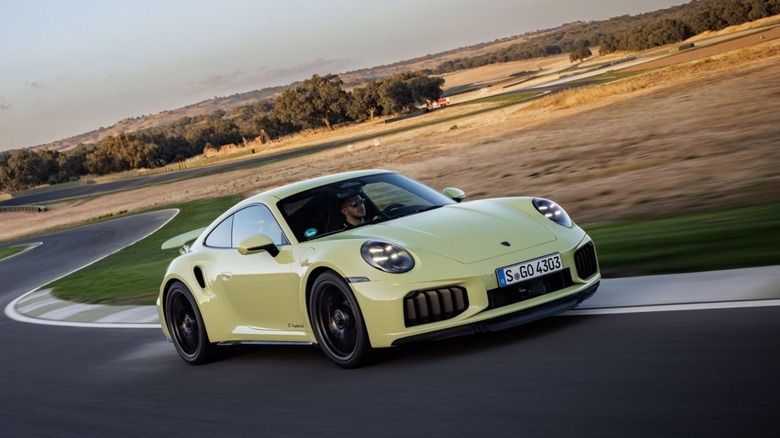
Yes, the 911 Turbo S has only one more horsepower than the GT2 RS. But Porsche's advanced T-Hybrid power train wasn't developed to fight horsepower wars; rather, it was meant to delete dreaded turbo lag by leveraging electricity. So, the 2026 911 Turbo S has a brand-new 3.6-liter flat-six with two relatively small turbochargers, but each of those can be spun immediately with electric motors. There is an additional 80 horsepower electric motor integrated into the eight-speed dual-clutch transmission housing, which further reduces turbo lag.
As a result, the latest 911 Turbo S should feel like a high-capacity naturally aspirated engine rather than a small, highly-boosted one. We already tested the less powerful Porsche 911 Carrera GTS T-Hybrid, and it was lag-free, so the same should be true for the Turbo S variant. Granted, its 701 horsepower and 590 pound-feet of torque aren't massive steps up from other cars on this list, but it's the delivery that matters. The 911 Turbo S has gobs of power available without any lag, and it's also stupendously fast; with the Sport Chrono Package, 0-60 lasts just 2.4 seconds and the top speed is 200 mph.
Inevitably, the hybrid system also added a bit of heft to the 911 Turbo S. Porsche worked on shedding as much weight as possible from the hybrid unit, but the car still has a curb weight of 3,829 pounds. Keep that in mind when looking at the 911 Turbo S — and its starting price of $272,650.
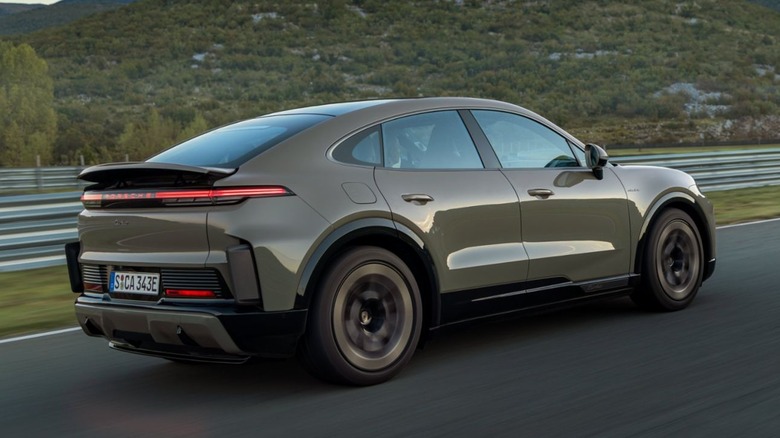
2024-Present Porsche Cayenne Turbo E-Hybrid/E-Hybrid Coupé (729 hp)
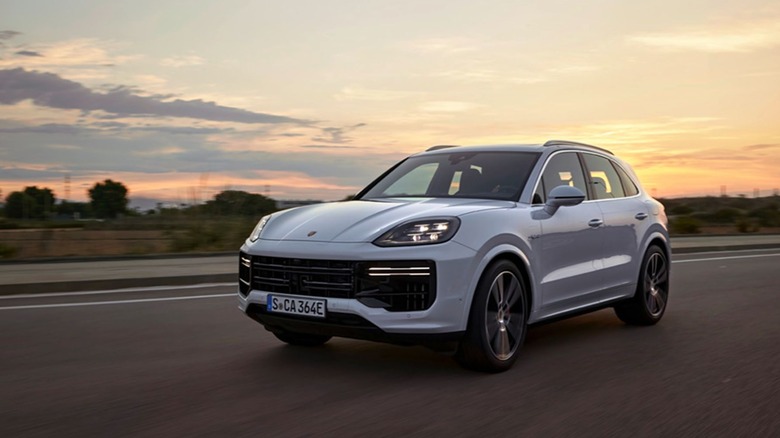
With 729 horsepower and 700 pound-feet of torque on tap, the Cayenne Turbo E-Hybrid is Porsche's most powerful SUV with an internal combustion engine. As a result, the 5,672-pound Cayenne reaches 60 in just 3.5 seconds. And the top speed is perhaps even more impressive, reaching 183 mph.
Some might argue that the latest Porsche Cayenne Turbo Electric will eat the E-Hybrid's lunch in a straight line. But if you want the aural bonanza to accompany that crazy acceleration, the E-Hybrid is the way to go. Porsche's V8 sounds meaty and throaty, giving this SUV some real character. It also produces 591 horsepower and 590 pound-feet of torque on its own, with the electric motor adding 174 horses and 339 pound-feet.
The Cayenne Turbo E-Hybrid isn't just about driving excitement. Thanks to the 21.8 kWh battery pack, it can also act as an EV with speeds of up to 84 mph. The EPA-rated range of 24 miles is a bit limited, though. Porsche was also aiming for practicality, too, with the regular and coupe versions both having comfortable rear seats. But because of the large battery, the 21.9 cubic feet of cargo space is smaller than on the regular Cayenne (27.2 cubic feet) and limiting for a $166,850 SUV. The Coupé version falls short, too, with just 15.3 cubic feet worth of cargo.
2024-Present Porsche Panamera Turbo S E-Hybrid (771 hp)
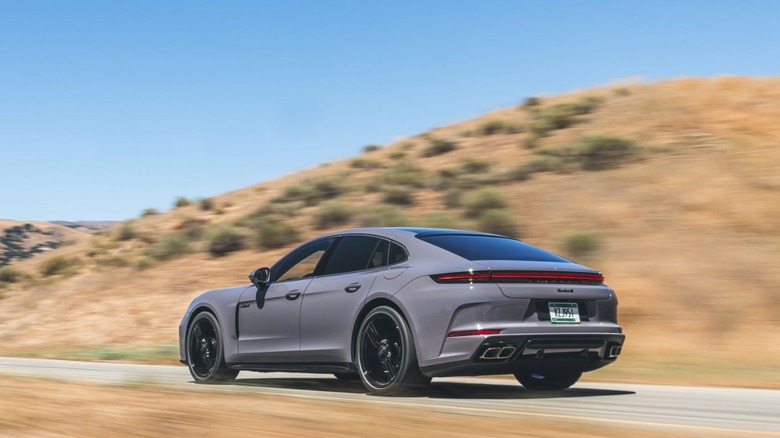
As if the 670 horsepower Panamera Turbo E-Hybrid wasn't already potent enough, Porsche also offers an even more brutal Turbo S variant. It brings an additional 101 horsepower to the table and produces 737 pound-feet of torque. All that added power and torque comes from the tuned 4.0-liter twin-turbo V8. In the Turbo S E-Hybrid, it produces 591 horsepower and 590 pound-feet of torque, while the electric motor keeps its original specs. Aided by an eight-speed transmission and AWD, the power train propels the sedan to 60 mph in just 2.8 seconds and gives it a top speed of 202 mph.
It's not just the performance figures that differentiate the Panamera Turbo S E-Hybrid from the regular model. Here, you get Porsche Active Ride as standard, while on the regular Turbo it's only optional. The Turbo S also gets forged 21-inch wheels with center locks. Braking is significantly improved, too, thanks to the high-performance Porsche Ceramic Composite Brake system. There's also rear-axle steering and the Porsche Vectoring Torque Plus system included. It wouldn't be a welcome surprise if they weren't, as the Panamera S Turbo E-Hybrid starts at an eye-watering $247,450.
2024-Present Porsche Taycan Turbo (871 hp)
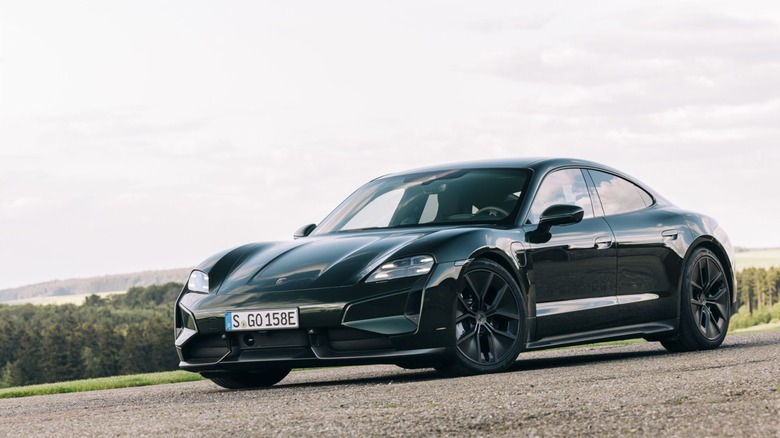
Porsche went to great lengths to extract as much power from its twin-turbo V8 as possible. But one look at the performance figures of the Taycan Turbo is evidence that EVs are in a different league. This is not the Turbo S version, yet it comes with a dual-motor power train that produces a whopping 871 horsepower with overboost and 656 pound-feet of torque with launch control enabled. As a result, the Taycan Turbo blitzes to 60 in 2.5 seconds and reaches a top speed of 162 mph. Yes, that top speed is lower than the most powerful Panamera, but does it really matter on the road?
What might matter to potential buyers is that the Porsche Active Ride system is only optional on the Taycan Turbo. The rear-wheel steering costs extra, too, despite this car costing $186,850. An adjustable air suspension is standard on the Taycan Turbo, though. Every model is also equipped with a two-speed transmission on the rear axle, which helps with highway range. As a result, the Taycan Turbo has an EPA-rated range of 292 miles, which is an excellent figure for a performance EV.
Unfortunately, you can't get the more practical Sport Turismo model with the Turbo power train in the U.S. The most powerful shooting-brake Taycan is the 690 horsepower GTS. You can get it with the Cross Turismo, though, which has higher ground clearance for light-terrain use than the regular model.
2013-2015 Porsche 918 Spyder (874 hp)
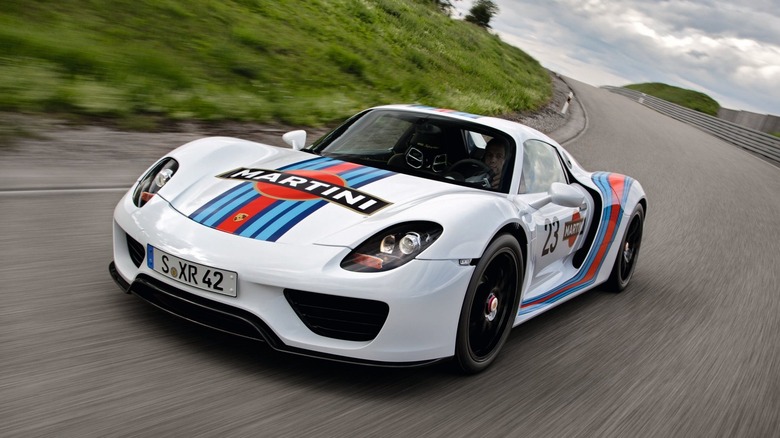
The 918 Spyder is Porsche's last hypercar. Yes, the company has made significantly faster cars since, but none have as much drama and panache as this. After all, this advanced hybrid machine has a 4.6-liter, flat-plane-crank, naturally aspirated V8 sourced from Porsche's endurance racing endeavors. On its own, it makes 608 horsepower — an astonishing feat for a naturally aspirated engine. Crucially, it also spins to 9,150 rpm, producing an edgy sonic feast that tingles your spine.
But 608 horsepower wasn't enough to compete with the other two hypercars of the era: the Ferrari La Ferrari and McLaren P1. So, Porsche equipped the 918 Spyder with two electric motors, and the combined efforts of those motors added 285 horsepower to the mix. Overall, the system produced 874 horsepower, and — crucially — allowed AWD. So, in Car and Driver's tests, the 918 Spyder blasted to 60 mph in just 2.2 seconds, making it one of the quickest factory-stock Porsches ever tested. It also covered the quarter-mile mark in just 9.8 seconds, which was otherworldly in 2014. Top speed: an impressive 214 mph.
And it's not just the neck-snapping straight-line acceleration that defined the 918 Spyder. It was also the first production car to break the seven-minute barrier at the Nürburgring (6:57). But perhaps the most remarkable feature is that it's an excellent daily driver that also provides a racecar-like driving experience.
2024-Present Porsche Taycan Turbo S (938 hp)
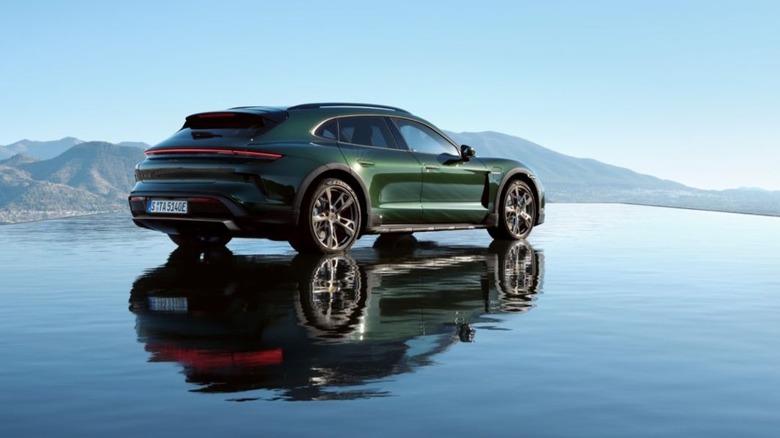
The Taycan Turbo S brings an additional 67 horsepower over the regular Taycan Turbo. More importantly, though, it also gets significantly higher torque, at 818 pound-feet. Because of this, MotorTrend got the Cross Turismo spec down to 2.2 seconds in its 0-60 tests. The publication also covered the quarter mile in 9.8 seconds, matching the 918 Spyder's time. At the top end, the Taycan Turbo S can hit 162 mph.
Unlike the Panamera Turbo S E-Hybrid, the Taycan Turbo S doesn't come with standard Porsche Active Ride. The rear-axle steering is optional, too. That wouldn't be such a downside if the Taycan Turbo S didn't start at $223,650, but it's not surprising for a Porsche car. At least the Stuttgart-based manufacturer introduced some upgrades for the 2026 model year, like a faster infotainment system and an optional sound system with Dolby Atmos.
Perhaps the biggest downside of the Turbo S is that it gets a significant range drop compared to the Taycan Turbo. The S rides on larger 21-inch wheels, which — along with the more potent drivetrain — reduced the EPA-rated range to 266 miles. On a more positive note, each Taycan can be charged at speeds of up to 320 kW.
2024-Present Porsche Taycan Turbo GT (1,019 hp)
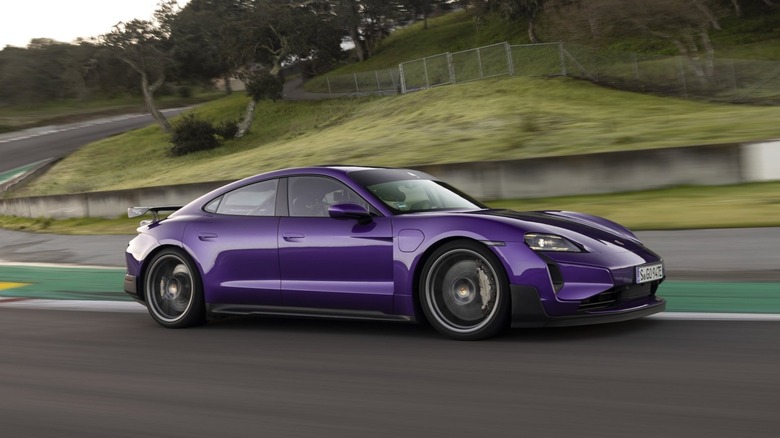
You'd think that the Turbo S sits at the top of the Taycan pecking order, but the competition from the likes of Tesla and Lucid Motors has forced Porsche to introduce an even crazier version: the Taycan Turbo GT. With two electric motors, it makes 1,019 horsepower and an Earth-shattering 914 pound-feet of torque with Launch Control enabled. Its top speed is 180 mph, and in Car and Driver's tests, it reached 60 mph in less than two seconds. Even more impressively, it covered the quarter mile in just 9.3 seconds.
Those are some fantastic figures, but the Taycan Turbo GT was made for track-day fans — not the drag strip. So, it has some aerodynamic improvements and a "push-to-pass" function that gives you 160 horsepower of boost for overtaking. The Weissach Package takes the Turbo GT to new extremes by deleting the rear seats for weight reduction and introducing an even more aggressive aero package with a fixed rear wing. As a result, that package bumps the top speed to 190 mph. Just know that if you want this power for yourself, the Taycan Turbo GT starts at an astronomical $245,950.
2026 Porsche Cayenne/Cayenne Coupe Turbo Electric (1,139 hp)
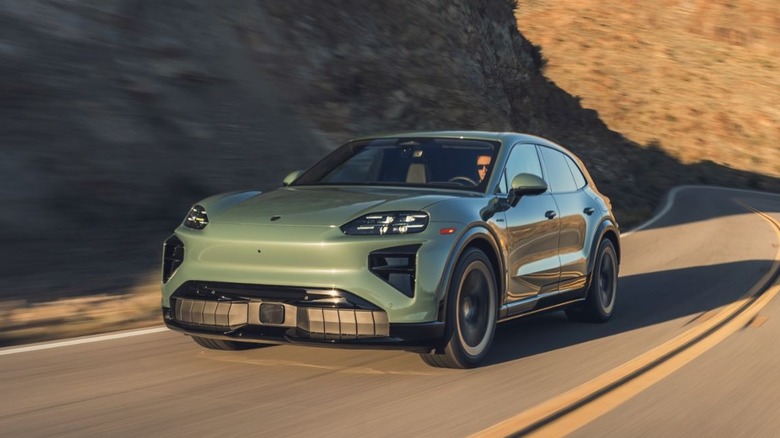
Porsche purists, you better look away now. Porsche's most powerful car ever isn't a low-slung hypercar, but a high-riding electric SUV. The Cayenne Turbo Electric packs a dual-motor power train that produces an astonishing 1,139 horsepower and a whopping 1,106 lb-ft of torque. Porsche claims that this is enough for a 0-60 sprint of 2.4 seconds and a quarter-mile time of 9.9 seconds. That puts the Cayenne Turbo Electric into the fabled 10-second car squad together with the 918 Spyder. The 162 mph top speed is also impressive for an SUV. To think that this is the regular Cayenne Turbo — not the S or GT variant (rumored to arrive soon) — is truly mind numbing.
The crazy performance figures are only part of the Cayenne Electric story. This is the first-ever vehicle with available wireless inductive charging. Just park the SUV over a wireless pad provided by Porsche and it will start charging at 11 kW; no fiddling with cables necessary. Meanwhile, the 800-volt architecture enables crazy-fast charging speeds of 400 kW. According to Porsche, that's enough to charge the battery from 10% to 80% in just 16 minutes.
Like the Taycan, the Cayenne Turbo Electric can be optioned with Porsche Active Ride. However, the vehicle comes standard with adaptive, height-adjustable air suspension, which increases the ground clearance for off-road driving. The Cayenne Turbo Electric starts at $165,350, with the better-looking coupe model costing extra $5,000.