

A 1931 Cummins Diesel Finished The Indy 500 On Just $1.40 Of Furnace Oil
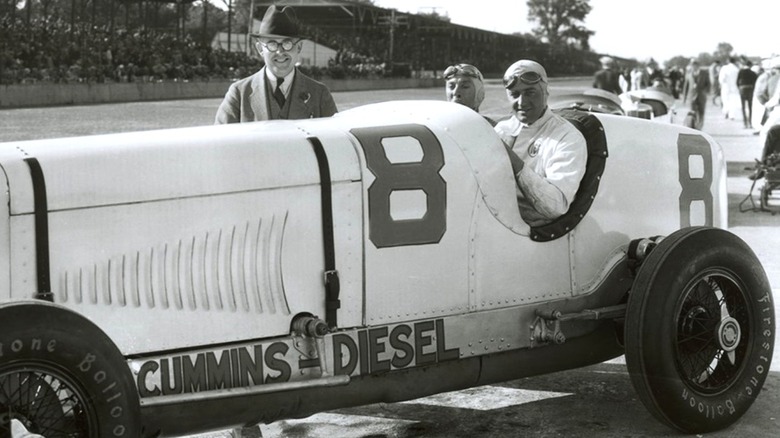
Clessie Cummins was an engineering genius who built a steam engine at the tender age of 11 using molten cast iron and wooden molds. The engine he built pumped water into the family farm. Cummins was also a pit crew member of the Marmon Wasp at the inaugural Indy 500 in 1911, helping Ray Harroun become the first-ever winner of the Indy 500. During that race, Harroun installed a small mirror in his car, making him the first to use a rearview mirror in a moving automobile.
Cummins was also a firm believer that diesel engines, once regarded as potent yet only meant for stationary powerplant applications, were viable for ordinary cars, trucks, and public transport. To prove that, Cummins drove diesel-converted cars throughout the continental United States. In 1930, he shoehorned his diesel engine into a Packard Touring sedan and drove it from Indiana to New York to showcase his vehicle at the New York Auto Show. He didn't make it to the exhibit, but the car only consumed 30 gallons of diesel for the entire 800-mile journey, achieving a remarkable 26 mpg.
After all of that, what better way to prove diesel engines were viable than to go racing? The diesel gods were smiling down on Cummins despite the bank closures, crippling poverty, and widespread panic triggered by the Great Depression, since Eddie Rickenbacker, then-owner of the Indianapolis Motor Speedway, was desperate to fill the starting grid for the 1931 Indy 500 after the stock market crash of 1929.
How a Cummins diesel shocked the 1931 Indy 500
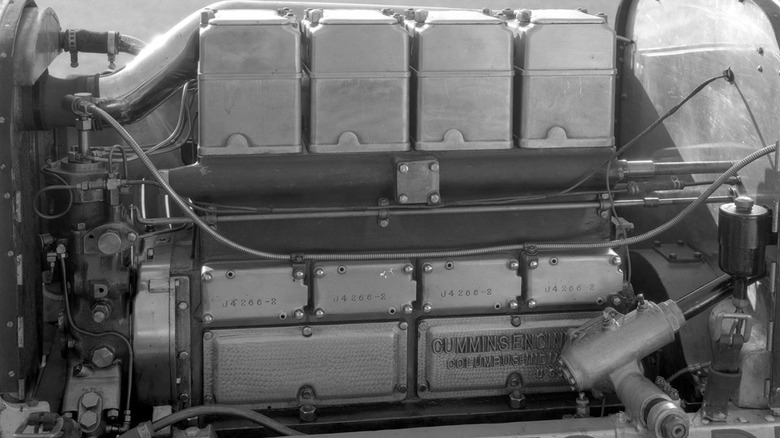
Back then, fielding a diesel car for racing was highly unlikely, but Rickenbacker had no choice. The AAA had to step in, bend the rules, and classify Cummins' diesel-powered Duesenberg — now known as the No.8 Cummins Diesel racing car –as a 'special engineering entry' since the car was too heavy and had a four-cylinder diesel that exceeded the maximum displacement allowed to qualify.
Cummins wasn't expecting to take the checkered flag, but he managed to prove a point. With racing driver Dave Evans at the helm, the No.8 Cummins diesel car ran a 97-mph average speed to qualify for 17th place at the starting grid. When all was said and done, the No.8 car crossed the finish line in 13th place. Not only that, but it earned the distinction of being the first Indy 500 race car to complete the 500-mile race without refueling or pit stops. In fact, it finished all 500 laps while only consuming $1.40 worth of furnace oil.
Cummins returned three years later with two diesel racing cars
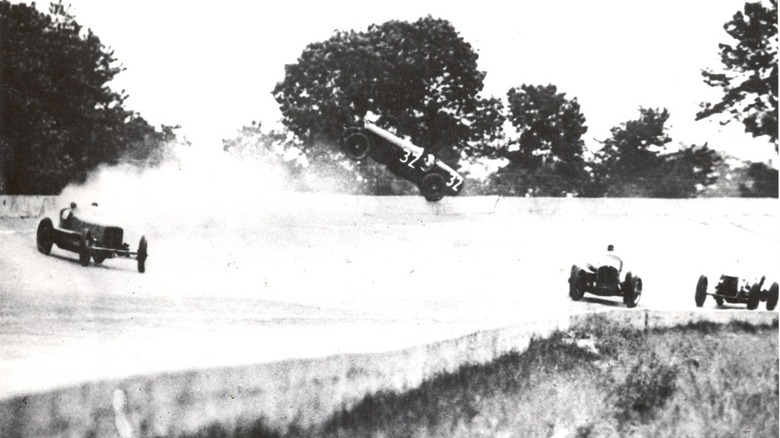
Clessie Cummins fielded two diesel cars at the 1934 Indy 500, but despite that, winning first place wasn't his top priority. Instead, he wanted to find out whether a two-stroke or a four-stroke diesel engine is more effective and durable in the race. Both engines had Roots-type superchargers, but the two-stroke managed to stay ahead of the four-stroke engine despite the former having seized pistons near the end of the race.
It was then that Cummins knew that four-stroke diesels were the future, which led to the company gaining notoriety for producing heavy-duty diesel powerplants that could stand the test of time. Cummins and his diesel-powered race cars would continue racing at the Indianapolis 500 until 1952, which is when one of them finally secured a first-place qualifying position but still ended up finishing 27th. As it turned out, the engine's turbocharger inlet got severely clogged by tire debris during the race, which led to the car's deteriorating performance despite starting in pole position. It was the last time that a diesel race car had ever graced the Indy 500.
As for the No.8 Cummins diesel that raced at the 1931 Indy 500, Clessie and Cummins co-founder W.G. Irwin took the car on a comprehensive European tour across France, Monaco, Germany, England, and Italy to highlight the torque, reliability, and efficiency of diesel engines. It now resides at the newly renovated Indianapolis Motor Speedway museum as a homage to being the first diesel to race around the Brickyard.