

Why Are Car Dealers Usually Clustered So Close To Each Other?

It can seem like greedy dealers make everything worse, especially with some of them adding nearly $5,000 to car prices in "middleman taxes." But one small customer advantage they often offer is a kind of geographical convenience: You'll usually find stores from many different brands all clustered together in the same place, making it easier to cross-shop. Of course, the actual reasons dealerships tend to be located near each other have little to do with helping customers. In many cases, they're simply following laws — whether it's state/local zoning laws or economics and consumer behavior incentives. Whereas state laws can confine dealerships to a limited number of specific areas, having dealerships close together can bring definite financial benefits to their owners.
Multi-brand dealerships often adhere to both of these rules, but while they are actually getting slightly less common today overall, the biggest ones still seem to be growing. Data from the National Automobile Dealers Association (NADA) indicates that the number of dealers owning 50 or more stores has doubled since 2016 -– going from 0.1% of the industry to 0.2%. These dealers will often locate their stores in the same area purely for the sake of convenience.
The effect of zoning and Hotelling laws
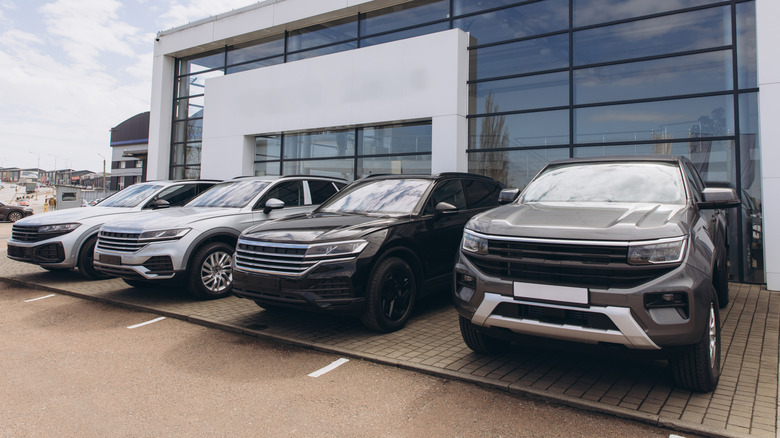
Moving on to the major drivers of dealership locations, it turns out there's a deeper connection between zoning laws and cars than you may think. Yes, people have been making legal contracts about land use for ages, but many sources pin the growth of modern zoning regulations directly to the growing popularity of automobiles in the first decades of the 20th century. Once more people started owning cars, the theory goes, workers didn't have to live as close to the factories and other businesses where they worked and could move out to more peaceful suburbs instead. Early zoning laws essentially made sure those suburban neighborhoods stayed factory-free to improve residents' quality of life. The same reasoning most likely hides behind squeezing suburban dealerships into retail-only zones today.
Yet, none of that might have mattered if it weren't for Hotelling's law (which has nothing to do with hotels). Harold Hotelling, born in 1895, was an American mathematician/statistician who pioneered applying high-level math to the field of statistics. He realized that, generally speaking, a top reason for customers picking a particular store comes down to how convenient it is to get there. So, it's better for dealerships to be closer to where their customers want to be than for them to try to set up in a rival-free area that's further from the preferred shopping zone –- even if it means competitors end up right next to each other. That said, Hotelling's law doesn't always apply to Jalopnik readers, as some of them have gone thousands of miles to buy the right car.