

The Ford Taurus Saved Ford, But Consumer Reports Said V6 Models Literally Stunk
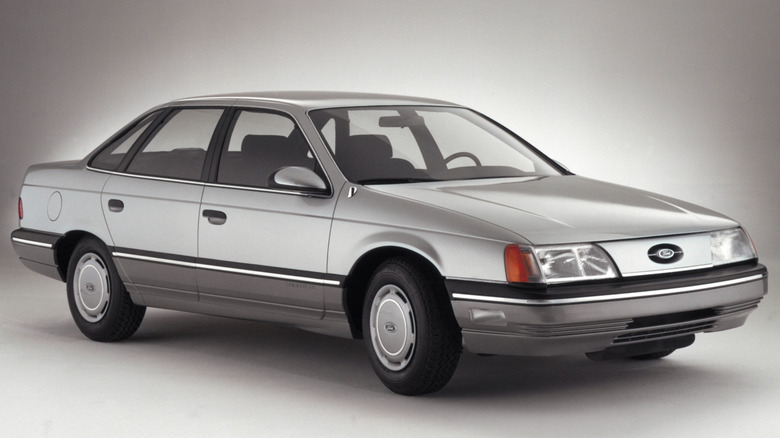
A lot of people probably couldn't believe their eyes when they got their first look at the 1986 Ford Taurus. With a radically aerodynamic design, the Taurus — and its corporate cousin, the Mercury Sable — upended expectations for automotive styling and helped the then-floundering Blue Oval get itself back on track. Unfortunately, some of the Taurus' drivers probably couldn't believe their noses when they got behind the wheel.
Owners began reporting a foul odor coming from the cars' exhaust outlets, and while the stink wasn't the usual one associated with the back of a bull, it was pretty nasty nonetheless. The sulfurous fumes reminded folks of rotten eggs — not exactly the new-car smell they were expecting. Even worse, that news was put on blast when Consumer Reports' chief auto tester, Robert Knoll, told the New York Times that some of the cars "literally stunk." It isn't clear from earlier reporting exactly what the issue was or how Ford addressed it — the Chicago Sun Times, for one, just notes the company spent several months coming up with a fix. As an FYI, though, that kind of smell can be a sign your catalytic converter is clogged.
It's also worth pointing out that the Taurus was recalled 18 times during its first 2 years in production, and that was despite the fact Ford had pushed back the car's launch specifically to address quality concerns. Now, that may be par for the course from Ford, a company that continues to garner NHTSA's attention for all the wrong reasons — like recalling 1.4 million F-150s over unexpected downshifts. But it didn't stop the Taurus from being a success.
The Taurus took on more conventional cars – and won
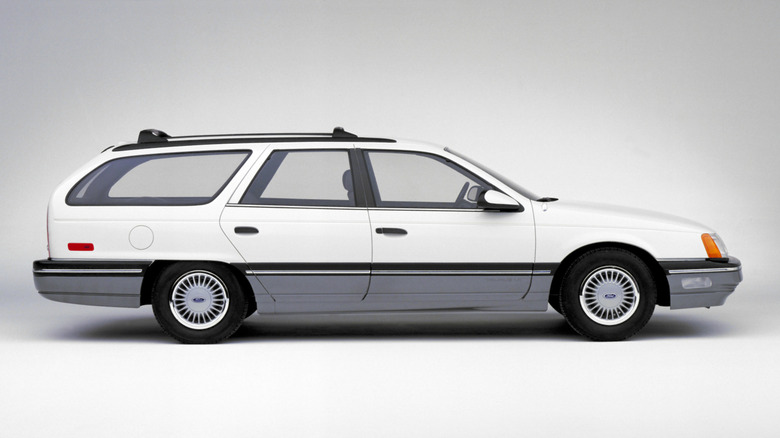
Work on the Ford Taurus began in the early 1980s, as the industry was still struggling to adapt to the post-Oil Crisis world. For Ford, that meant modernizing its lineup to meet the new conditions, so the company completely updated how it developed cars as well. The process would put a new emphasis on teamwork within Ford and look outside the company — from running consumer focus groups to benchmarking the best of the competition –- to deliver a car like no other before it. In the end, Ford sunk some $3.5 billion into the project, an amount equivalent to roughly $10.5 billion today. To put that into context, some financial experts started freaking when Lucid had a net loss in the first quarter of 2026 that reached $1 billion.
None of this prevented the extensive teething pains we've already mentioned, but Ford sold more than 236,000 Taurus models in total in 1986 — sedans and station wagons — and deliveries of both body styles approached 375,000 units in 1987. Yet, perhaps more important was the Taurus' effect on Ford's bottom line. Thanks to the combined efforts of the Taurus and Sable, Ford surpassed GM for pre-tax earnings in 1986 — the first time that had happened in almost 60 years. Blue Oval shareholders were rewarded with a 76% increase in stock prices in 1987, too.
The first-generation Taurus also set the stage for the final chapter in domestic car domination in the United States: In 1992, the Taurus began a streak of 5 consecutive years as the best-selling car in the country. No other domestically branded car has claimed the top spot since.