

Here's What Affects Turbo Reliability The Most
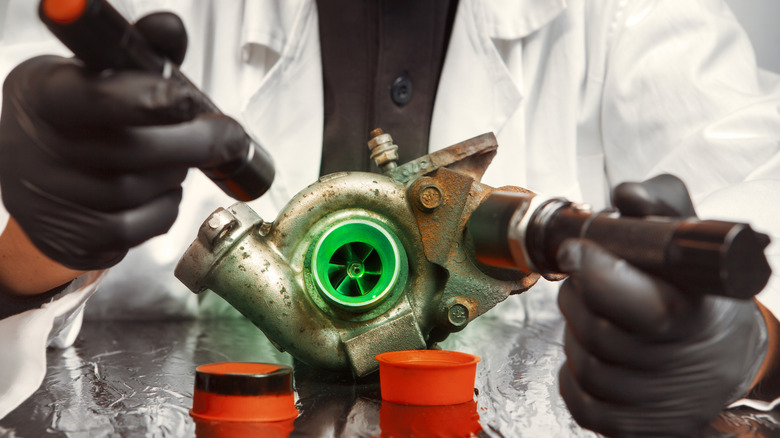
In the 1980s, having a car with a "Turbo" badge meant that it could outpace many other cars on the road. Today, turbochargers are everywhere and, thanks to the relentless downsizing and strict emissions mandates, even your neighbor's sensible crossover features a turbocharger paired to a tiny engine. Heck, we even have electric turbos today, which sounds like a gimmick. But while turbos have transitioned from niche to mainstream, the laws of physics remain unchanged, and these systems can still fail.
The turbocharger undergoes high thermal and mechanical loads. It spins at crazy speeds, sometimes upward of 300,000 rpm, and the exhaust gases turning the turbines can easily reach 1,800 degrees Fahrenheit, while the compressor side tries to pack cool, dense air into the cylinders. This massive temperature difference between the two halves of your turbo is kept in check by your engine oil and a cooling circuit.
That being said, it's a widely reported industry consensus that less than 1% of all turbo failures are due to manufacturing defects, meaning most turbo failures come down to ownership and maintenance. The three "turbo killers" oil deprivation, dirty oil, and foreign objects getting inside the system, each carrying its own set of catastrophic risks.
Oil is the key to keeping a turbo healthy
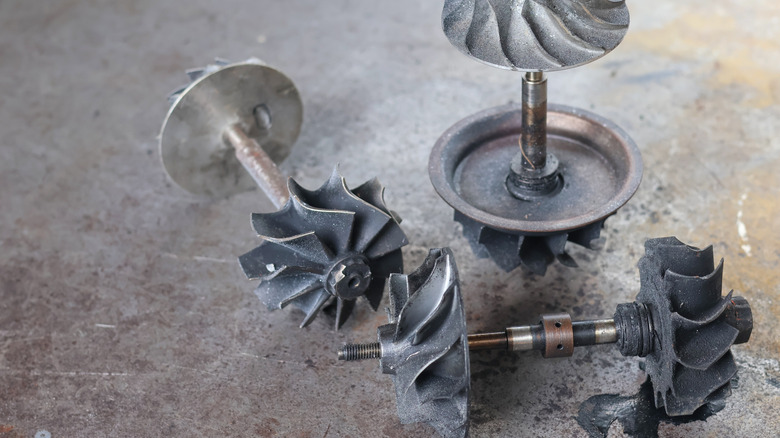
Oil-related issues account for more than 90% of turbo failures. Turbochargers have tight tolerances, such as in the space between their turbine shaft and bearings. This space relies on a thin film of oil to prevent metal-to-metal contact. It is so narrow that if a tiny particle of carbon or metal debris bypasses a worn or low-quality filter and wedges itself between the turbine shaft and bearing, it would act as a very fine polishing medium, almost like liquid sandpaper, wearing out the bearing surface quickly and causing turbo failure.
While switching to synthetic oil is a good idea since it is a lot more technologically evolved than conventional mineral-based oils, it is not immune to degradation. Heat is still one of its biggest enemies, and the turbocharger is one of the hottest parts of your engine bay. As oil degrades, it loses its viscosity and its ability to lubricate the high-speed turbine shaft.
Another important cause of turbo failure is oil starvation. Aside from low oil levels or using contaminated oil, it is often triggered by "hot shutdowns." When you drive your turbocharged car aggressively and immediately kill the ignition, the oil trapped in the bearing housing stops circulation. The intense residual heat soaked into the housing can cause the oil inside to "coke" or carbonize into hard, abrasive deposits. This carbon buildup is a cause of bearing and shaft failure.
Some modern cars utilize auxiliary electric coolant pumps to mitigate heat soak. However, it is a prudent practice to let the vehicle cool down after spirited driving while still running. This allows the oil to carry away residual heat as it continues to circulate, helping prevent coking.
Air leaks and debris are a hazard for every turbocharger
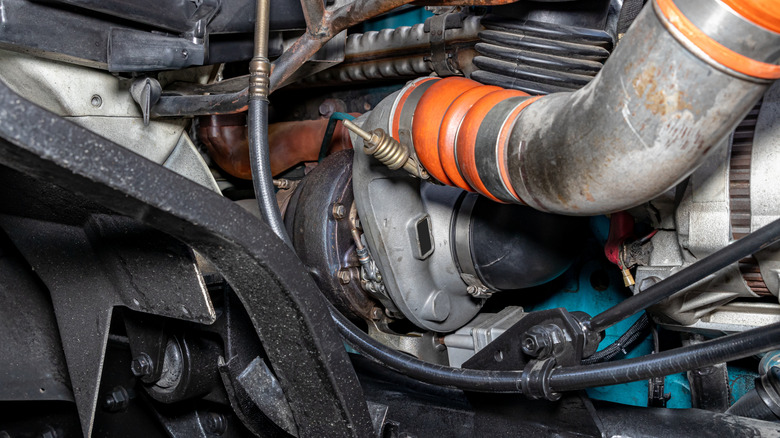
A turbo compresses air at such a high velocity that even a minor ingestion of foreign objects can dent compressor blades, throwing the entire rotating assembly out of balance. This is why a quality air filter is your first line of defense. Damaged air intake plumbing can also lead to turbo failure. A minor cut in a rubber intercooler hose will create a boost leak on the intake side. The ECU, sensing a drop in manifold pressure, will compensate by keeping the wastegate– the valve that regulates boost pressure — closed, causing the turbocharger to spin faster to reach the target boost pressure.
If the turbocharger wastegate is stuck, the turbo is forced to go into overdrive, exceeding its operating speed and internal thermal limits. This leads to rapid bearing wear and potential overboost and can lead to turbocharger failure. At best, your engine will go into limp mode. At worst, you could have bits of turbo internals being sucked into the combustion chamber and eventually resulting in catastrophic engine failure. A good way to detect air leaks in the turbo system is to do a pressure test, such as by using a boost leak tester.