

The Griffith 200 Wasn't Just A Tiny Car With A Big Engine, It Was The World's Fastest
Take a small car, and put a big engine in it. It's a recipe that has worked time and time again for thrill-seeking gearheads, and perhaps most notably in the case of the Shelby Cobra. In this instance, Carroll Shelby took the lightweight AC Ace — a rare British sports car with killer good looks — slotted a sizable Ford V8 under the hood, and voilà , the Shelby Cobra was born. A masterclass of how American muscle could enhance a quintessential British sports car.
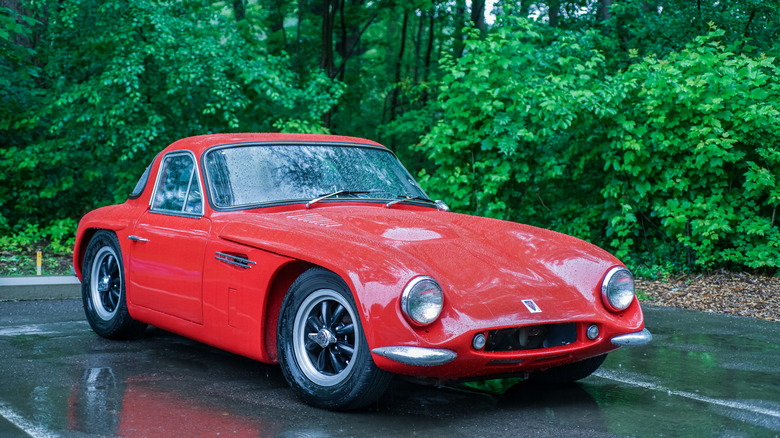
However, U.S. car dealer Jack Griffith, a friend of Carroll, thought he could out-Shelby the man himself, by building what he claimed was the "world's fastest production automobile". As the story goes, Griffith got hold of some TVR Grantura chassis through TVR importer Dick Monnich, slung a small-block Ford V8 under the hood of each, and began figuring out how to make it work as a small-scale production model.
This was no technical masterpiece, but it was brilliant in its own simplicity. As standard, the Griffith 200 kicked out 192 horsepower from its 289. That grunt was sent to the rear wheels via a 4-speed manual transmission. For buyers with a little extra cash, an additional 75 horses was available, courtesy of a high-performance 289 lump. These are exciting numbers regardless, but couple that power with a fibreglass shell and skinny tires, the result is a wild 1,900-pound sports car that the Griffith Motor Company claimed was the fastest production car anywhere at that time.
Digging deeper into the Griffith 200
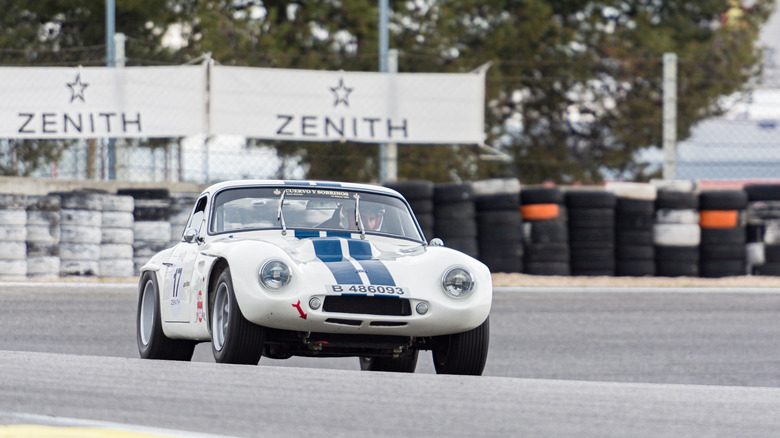
It was clear from the outset here that performance was the key for Jack Griffith and his new project. The 200 was never designed to be a jaw-dropping showboat. The fact the first 20 cars or so were finished using scraps of kitchen counter tops to cover cooling vents should volumes about the quality and intention of these plastic-bodied sports cars.
Still, the Griffith 200 could get away with being a little crudely finished, as it offered Cobra-rivalling performance for a considerably lower cost. Surviving invoices show that a well-specified Cobra 289 in the '60s would set owners back north of $6,000, whereas the Griffith 200 kicked off at just $3,995. Factor in $495 for the high-performance engine, and the mighty Grantura-based rocket looked quite the steal. Sure, Carroll Shelby's creations made him an automotive legend, but Jack Griffith's little sports car took the fight right to the Cobra, and has proved to be a successful racer ever since.
Regardless, the 200 was never going to be a volume-seller, instead appealing to die-hard drivers who desired something fast and unforgiving to wrestle on the weekends. Only 192 examples of the Griffith 200 were ever produced, which means stumbling across a survivor today is no easy feat. To put things into perspective, Shelby churned out 260 street-spec 427 Cobras, and that excludes early S/C and Competition-spec models.
Griffith's legacy and owning one today
British sports car enthusiasts will no-doubt be familiar with both the TVR and Griffith names, although these are names usually seen together, rather than separately. It is true that TVR did indeed launch its own Griffith many years later, in the 1990s. This later model stayed true to Griffith's original recipe of a lightweight construction and powerful V8 engine, although TVR's Griffith was built in more plentiful numbers, and as a soft-top too.
In fact, many TVRs that followed the Griffith 200 were V8-powered, whereas the earliest pre-Griffith models — like the Grantura it's based upon — opted for more humble powerplants. Perhaps TVR's long-term relationship is the real legacy of Jack Griffith's power-crazed creation. TVR announced that both a V8 and all-electric Griffith would be coming some years ago, and it speaks volumes about the original Griffith's importance that the new model pegged to save the company would share that iconic nameplate.
With only 192 Griffith 200 models ever made, plus 52 UK examples and 49 Griffith 400s, these cars were never frequent sites, and that's even truer now six decades on. Finding an example can be tricky, and so when one does come up for sales, enthusiasts act accordingly. Recent auction results include a wonderfully original project car, and a very well presented and competition-ready example. The former fetched $41,500 in 2024, while the latter has sold twice in recent years; $100,000 in 2023, and more recently $72,500 in 2025.