

Can The Hybrid Toyota Corolla's Efficiency Eventually Make Up For Its Higher Cost?
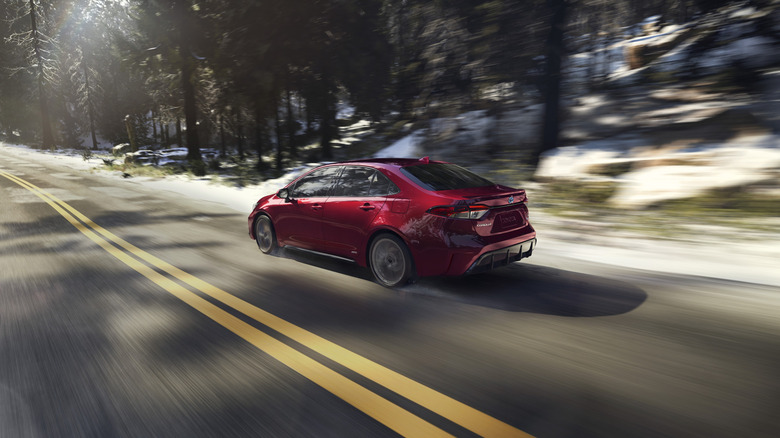
Although there have been exceptions — see the 2011 Lincoln MKZ — most automakers still charge a premium for hybrid models. It's easy to understand why, as even if everything else is the same, the hybrid has additional components, like an extra hybrid battery and regenerative braking, and those have to be paid for somehow. In the case of the 2026 Toyota Corolla, however, the hybrid is so much more efficient than the non-hybrid that it can claw back its higher price after just a few years on the road.
Let's run some numbers: The conventional gas-powered Corolla in entry-level LE trim has an MSRP of $23,125, while the hybrid LE starts at $24,975. Both have the same $1,195 fee for delivery, processing, and handling, which means you'll pay $1,850 more for the hybrid than for the gas-only Corolla.
Next, the EPA reports that the hybrid can achieve 46 mpg highway/53 mpg city/50 mpg combined, with the gas-only Corolla checking in at 41/32/35. When you also consider that American drivers on average cover 13,476 miles annually, the result — using each car's combined EPA rating — is that the more efficient model drinks 254.25 gallons of gas every year. To cover the same distance in the non-hybrid car, drivers would need 385 gallons of gas, representing a difference of 130.75 gallons.
Now, the average regular gas price hit $4 nationwide earlier this year, and was at $4.23 a gallon when this story was written, so the hybrid saves $553 per year in fuel costs over the gas-only Corolla. With that in mind, it could take around three years and four months to make up the original difference in purchase price.
What about other costs?
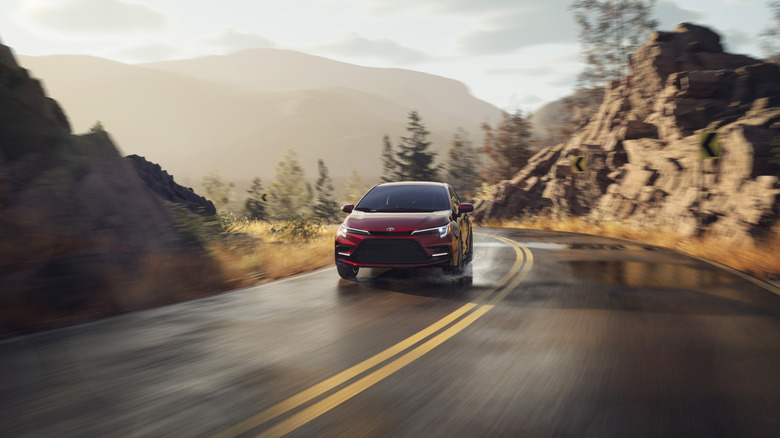
Yes, there's more to the cost of vehicle ownership than the manufacturer's suggested retail price – though those additional expenses may not add up the way some folks think when comparing hybrids and non-hybrids. For instance, some people believe that hybrids cost more to maintain and repair than gas-only vehicles. But we busted that myth when we looked at common misconceptions about hybrid engines in the past. The short story is that, except in the rare case when an owner has to replace the hybrid-battery system, hybrids can actually be cheaper to maintain and repair.
On the other hand, it turns out that hybrids often do cost more to insure than their gas-only counterparts. It's not necessarily a huge difference, since Insurance.com indicates the average insurance outlay for a hybrid is $2,544 and the price is $2,513 for a non-hybrid. Zeroing in on Toyota's compact sedan, Zebra.com lists the non-hybrid Corolla at $958 for six months versus the hybrid at $1,150. (Not bad considering Toyota isn't one of the cheapest car brands to insure, according to Consumer Reports.
Hybrids can be more expensive to register in some states – up to $100 in certain cases — and their higher MSRPs naturally lead to higher sales tax payments. In a place like Michigan, where the sales tax is 6%, that's roughly another $100 extra for the hybrid.
All those little extra costs may indeed drive up the time needed for the Corolla Hybrid to earn back its higher starting point. But if gas continues to get more expensive, running the more efficient hybrid is always likely to make sense in the long term.