

These Semi-Trucks Rely On Design As Much As Driving Style To Cut Diesel Consumption
Despite considerations for size, weight, and hauling capacity, fuel economy remains a top priority for drivers and operators of semi-trucks — especially now that diesel prices are through the roof. With average diesel prices reaching $5.50 per gallon in April 2026, a more fuel-efficient diesel truck reduces operating costs and brings a healthier bottom line.
However, an average truck can only achieve 7.2 mpg on a lucky day, but improving those numbers equates to greater fuel savings and better profits. It's why semi-trucks have morphed from crude boxes to the aero-optimized machines on the road today. Saving fuel is also why some trailers have big, plastic scoops to save 10% in fuel, in the same manner as you'll see some trucks with Airtabs on the body edges to smooth the airflow.
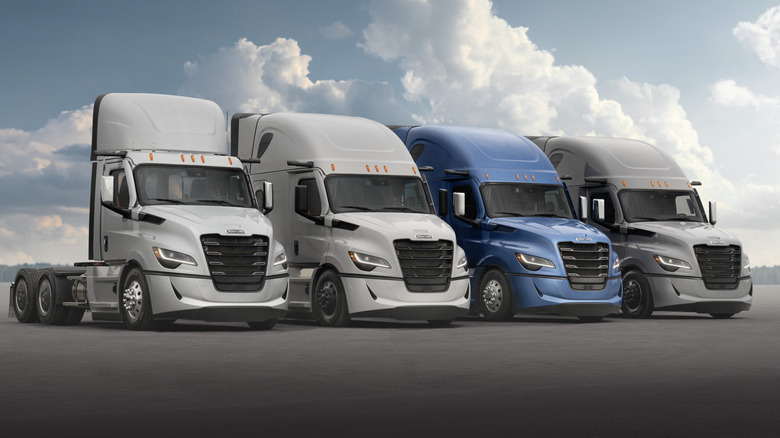
For instance, the fifth-generation Freightliner Cascadia features redesigned styling that makes it one of the most fuel-efficient semi-trucks on the market. It features what Freightliner calls a Max Aero front bumper, including three-piece closeouts for the front wheel wells, to reduce drag and improve the fuel economy. Other changes include optimized A-pillar deflectors, a redesigned hood, and a hood-to-bumper seal. Engineers further improved the truck's Detroit DD13 or DD15 diesel mill and Detroit DT12 transmissions to make the most of every drop of fuel.
Shapelier trucks are good for business
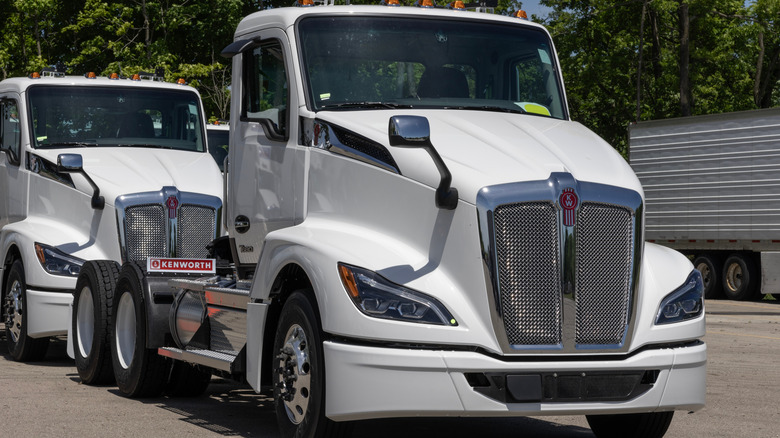
Another notably efficient semi-truck is the Kenworth T680 Advantage. Kenworth is a legendary name in the trucking industry, and it pulled out all the stops to make the T680 Advantage the most aerodynamic and fuel-efficient semi-truck to wear the Kenworth badge. The shapely body now includes longer side extenders on the T680 76-inch sleeper model, a front air dam, aero-optimized mud flaps, fairing extenders, exhaust cut-out covers, air deflectors on the rear fairings, and wheel covers.
Equipped with a Paccar MX-13 diesel mill and an Eaton Fuller Advantage 10-speed automated transmission, the T680 Advantage can deliver up to 9 mpg, but road tests by 10-4 Magazine have revealed that it can do 10.14 mpg. For comparison, a Ram 1500 TRX with AWD can only muster 12 mpg — low enough for it to be named on our list of new cars with the worst fuel economy – so for a Class 8 truck like the Kenworth T680 to achieve upwards of 10 mpg is fairly impressive.
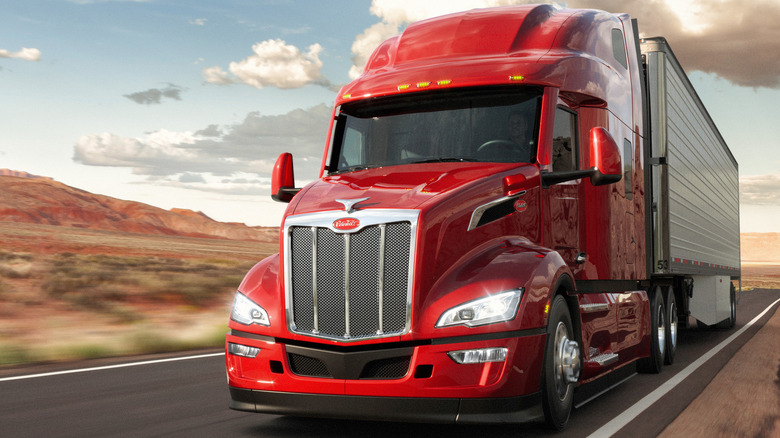
Meanwhile, the Peterbilt 579 features similar enhancements to its body design to mitigate wind drag. It has an air dam in the front bumper, an aero-optimized front grille, redesigned mirror heads, and wheel well closeouts, to name a few. The powertrain and drivetrain include PACCAR MX engines, DX-40k tandem drive axles, a TX-12 transmission, and a thru-shaft pinion design that are all optimized to deliver power without sipping too much diesel.
Why fuel economy matters to big rigs
Basic math reveals why truckers and fleet operators prefer fuel-efficient trucks. Let's say the truck improved its average fuel economy from 7 to 8 mpg. We can derive the gallons-per-mile (gpm) equivalent of 7 mpg by dividing 1 by 7 mpg, which equals 0.143 gpm.
Meanwhile, 8 mpg is 0.125 gpm. From that, the truck managed to save 0.018 gpm or 1,800 U.S. gallons of diesel over a presumed annual mileage of 100,000 miles. That's roughly $9,500 in fuel savings per year (based on current diesel prices), which further highlights how fuel economy matters for big rigs.
Truckers can get the most mileage with every tank of diesel by minimizing idling, keeping the engine revs low, and limiting the top speed. Despite semi-trucks being shapelier and more aerodynamic than before, they're still pretty big and produce a lot of drag as speed increases.
Shell explains that every 1 mph over 55 mph incurs a 0.1 to 0.2 mpg in fuel economy, and cruising at 60 mph reduces fuel efficiency by 0.5 to 1.0 mpg. Again, the numbers highlight how small changes in fuel economy can either put money in truckers' pockets or significantly reduce profits.