

Why SUVs Aren't Necessarily Safer Than Sedans In A Crash
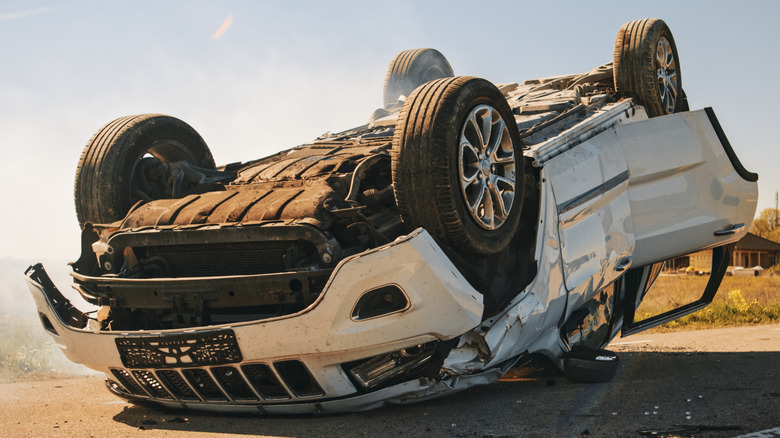
SUVs continue to dominate the automotive landscape. They're generally more practical than sedans thanks to their boxy shapes, allowing for a larger interior volume. They seem safer, too; the higher, commanding seating position provides better visibility, and the sheer size gives a psychological reassurance to the passengers. And they are indeed safer for their passengers when involved in multi-vehicle collisions. In other words, if a sedan and an SUV collide, the SUV's passengers are more likely to survive.
Case closed, then? Well, multi-vehicle collisions are only a part of all types of road crashes. And although they're the most common, they lead to fewer fatalities than other road accidents. What happens when you hit an immovable object (or a cyclist) with an SUV? And what about rollovers? In cases like these, SUVs are much less safe than sedans. From longer stopping distances to higher centers of gravity, SUVs have their own gremlins that can threaten the lives of passengers and other traffic participants. That's why this article will have a closer look at all safety aspects of SUVs using real data from reputable organizations and research papers.
SUVs are more prone to rollovers
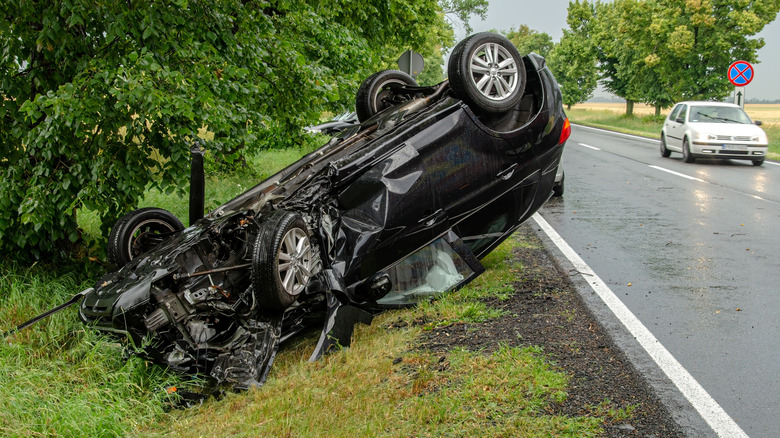
You've probably heard "You can't beat physics" way too often in car reviews. Yes, it's stale, but also 100% true. There's a measurement called Static Stability Factor (SSF), which determines how top-heavy a vehicle is. The formula that determines this factor is SSF = T/2H. T is the track width (the distance between the left and right wheels), while H is the height of the center of gravity. According to the National Highway Traffic Safety Administrtation (NHTSA), the SSF of most passenger cars is from 1.3 to 1.5, while for SUVs it ranges from 1 to 1.3. The lower value means that SUVs are more top-heavy in general, which increases their rollover probability.
The statistics support this claim. According to the Insurance Institute for Highway Safety (IIHS), 34% of the occupant deaths in SUVs in 2023 were rollover-related. For cars in general, including lower passenger vehicles, the number was much lower, at 21%. For single-vehicle crashes, 24% of the deaths in SUVs were rollover-related, while in cars it accounted for just 16%.
To be fair, rollover deaths in both cars and SUVs have been decreasing since 1978, mainly thanks to the implementation of modern stability systems. However, SUV drivers seem to be less aware about their safety. A 2017 observational study published by the National Center for Biotechnology Information (NCBI) found that SUV drivers are more likely to drive without a seat belt. And, unsurprisingly, many fatal rollover crashes involve victims being ejected from the vehicle.
Longer stopping distances mean SUVs carry more inertia in a crash
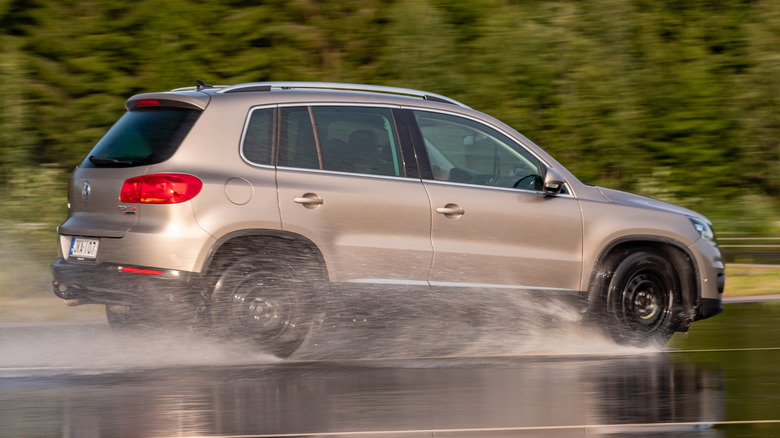
According to Newton's Second Law of Motion, objects with higher mass carry more momentum. So, naturally, heavier vehicles also carry more momentum, meaning they require more energy and space to stop — and SUVs are heavier than sedans. For instance, the base Honda Accord with the 1.5-liter four-cylinder turbocharged engine weighs 3,239 pounds. The CR-V with the same engine is as much as 3,614 pounds. So it shouldn't be surprising that SUVs are not present among the cars with the best braking times.
Sure, automakers usually put bigger brakes and wider tires on SUVs to counteract the added weight. But sedans still have slightly shorter stopping distances. In a 2021 Consumer Reports study, luxury midsize cars needed 128 feet to decelerate from 60 to zero mph, while luxury midsize SUVs needed 134 feet. You might think that six-foot difference isn't massive, but there's more to the story; at the 128-foot mark, the SUV will still be moving and carrying momentum forward. And since SUVs are heavier and travel faster during braking, they will hit any object with greater force.
Although automakers have improved SUV braking systems significantly over the years, a recent study by the Massachusetts Institute of Technology Mobility Initiative found that SUVs and pickup trucks still have inadequate braking. This is only worsened in electric SUVs, which accelerate to 60 as fast as sports cars but don't stop nearly as well.
SUVs are worse in single-vehicle collisions
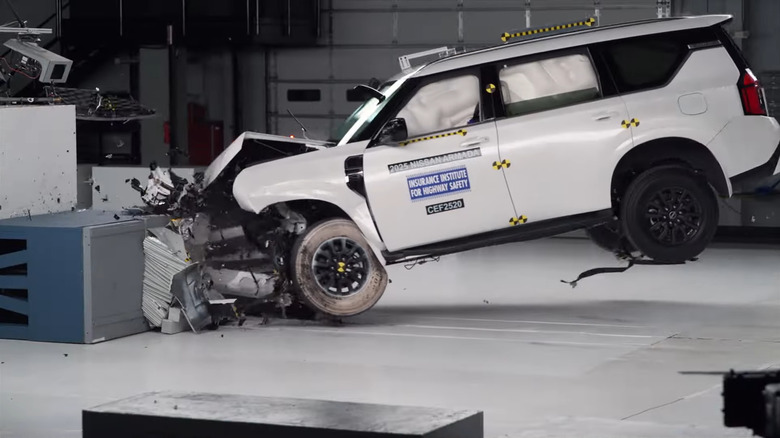
It's undeniable that SUVs fare better in head-on crashes with passenger cars. So, yes, you are safer in your SUV in a multi-vehicle crash than in a sedan. However, SUVs are worse in single-vehicle crashes than sedans. Rollovers are the primary reason here, but hitting an immovable object — like a bridge pillar or a tree — is way more dangerous in an SUV.
Again, it's all due to the higher momentum of heavier vehicles. Even at the same speed, SUVs carry more kinetic energy than sedans, which results in heavier crashes. In other words, sedans will hit a tree, lamppost, or wall less hard than SUVs, resulting in a lower likelihood of severe injury or death. SUVs' longer stopping distances and higher center of gravity don't help the situation, only serving to increase the probability of death and serious injury.
There's also a significant difference between unibody and body-on-frame SUVs. Unibody SUVs have a chassis that's similar in construction to sedans with safety features like crumple zones, while body-on-frame SUVs have a ladder chassis like pickup trucks. So, unsurprisingly, a 2014 crash fatality study published on PubMed reveals that passengers in unibody SUVs were at an 18% lower risk of death than passengers in body-on-frame SUVs. The latest data continues to support this conclusion, as there are no body-on-frame SUVs that have earned the highest Top Safety Pick+ award from IIHS. It seems like ruggedness is more of a marketing term, not a safety rating. That being said, in general, small crossover SUVs still have more occupant fatalities per mile.
Bad front-over visibility can turn kids invisible

One of the most chilling aspects surrounding the risks of increasingly large SUVs is child deaths. A study from the NCBI noted that these vehicles (as well as pickup trucks) are more likely to hit kids while moving in reverse down their driveway. While doesn't mention the specifics behind these circumstances, it's not too hard to assume that blind spots could play a major role.
SUVs have much larger blind spots, often hiding kids from the driver's view — and blind spots keep getting larger, too. Notably, a 1997 Honda CR-V enabled drivers to see 68% of the area within 32.8 feet in front of the car. Meanwhile, the current-gen model decreases the viewable area to just 28%. And it's not just Honda's bestseller — SUVs fared significantly worse across the board. The latest Accord, on the other hand, provided a significantly higher 60% viewable area, which is only a 5% drop over its 2003 model.
Of course, the biggest reason for this is the increasingly taller hoods of the latest SUVs. They are so high that you can fit multiple kids in the blind zone and they will be completely invisible to the driver. Because they sit higher from the ground, SUVs also have worse back-over visibility. Fortunately, all new cars sold in the U.S. from 2018 onward are equipped with a backup camera, which largely solves that particular issue. If front cameras were mandatory in new SUVs, these frontover blind spot problems might not be quite as worrying.
SUVs are more likely to cause pedestrian and cyclist fatalities
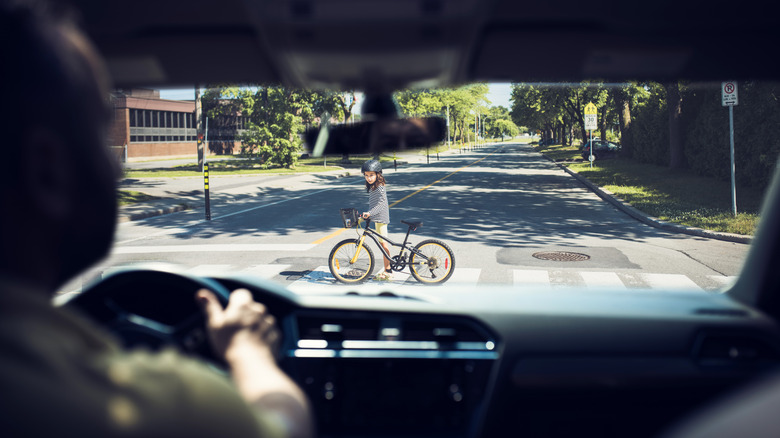
Kids aren't the only demographic affected by SUV size creep — it also endangers cyclists and pedestrians. In a 2020 study, the IIHS looked into 79 crashes in three urban areas in Michigan and found that SUVs caused more severe injuries than passenger cars, including sedans, when they hit pedestrians. A meta-analysis of several studies by the NCBI also found that SUVs are disproportionately more dangerous for pedestrians and cyclists.
Those pesky blind spots also play a role here, but SUVs' tall front fascias are also significantly more dangerous for cyclists and pedestrians during the crash. In an impact, the fascia strikes the pedestrians and cyclists directly in the head and chest, which are the most vulnerable parts of the body. Meanwhile, sedans are engineered to strike a pedestrian at the legs, with the head and chest hitting the hood with less considerable force. Let's not forget: Heavier vehicles hit harder.
SUVs also negatively affect overall urban visibility – and not just for the driver. Pedestrians and cyclists also experience restricted sightlines at intersections when SUVs are involved. Some are so high and wide that peeking over or around them is impossible for most people. Meanwhile, the lower profile of a sedan preserves a clear line of sight for pedestrians and cyclists, letting them see over the vehicle and anticipate distant traffic. For cyclists and pedestrians, early detection is key to avoiding accidents.
SUVs are more lethal to other cars, particularly lower vehicles
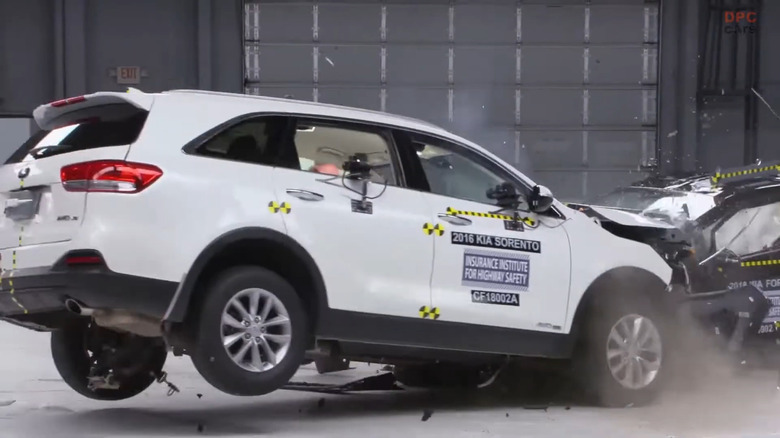
SUVs are safer in multi-vehicle crashes — no question about that. However, heavy, high-riding vehicles increase the risk of fatality for occupants in smaller, lower-riding vehicles during collisions. This happens because the roll cages of these vehicles are historically misaligned, with SUVs usually overriding the sedan's crumple zones. In other words, instead of hitting the sedan's front end directly, SUVs can go over it and bypass the structures designed to absorb impacts. The same goes for T-bone side crashes, as some SUVs are so high that they can hit the door panels or window glass. A research by the National Bureau of Economic Research indicates that being struck by a vehicle weighing an additional 1,000 pounds raises the baseline fatality risk by 47%.
Regulators and automakers have worked on this issue and introduced bumper-matching standards. As a result, significantly fewer deaths now occur for passengers in lower-riding vehicles when an SUV is involved. Passengers in sedans are still at a slightly higher risk (although it's significantly lower today than in the past) mainly due to the excess weight of SUVs. This is especially the case for SUVs heavier than 5,000 pounds (such as the Chevrolet Tahoe/Suburban), which are 20% more likely to result in car-partner fatalities.