

What Engine Parts Are Most Susceptible To Carbon Buildup?
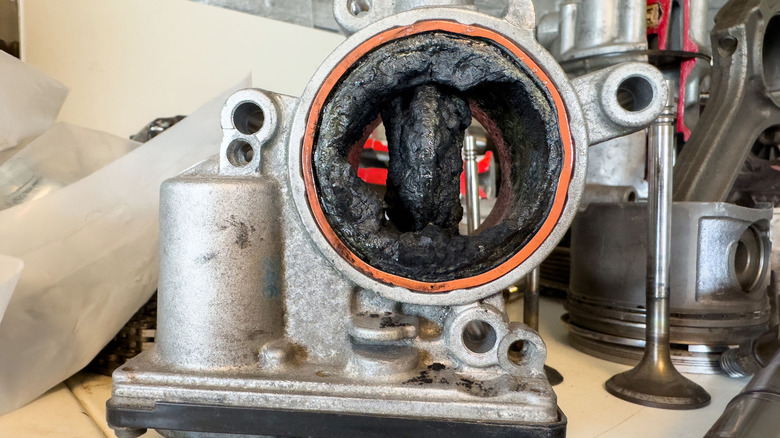
Before the turn of the millennium, you wouldn't find many people complaining about carbon deposits on engine valves. However, all of that changed as gasoline direct injection (GDi) went mainstream in the late 1990s and early 2000s. The same technology engineered to squeeze more power from less fuel quietly created one of the most common maintenance headaches in the modern automotive repair game. Consumer Reports described direct injection benefits as an "efficiency snowball effect" because it allowed automakers to downsize engines and save fuel while squeezing out more performance.
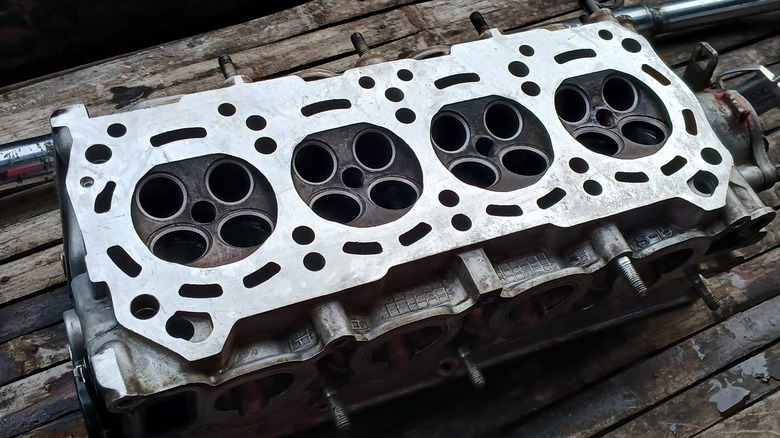
However, the technology came with carbon buildup as an unwanted side effect. Carbon buildup happens because of incomplete combustion, meaning that carbon particles deposit on the engine's inner surfaces over time. And a few specific engine parts bear the brunt of that buildup, with the parts most at risk being the intake valves. Other engine parts susceptible to carbon buildup include cylinder head ports, the intake manifold, piston tops, and fuel injectors.
Why direct injection engines are carbon magnets

In traditional port-injected engines, fuel washes over the intake valves on every cycle, keeping deposits from forming. Direct injection engines remove that cleaning mechanism entirely, and that means the valves aren't cleaned in the same way they are with port-injected engines. If your valve guides are worn out or the engine uses variable valve timing, this can accelerate the process further, since the valves spend more time exposed to combustion byproducts.
Carbonization can directly cause ignition problems, rough operation, fouled spark plugs, and misfire codes. These issues happen because when carbon messes up the port walls, it changes the way air enters the cylinder and breaks up the precise airflow that GDi combustion depends on. The intake manifold is in the same boat; its job is to distribute the air-fuel mixture evenly to each cylinder, and carbon restrictions compromise that function directly. Oil and carbon building up inside the manifold can cause reduced power and worse fuel efficiency. As for piston tops, the buildup grows worse with mileage, with symptoms ranging from light ticking to full-on hammering and knocking.
The danger goes beyond noise since heated carbon debris is capable of triggering low-speed pre-ignition in turbocharged gasoline direct injection engines. Residual fuel bakes onto the injector tip during heat soak after shutdown, restricting fuel delivery and forcing the engine to run lean. This is partly why your engine hates short trips, because it never fully cools between cycles — especially since these injectors use fuel as coolant for the nozzle tip during operation.
How to de-carbonize your engine
There are several methods of preventing and cleaning carbon buildup worth knowing about, but the most impactful ones come down to fuel, oil, and — when it's too late for either — a shop visit. An independent engine lab study carried out by AAA found that non-Top Tier gasoline leaves 19 times more carbon deposits on injectors and intake valves. It even added that switching to Top Tier can cut existing intake valve deposits by 45%-72% over 5,000 miles. Meanwhile, conventional motor oils are more likely to suffer from oxidation and thermal breakdown than synthetics, which can increase deposit formation over time. Some people will install oil catch cans to intercept oil vapor and contaminants from crankcase gases before they re-enter the intake. This filters out the oil mist that would otherwise bake onto your valves and create deposits.
However, if you're late to the game and the goal isn't prevention, but rather a fix, there are a few things you can do. Walnut blasting is intended to get rid of those deposits by blasting finely crushed walnut shells at high pressure through the intake ports with the manifold removed. But that process can cost around $1,000, so many are more inclined to rely on using chemicals for cleaning instead.
Regardless of the method you prefer, cleaning addresses the symptom rather than the source. On direct-injection engines especially, deposits are likely to return because fuel never washes the back of the intake valves. This is simply a structural limitation of the design, so you'll have to worry about deposits again eventually. Either way, combining cleaning with preventive efforts should give you a good chance of keeping your engine as healthy as possible.