

How To Camp In Your Car Like A Pro
We may receive a commission on purchases made from links.
Hotels are for people who've given up — not on comfort, but on living. With beige rooms that smell faintly of other people's regrets, bathrooms with the ambiance of a mortuary prep room, and minibars stocked with $15 cashews, they charge top dollar for a sterile version of mediocrity. Car camping, however, is at the opposite end of the spectrum, trading in superficial comforts for unforgettable experiences.
Of course, car camping can also be far less glamorous. For rookies, it can result in lying awake at 4:00 in the morning with a gear shift embedded in their spine, staring at a bear right outside of their fogged-up windows. Luckily, this article is here to ensure that doesn't happen. Keep reading for a comprehensive guide to car camping, where we teach you how to turn your daily driver into a comfortable overnighter. And you'll be able to make use of this guide whether you're rocking a brand-new Land Cruiser, a 1998 Mitsubishi Montero (which makes a mean off-roader), or a Chevrolet Suburban stripped of its rear passenger seats.
Prepare bedding, bed frames, and gear for a good night's rest
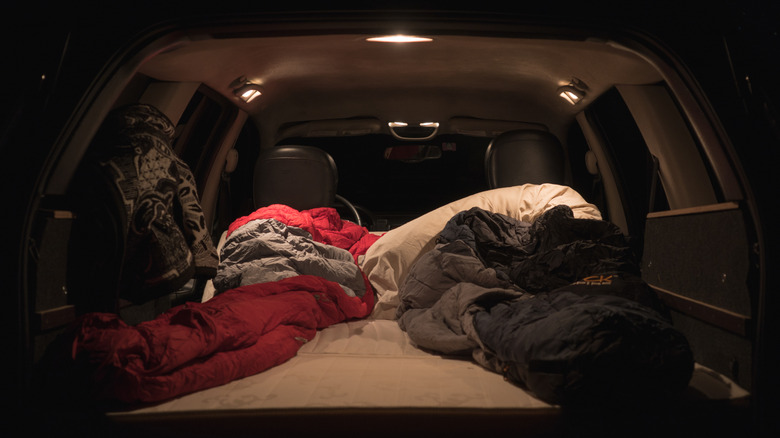
The single biggest mistake rookie car campers make isn't forgetting a can opener or parking on a slope — it's treating their sleeping setup like an afterthought. They simply crawl into the trunk, fold themselves into a sleeping bag like a human burrito, and spend eight hours staring at the headliner questioning every decision they've ever made. Spend some time planning your sleeping arrangements instead, and both your spine and mental health will thank you later.
At the heart of comfortably sleeping in your car lies, of course, a good mattress. And since you won't be carrying your bed around on your back, make sure to go beyond a regular roll mat. Memory foam camping mattresses, available in a variety of sizes, are cheap and comfortable — especially when you dress them up with a good pillow and a sleeping bag rated at least 15 degrees Fahrenheit. That means you'll feel warm even when the night is colder than your freezer.
But here's where things get genuinely clever: raised trunk bed platforms. These are elevated wooden or aluminum frames (which you can buy online or build yourself for under $100 in an afternoon) that sit above your cargo floor and create a flat sleeping surface with plenty of storage space underneath. You get to sleep comfortably on top like a real human being while all your gear disappears below. If you're going for the pre-built option, check out the popular Hele Car Camping Platform. If you're building your own, ensure you create a foundational frame strong enough to keep you from crashing through the bed and waking up impaled by a cooking utensil.
Eat well in any zip code
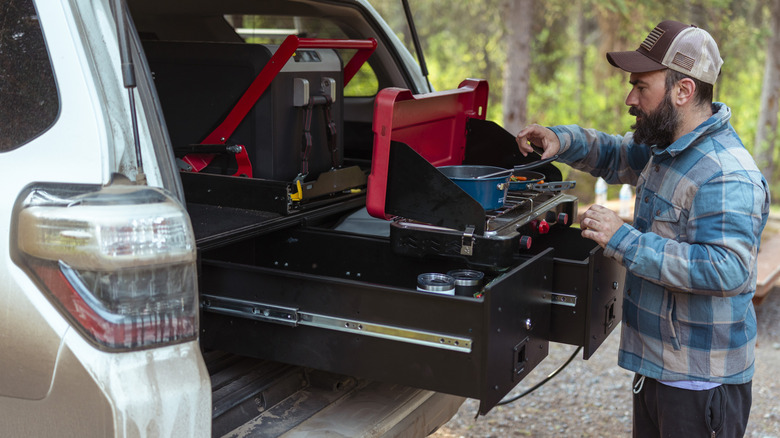
Bad food ruins great trips. The best campsite in the world won't save you from feeling miserable while you try to shovel cold canned beans into your mouth with a plastic fork in the evening. Luckily, building a functional car camping kitchen costs less than the standard price of room service and can churn out a wider variety of meals, too. The anchor of a solid camp kitchen, of course, is a two-burner stove. Even at the height of the digital age, nothing really compares to the simplicity of a Coleman Classic. Made from aluminized steel and powered by propane, this cornerstone camping stove puts out 20,000 BTUs of cooking power — enough to cook a real meal, not just boil water. Pair that with a good cooler and you've got the foundations of a fully-functional camp kitchen sorted.
Other kitchen essentials come next. Cheap camping cookware sets contain plates, cutlery, cups, and other gear that can round out the rest of your car camping cooking essentials. If you want to seriously step up your camping kitchen, consider a 12v refrigerator like the Dometic's CFX3 (which we reviewed here). Drawing power directly from your vehicle's battery or a power station, camping fridges eliminate ice runs entirely, hold temperature reliably, and let you carry real food (like eggs, meat, and fresh vegetables) instead of whatever survives three days in a pool of meltwater.
Keep your trunk from becoming a dumpster
There is a special kind of madness that sets in around day two of a poorly organized car camping trip. It starts subtly — a lighter goes missing, the flashlights are buried at the bottom of a backpack, and the tarp gets lost beneath a pile of dirty clothes. Then, by day three, you find yourself excavating your entire vehicle in the dark just to find a pair of wet socks.
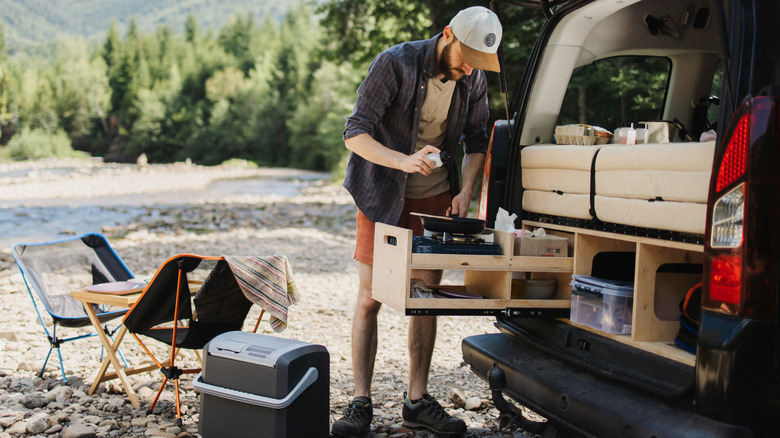
Unfortunately, organization isn't glamorous. It is, however, what makes the difference between a car camping trip that resets your nerves rather than eroding your sanity. Start by zoning off the areas within your vehicle. Give every type of gear or supplies (cookware, food, clothes, tools, etc.) a designated area and make sure that they stay there. When every kind of gear has a home, finding something specific in the dark becomes instinct rather than a practice exam in archaeology.
Next, use adequate packing gear. Soft-sided packing tubs are cheap and compressible, ideal for storing clothes. For cookware and non-perishable food items, basic stackable plastic storage bins are inexpensive and highly effective. Gadgets like flashlights, phones, and other miscellaneous items fit really well into roof cargo nets. Finally, tools are best kept in durable hard-shell cases. Brands like Pelican make high-quality storage cases specially built for overlanding and adventure travel. While they are expensive, the investment is worth it for serious car campers.
Manage electricity while car camping
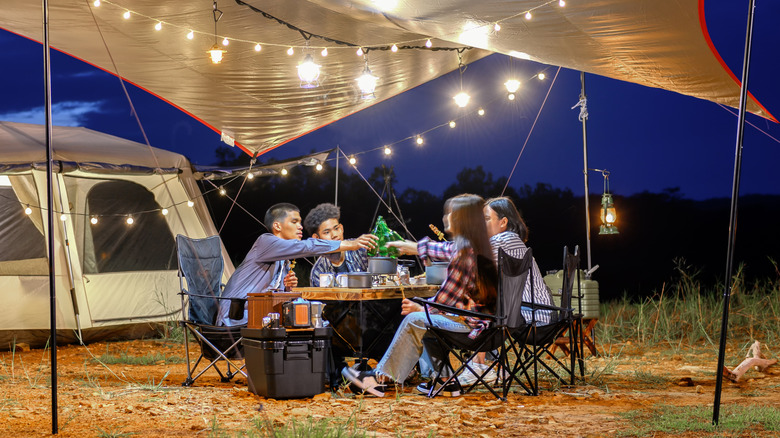
Car camping offers a great opportunity to recalibrate your burnt-out dopamine circuits by looking out into nature rather than down at your TikTok feed. However, disconnecting from screens doesn't have to come at the cost of navigating the wilderness using sun dials. Managing power on a camping trip is fairly inexpensive and can be as simple or complex as you want, depending on the level of civilization you're trying to maintain. In all scenarios, however, it's best to use a setup that doesn't solely rely on your car battery.
If all you need is to charge your phone and a few USB gadgets, a small portable power station is the perfect solution. The Anker SOLIX C1000 offers up to 1,056 watt-hours, extra-fast charging, and 11 ports — more than enough power to keep basic gear running for a few nights. Of course, adding solar to your camping setup provides even more flexibility. Read up on the ins and outs of solar power for RVs here — most of this info translates seamlessly over to car camping.
Manage privacy and insulation while avoiding suffocation
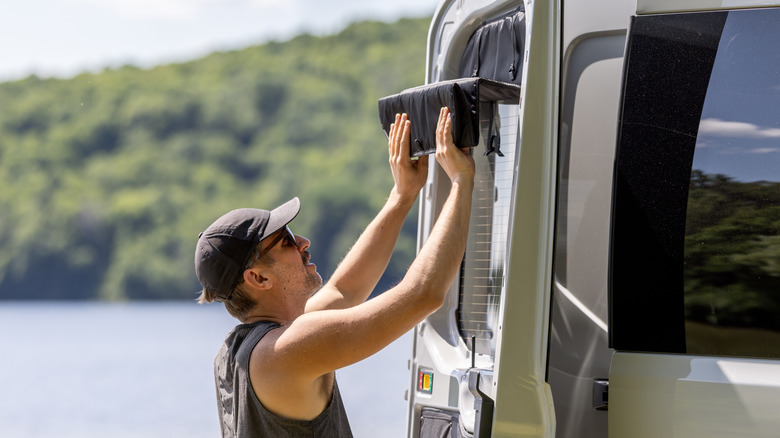
Your vehicle's windows are simultaneously your greatest asset and biggest liability. Manage them properly and you'll sleep like a baby. Get it wrong, however, and you'll spend the night roasting like a rotisserie chicken while a stranger peeks deep into your soul. Luckily, managing privacy, insulation, and ventilation while sleeping in your car is far from rocket science.
Made of reflective film bonded to two internal layers of heavy polyethylene, Reflectix is the holy grail of thermal vehicle insulation and does three things at once: block prying eyes, reflect external heat or cold, and keep your car from becoming a greenhouse. 10-foot rolls can be bought on Amazon and cut to perfectly match the size of your windows in a few hours. Some brands also offer custom-cut magnetic window covers if you're willing to spend a little extra.
Next comes ventilation. This is non-negotiable unless you like the idea of waking up in what seems like the locker room of a Florida high school in July. Luckily, keeping your vehicle ventilated while you sleep will set you back the price of a cheap portable car fan and window shades (which we recommend everyone keep in their car in case the A/C fails). The former will keep air flowing around your car while the latter will allow you to crack the windows and breathe fresh air without inviting the local insect population into bed with you.
Keep some miscellaneous car camping gear on-hand to save trips (and lives)
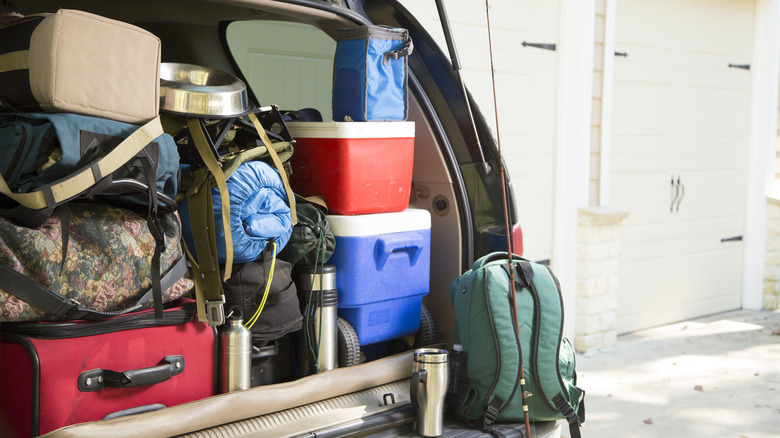
Every camper has a story that begins with "thank god I had..." — and it never ends with a camping chair. The unglamorous car camping gear is, paradoxically, the most important, and what keeps a trip from driving you insane. Flashlights and headlamps are at the top of the unforgettable car camping gear list, as fumbling around in the dark is dangerous and undignified. Next comes a car emergency kit, which needs to be complete with jumper cables, a tire pressure gauge and inflator, reflective triangles, a tow rope, a tire iron, a small fire extinguisher, and a first aid kit.
Physical roadmaps also deserve a revival. They don't require a signal, battery, or subscription fee, and they'll save your trip when you run out of phone service coverage or battery (which always happens exactly when you'll need your phone most). Finally, remember to carry dedicated waste containers, because the wilderness isn't your personal rubbish bin. Good-quality trash bags, biodegradable camp soap, clean sponges, and dish towels will ensure you leave no trace and run a clean campsite.
Try some pro-level car camping upgrades
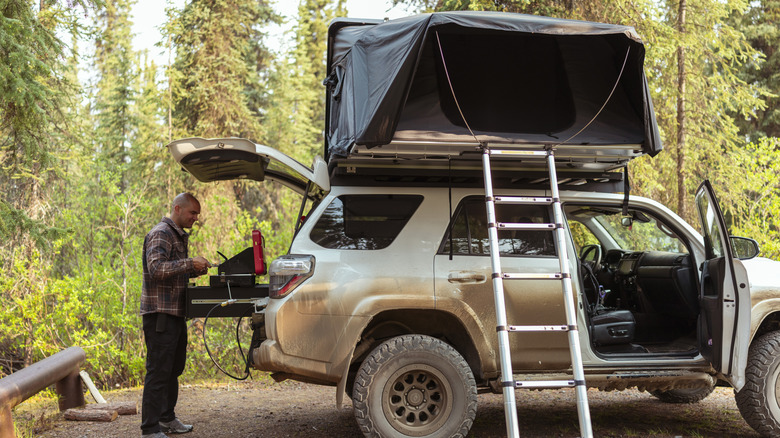
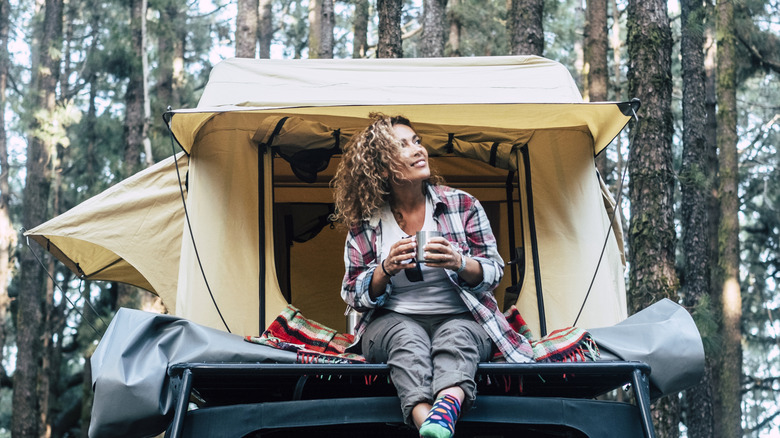
Camping in your car can be basic. At some point, however, you'll find yourself eyeing new gear with the glassy-eyed enthusiasm that historically precedes poor financial decisions. The good news is that some pro car camping gear is totally worth it. Rooftop tents sit at the top; they're not cheap, easily setting you back over $1,000 (or $7,000 if you opt for this Porsche tent), but they're a fundamental quality-of-life upgrade that's hard to argue against once you've slept in one. If you're ready to make this investment, check out GFC, which makes some of the best-rated rooftop tents currently on the market.
Dual-battery solar power systems are next. Using two of the aforementioned Anker SOLIX C1000 power stations with a 400W portable solar panel, for example, will give you enough power to run your fridge, fan, and lights overnight while charging your devices. And it all comes without the anxiety of waking up to a dead engine. Finally, equip your car with a pressurized camping shower and portable camping toilet. That way, you won't need to worry about the stink that comes from not having a shower in three days — or the need to scramble into the undergrowth with a trowel at 3:00 a.m. Popular options include the NEMO Helio Portable Pressure Shower and the Thetford Porta Potti 365.
Again, none of this gear is a necessity. Focus on mastering your sleeping setup, camping kitchen, organization, and emergency gear first, and you'll have a solid foundation that you can upgrade as you go. Make use of these tips as you plan your next road trip across the U.S. — but don't forget to avoid the states that make sleeping in your car virtually impossible.