

The Major Difference Between Semi Truck And Car Tires
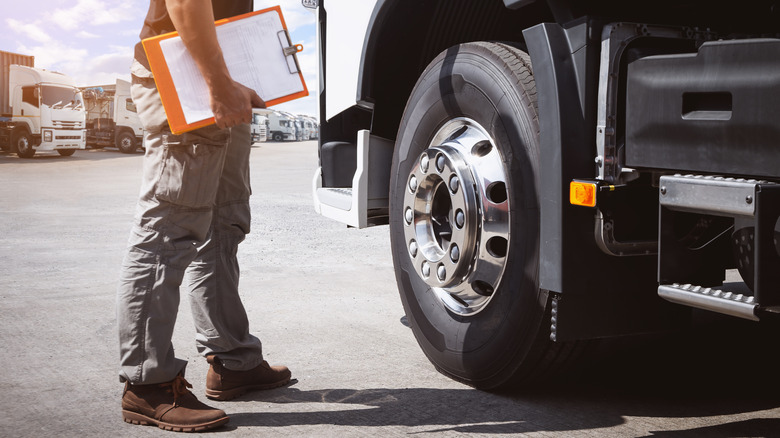
If you pull up next to an 18-wheeler at a red light and look at its tires compared to your car's, the size difference is obvious. However, size is just one of the differences. Commercial truck tires and passenger car tires are built around entirely different demands in terms of load, inflation, and, critically, the consequences when either one fails.
The temptation is to think of a semi truck tire as a scaled-up version of what's on your daily driver. It isn't. Semi truck and trailer tires are constructed with more natural rubber and steel than car tires, and the structural gap goes well beyond just the material ratios. A standard passenger car tire typically runs at pressures of 28 to 36 pounds per square inch (psi). Most semi truck tires operate in a range of 85 to 110 psi. That's nearly three times the pressure — and it's not arbitrary.
The average passenger car weighs around 3,806 pounds. A loaded semi can legally tip the scales at 80,000 pounds on interstate highways — roughly 21 times heavier. Although a tire's construction determines how much pressure it can hold — it's the inflation pressure that determines its load-carrying capacity — a vehicle carrying 80,000 pounds demands dramatically higher inflation across every axle than a passenger car ever would.
That pressure requirement is so critical for fleets that many modern rigs now run automatic tire inflation systems to maintain it mile after mile. That difference in purpose shapes everything else about how these tires are built, rated, and maintained.
What do the numbers tell us?
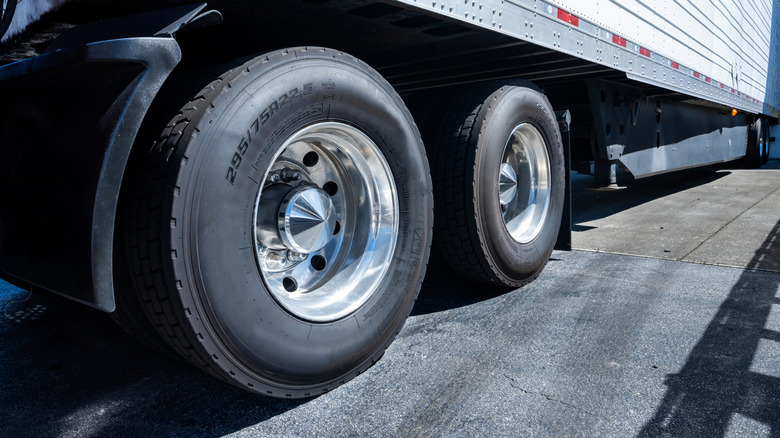
Passenger-car tires carry four-ply (B) ratings or lower. Light truck tires start at six-ply (C), or higher (and if you've ever wondered why someone would choose a 10-ply tire, we break down exactly what that buys you in real-world durability). Heavy commercial tires go further still — common load ranges for commercial truck tires are G, H, and L (14-, 16-, 20-ply). All that said, today's ply count isn't about the actual number of ply layers inside a tire — it indicates an equivalent strength compared to earlier bias-ply tires.
There's also how much weight each tire is expected to bear. A tire load index of 95 — common on passenger-car tires — corresponds to the tire supporting a maximum of 1,521 pounds (remember, this is multiplied by the number of tires to see how much they can hold up as a group). If you look at load indexes of 144 (semi-truck territory), you're looking at 6,173 pounds per tire.
Then there's the position question. Unlike a passenger car, where all four tires do essentially the same job, a semi runs three distinct types. Steer tires, on the front axle, rely on ribbed treads to channel water and ensure stability. Drive tires use lug-type treads for traction on the truck's powered rear axles. And trailer tires are built to endure braking and side-to-side forces while carrying diverse load weights.
There's also the question of using regional or long-haul commercial tires. The former are designed for shorter and medium-length distances while the latter are meant for long-distance hauling. Lastly, speed rating is something most car drivers overlook, but truckers typically don't. Many commercial truck fleets carry an "L" speed rating — a maximum of 75 mph. A standard passenger car tire is rated for 112 (S) to 118 mph (T).
What tire failure looks like
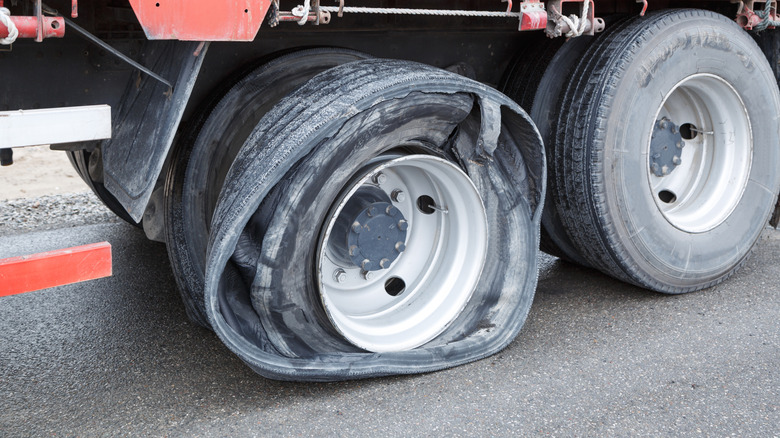
Car tires are capable of catastrophic failure too. However, the difference isn't how often tires fail — it's what happens when they do. Depending on the configuration, semi trucks can run between 10 to 36 tires — and a failure involving a single tire built to carry its share of 80,000 pounds — on a vehicle that can weigh 21 times more than a passenger car — operates on a different scale entirely. Exceeding speed ratings, heavy front axle loads, and high equipment utilization have all been linked to increased tire failures on commercial trucks — and few vehicles on the road combine all three as consistently as a loaded semi.
As reported by InvestigateTV, on July 18, 2023, a blowout on an 18-wheeler's front tire on I-40 in New Mexico sent the truck across the median and into oncoming traffic, killing a family of three — one of more than 200 large truck crashes from 2021 to 2023 where tire problems killed 173 people. Highway car blowouts can cause serious accidents too, but a passenger vehicle that loses a tire rarely carries the weight to do what that New Mexico truck did.
For everyday car drivers, the practical takeaways are straightforward. Loaded tractor-trailers require 20% to 40% more stopping distance than cars. This means that following too closely behind a semi is a different proposition than following or tailgating a car. So when driving near these behemoths, pass quickly and don't linger alongside — especially in summer heat when tire temperatures and pressures climb. And keep in mind that at 75 mph, a loaded semi is often at its tire's rated speed limit.