

If Your Manual Transmission Has An E, What Does It Stand For?
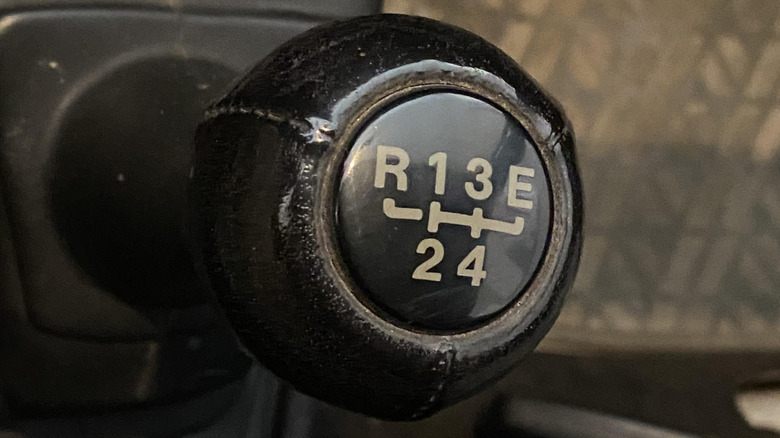
You might have read somewhere that the E in some cars with manual transmissions stands for economy or extra. Technically, they're not wrong, since the E gear position helps improve fuel economy by acting like a taller extra gear, most helpful when driving on highways and open roads. However, the official meaning of E in older manual-equipped German cars is efficiency, per Car and Driver, and cars equipped with such will have a tall overdrive ratio to keep the engine humming at a lower rpm and save gas.
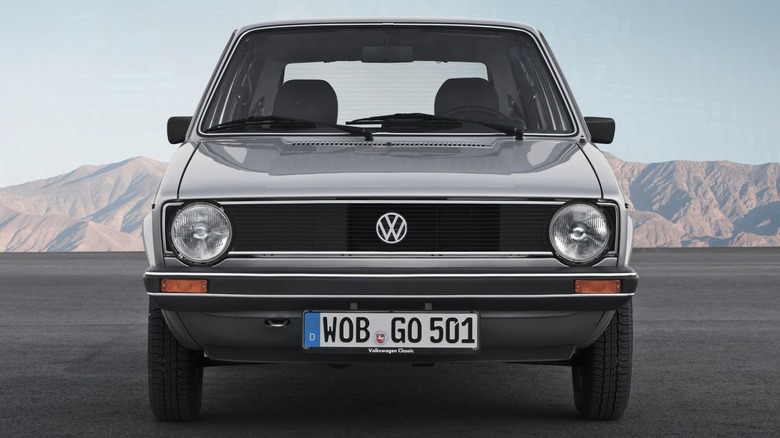
The 1981 Volkswagen Rabbit (or Golf) debuted with a longer-stroke 1.7-liter four-cylinder engine that paired with what VW referred to as a 3+E manual gearbox. It was essentially a four-speed manual from the 1980 model converted to three gears and an E overdrive gear. Despite the changes, the VW four-speed and the new 3+E manual deliver the same 3.89:1 final-drive ratio, enabling the Rabbit to achieve an EPA-verified 28 mpg in city driving, better than its predecessor's 24 mpg.
In some markets, the Mk1 Golf came with a Formula E version for the 1981 model year. The package included a 3+E manual transmission, a gear shift indicator, a fuel-consumption display, and a more aero-friendly body to improve the drag coefficient. In 1983, VW offered an optional 4+E manual transmission to select Golf diesel and gasoline variants. The gearbox was essentially a four-speed with an efficiency or overdrive fifth gear.
How does it work?
Old cars with a 3+E or 4+E manual transmission work the same as standard manuals. Drivers row through the gears –- first to fourth gear, for the 4+E –- as the vehicle builds momentum. Upon reaching the highway, drivers can engage E to reduce the engine rpm while mitigating pumping losses. That last part is important since reducing pumping losses allows the engine to breathe more efficiently while helping save fuel. The higher the rpm the higher the potential pumping loss, and shifting to E enables the engine to churn at lower rpm, reducing engine wear and producing a quieter ride. With the 3+E, drivers move from first to third before engaging E.
Nowadays, manual vehicles are nearing extinction in North America. There are still a few cars you can buy with factory-equipped manual transmissions, but manual vehicles made up fewer than one percent of U.S. vehicle sales in 2024. Things are different in other markets, though, as manual transmissions are still popular in countries like China and India.
The manual transmission's declining popularity in America could be attributed to newer, more fuel-efficient engines with variable valve timing, multiple displacement systems, direct injection, turbocharging, and more competent automatics like continuously variable automatic transmissions (CVTs) and dual-clutch automatic transmissions (DCTs). Whatever the reason, obscure manual overdrive systems from the '80s such as the Rabbit's E gear are becoming increasingly rare – although that might not be such a bad thing.