

This Old Detroit Cemetery Is Only Open Twice A Year After A Car Factory Swallowed It
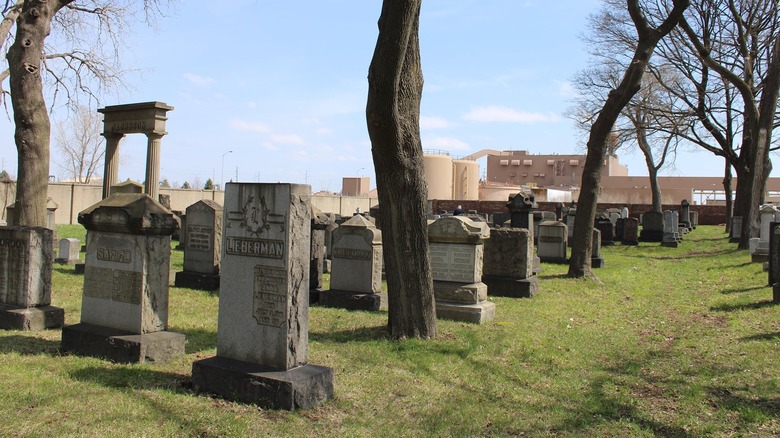
Long before the automobile, Congregation Shaarey Zedek purchased land for a cemetery far outside Detroit city limits. However, thanks to urban sprawl and industrial expansion, this sleepy little cemetery is now entirely surrounded by the General Motors Factory Zero facility. It's closed to the public except for just three hours on the Sunday before Rosh Hashanah and three more on the Sunday before Passover. This Building Matters on YouTube tells the story of how things came to be this way.
It was a long haul from Detroit to Beth Olem Cemetery when it was established in the 1860s, especially by horse and buggy. That was the point. It was far outside the city, surrounded by farms, and would never be disturbed. Over the years, more and more people moved out of Detroit to the suburbs. The nearby township of Hamtramck grew into a village by 1901, but would boom when the Dodge Main auto factory opened in 1914, a stone's throw from Beth Olem Cemetery. According to the Detroit Historical Society, Hamtramck grew from a population of 3,559 in 1910 to 46,615 by 1920, mainly Polish immigrants who moved there to work at the factory. The residential area that sprung up around it was known as Poletown for this reason.
What was once a quiet cemetery in the middle of nowhere was now an anachronism surrounded by a thriving community. All the land surrounding it was bought up, and there was no room for expansion. The last burial in Beth Olem took place in 1948. In the 1960s, Chrysler expanded Dodge Main all the way to the cemetery walls, including Smith Street which used to be its access point. Chrysler added a driveway from nearby Clay Street to preserve public access.
From boom to bust
Dodge Main went from boom to bust in the 1970s, and was vacant by January 1980. General Motors was also threatening to leave Detroit, but the city used its eminent domain powers to enable GM to not only acquire the Dodge Main plant, but also the Poletown neighborhood to build a newer, bigger factory. Officially named the Detroit-Hamtramck Assembly plant, most called it the Poletown plant instead. This would displace 1,500 homes, 144 businesses and 16 churches, according to the Detroit Historical Society. This use of eminent domain to displace residents and "encourage commercial growth" was fought, but upheld by the Michigan Supreme Court at the time. The court reversed this decision in 2004, but that's little consolation to the former residents of Poletown.
However, it seems the dead have more protection than the living. Jewish law forbids graves from being moved, and Michigan state law backs up such religious considerations, so Beth Olem Cemetery remains. GM has continued to support it, donating supplies and funds to Clover Hill Park Cemetery who now maintains it, and allowing public access twice a year despite being on factory property.
GM has gone though some boom-bust cycles itself. The plant that GM razed a neighborhood to build was idle and "unallocated" in 2019. This raised concerns that it might go up for sale once again, and that a new owner would not be as accommodating of Beth Olem as GM has. It got a new lease on life as Factory Zero, GM's first dedicated EV assembly plant. This was supposed to save it, but EV sales have tanked, and the plant once again sits idle. The present is so chaotic that no one knows how to plan for the future, so we can't even speculate on what this plant's future holds. Yet Beth Olem Cemetery, a relic of the past when this area was nothing but farmland, still remains.