

Twin-Turbo Vs. Twin-Charged Engines: What's The Difference?
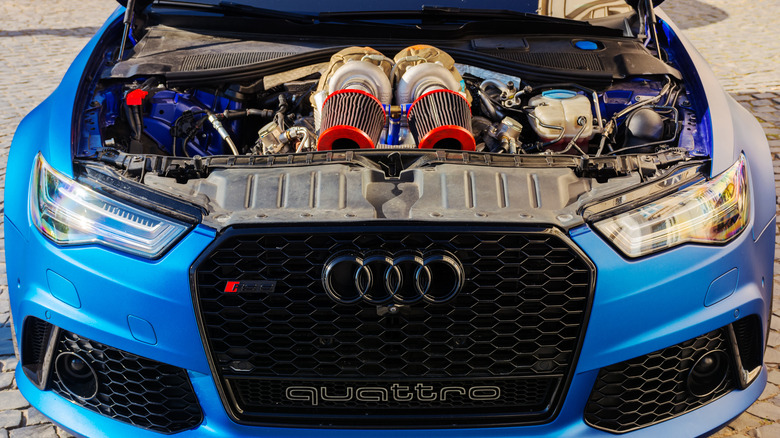
Have you ever sat at a stoplight next to a pricey German SUV, and wondered, how is that 5,000-pound brick so fast? The answer often lies in the magic of turbocharging. In most instances, it's a single turbocharger doing the heavy lifting. In performance SUVs though, it's a pair of turbochargers, and in rare instances, it's the combination of a turbocharger and a supercharger playing the forced induction trumpet. The latter two are what we call "twin-turbo" and "twin-charged" setups. Why both play the boost game well, the way they go about it vastly differs. Let's start with twin-turbo.
The twin-turbo concept is simple on paper. If one turbo makes a car go fast, two make it twice as fast. It's not that simple, though. In a twin turbo setup, two separate turbochargers work together to compress intake air, but the way it is delivered can vary. In essence, twin-turbocharging be categorized into two primary setups: parallel or sequential. The parallel setup, mostly used on V-6 and V8 engines like the Nissan GT-R and Lamborghini Urus, has each turbo responsible for one bank of cylinders. Think of two workers sharing a load instead of one. This setup works on reducing turbo lag as two small turbos spool up faster than a single large one. That means you get the power delivery feels more instantaneous.
The sequential setup seen on cars like the Mazda RX-7 FD and Porsche 959 is a more sophisticated one. It contains a small turbocharger paired with a larger one. The smaller one is responsible for the low rpm throttle response for when you are pottering around town, while the larger one wakes up once there is enough exhaust volume to provide a larger punch at high revs.
Different modes of efficiency
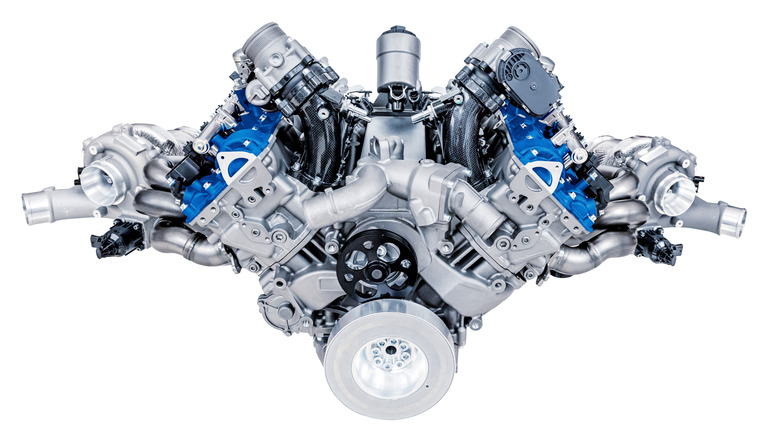
The main draw of a twin-turbocharged setup is fuel efficiency, rather than power. By using two turbos, engineers can work with downsized engines, like 2.9 or 3.0-liter V6s that can push out V8 levels of torque. With turbocharging, you are relying entirely on exhaust gases for the system to work. Unless you are moving enough spent gases out of the exhaust pipe, the turbocharger won't work optimally. The twin turbochargers somewhat solve this "turbo lag" problem. However, it does not solve the idle rpm boost issue, where the turbocharger won't provide much boost when the engine is idling or at low revolutions. For that, you need a much more complicated setup. Like twin charging.
A twin-charged engine uses both a supercharger and a turbocharger to make power. The logic is foolproof. Larger turbochargers work best at high rpms, when exhaust gas flow is high, but they suck at low rpms. Superchargers, being belt-driven from the engine's crankshaft, can provide instant boost from idle rpm onwards. However, they don't work so well at high speeds due to parasitic drag at high engine revolutions. Bolting them both together allows you to use the supercharger to provide low-end torque while the turbocharger is still waking up. Once the turbo is at full boost, it takes over.
The twin-charging tech isn't exactly new science; it's just rare. One of the most famous examples is the Lancia Delta S4 Group B rally car. It used a 1.7-liter motor that made around 300 horsepower (in the homologation model) thanks to a combination of a Volumex supercharger and a turbocharger. The advantage of twin-charging is the linear torque curve. Instead of a sudden shove in the middle of the rev band, you get a relentless wall of torque from idling rpm onwards, all the way to the redline.
The three horsemen of the charging apocalypse
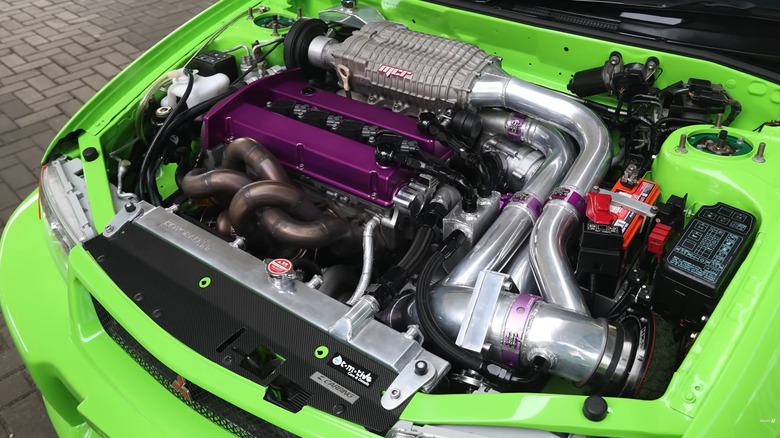
Given its foolproof logic, why aren't there more twin-charged cars around? Why do manufacturers prefer twin turbos over twin charging? It all boils down to three factors: weight, cost, and complexity. Twin charging is a packaging nightmare. You need a belt drive for the supercharger, an exhaust manifold for the turbo, separate intercooling systems for both, and a large array of sensors to manage the handoff between the two. They add weight, cost, and complexity to the build. That shouldn't stop you, though, from shoving a 450-horsepower Volvo twin-charged engine in your BMW E30. Modern turbo tech has advanced quite a bit, too, with lightweight titanium aluminide wheels and electronic wastegates that help almost eliminate turbo lag. Also, it's easier to get more power with a twin turbo setup by simply turning up the boost with bigger turbos. Even Lexus revealed that its upcoming LFA-successor will have a twin-turbo hybrid V8.
The twin-charger is seeing a revival of sorts, thanks to electricity. Modern twin-charged engines use an electrical supercharger that uses a 48-volt electrical system to spin the compressor to 70,000 rpm in less than a quarter of a second. It works as well as a belt-driven supercharger but without the parasitic drag or extra plumbing, and can draw its energy from regenerative braking systems, improving efficency.
The twin-turbo remains the industry benchmark because it offers a superior ratio between peak air flow and manufacturing cost. It is a more evolved technology where the primary challenge of instant throttle response has been largely solved by low-inertia turbine materials and electronic wastegate actuation. However, if your goal is to get peak volumetric efficiency across the rev range, the twin-charged architecture is a better bet, especially with the recent advancements in technology.