

Here's How Motor Oil Is Made

Crude oil, the kind you might see bubbling up from the ground Jed Clampett-style, has been used for thousands of years. It's found employment doing everything from waterproofing for boats to burning as incense to treating medical problems. It was even used as sort of a mortar between the blocks of stone in ancient pyramids, while oil wells date back to 347 CE, when folks in China used bamboo poles as drills to get to the stuff.
But it wasn't until the middle of the 19th century that folks began refining the crude oil, which naturally comes in a thick mess contaminated with other compounds that make it unsuitable for products like, for example, motor oil. The identity of the very first refinery is a matter of contention, as some people point to a single-barrel still that was put to work in Pennsylvania in 1850, and others say it was Romania's Ploieşti Refinery, a larger concern that came on line in 1857. What we do know for sure is that in neither case did the motor oil come from dinosaurs.
Anyways, that refining business is only part of the picture. Beyond removing impurities, oil producers also introduce additives to the oil itself to further improve its performance. Now, those are the two main steps in "making" motor oil, and we'll discuss them below, but keep in mind that the process really starts with exploration, exploitation, and extraction, which can be dangerous, dirty, and expensive — despite what you may have learned from watching Big Oil's propaganda film for teens.
How is crude oil refined

Yes, you can make motor oil from natural gas or synthetic sources, but when we're looking at conventional motor oil, the typical first stage is called desalting. The issue is that crude oil naturally contains a variety of different salts when it's still underground, and it can also get further contaminated by more on the way to the refinery — and regardless of source, those salts can cause the metal in the distillation machinery to corrode, and impact other chemical processes. To do that, crude oil is heated and then mixed with fresh water and chemicals engineered to help separate water from oil (emulsion breakers or demulsifiers). When the mixture settles in the treatment tank, the dirty, more dense water sinks to the bottom and can be removed.
Now you've got clean crude oil, but it contains a wide range of different hydrocarbons that can be further separated to take advantage of their different chemical characteristics — which, it's important to note, include different boiling points. At the macro level, this so-called fractional distillation works by heating crude to different temperatures, allowing the individual hydrocarbons to boil into gas, then capturing the purer material as it cools and recondenses into liquid.
To be clear, that can be the case whether you're distilling crude oil into motor oil or some other petroleum product. For instance, fractional distillation plays the same basic role in how diesel fuel is made.
Improving motor oil with additives
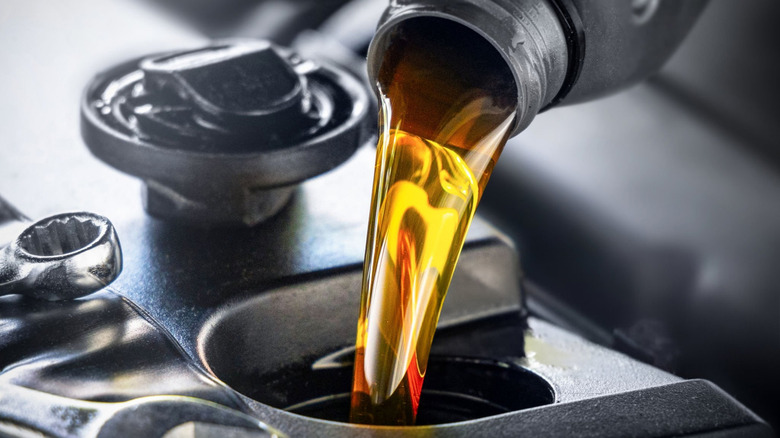
The oil is pretty much free from contaminants at this point, but — as mentioned — it's not yet ready for lubricating your engine. Oil companies also mix in additives that are engineered to increase the natural advantages of the pure oil, reduce its drawbacks further, and introduce new properties for improved engine operation. In fact, some 30% of the ingredients in motor oil can be made up of additives.
Among them are unique chemicals that work in three essential areas. For starters, anti-wear additives can be used to help reduce metal-on-metal damage to engine parts, usually by creating a barrier between the components when the engine temps start to rise. Anti-corrosion additives work in a similar way, acting as a protective layer on metal parts to keep them free from moisture — and neutralizing corrosive acids, too.
Highlights of performance-boosting additives can extend to viscosity-index improvers, which help motor oils maintain their ability to flow under extreme temperatures — lowering the risk of overheating on hot days and making it easier to start on cold ones. Finally, oil companies will often blend in additives specifically created to extend the motor oil's life. Here a case in point would be anti-oxidants. It turns out oil degrades simply by being exposed to air, and these additives sort of sacrifice themselves to oxidation so the process degrades the additives, not the oil proper.
Just remember that these are "standard" additives, combined with the base oil by the manufacturer. The jury is still out on the effectiveness of aftermarket engine oil additives like Seafoam or Lucas.