

Never Tow A Trailer Without Checking These Three Numbers First
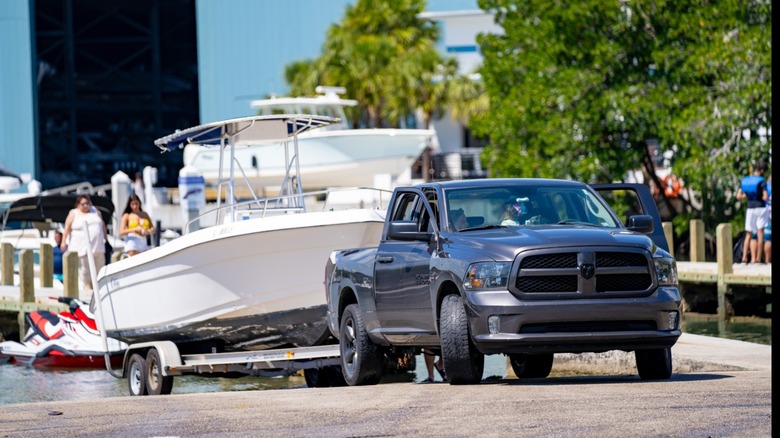
How much can your truck safely tow? We're not just talking about towing capacity, which should exceed the weight of the loaded trailer. But how much can it really tow? For example, let's say Charlie has a boat and trailer that together weigh around 4,000 pounds. So, he buys new Ford F-150, a truck with one of the highest towing capacities available in 2026. Charlie's model has a towing capacity of 9,200 pounds. He's all set, right? Not so fast. Charlie has to take into consideration his weight, the weight of his passengers, the weight of his cargo, and the weight exerted on his tow hitch.
In addition to towing capacity, the second weight Charlie has to be aware of is his truck's GCWR, or gross combined weight rating. This weight includes the truck's weight, the weight of the passengers, the cargo, and the towed weight. All of that together should not exceed the GCWR, which should be found in the manual and on Ford's website.
The third main weight in this article that Charlie should be aware of is tongue weight. This weight represents the downward force on the trailer hitch. As such, it is actual weight carried by the truck. It's pretty easy to calculate, since it is just a percentage of the loaded trailer's weight. Your vehicle manufacturer typically states what percentage to use. This weight will need to be factored against the truck's payload capacity and GVWR (not to be confused with GCWR).
How to calculate if your weight is within the GCWR
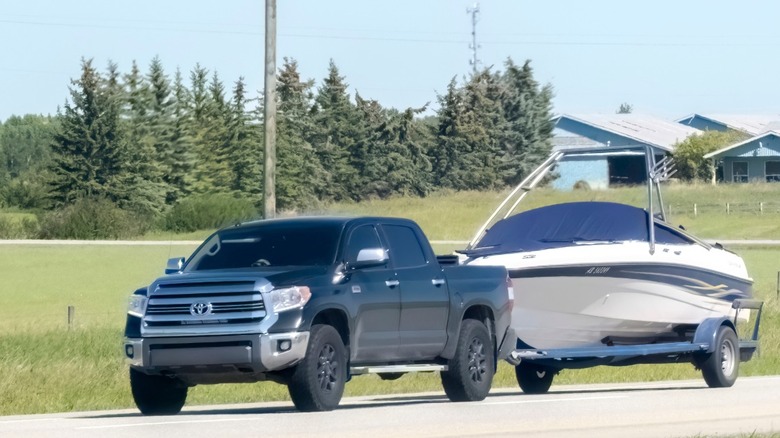
So, Charlie has decided to take four of his buddies out to the lake. To make sure that he doesn't exceed 14,800 pounds, which is the GCWR for his new Ford F-150, he needs to add his weight to that of his buddies, along with the weight of everything they're carrying in the truck, the combined weight of the boat and trailer, and the weight of the truck itself.
Charlie and his buddies, who are all of the age to be sporting dad bods, weigh close to 1,000 pounds combined. But they decided to hit the breakfast buffet this morning, so they are definitely tipping the scale at 1,000 pounds at least. The weight of the truck is around 5,100 pounds. They've loaded about 600 pounds of gear into the bed of the truck, including that big barbecue cooker Charlie's buddy Hank insisted on bringing, even though everyone told him to leave it at home (in Hank's defense, the F-150 does have one of the largest beds out there, so there's plenty of space). So, if we add the truck weight (5,100 pounds), the guys' weight (1,000 pounds), cargo (600 pounds), and the combined weight of the boat and trailer (4,000 pounds), we get a total of 10,700 pounds. Charlie even stops by a scale to confirm this number, which is highly recommended. That's far below the truck's GCWR of 14,800 pounds. That's great!
How to factor in tongue weight
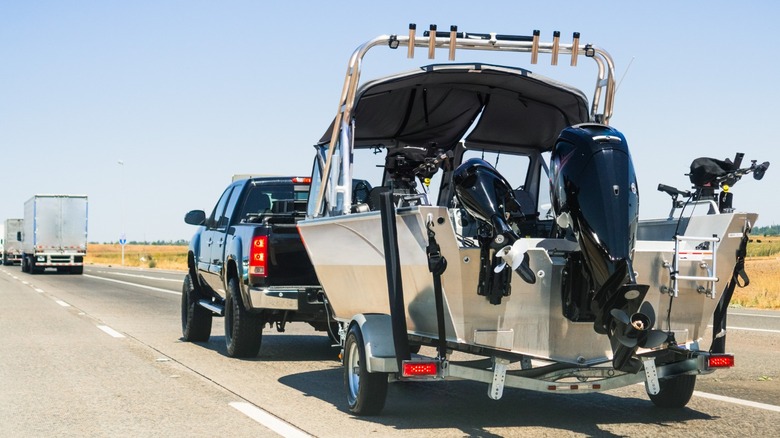
Charlie has calculated that the weight of his truck, passengers, cargo, and loaded trailer combined is well below his truck's GCWR, but he's not quite finished. Now, he has to factor in tongue weight, which plays an important role in keeping your trailer level. Ford says tongue weight should be 10% of loaded trailer weight. Charlie's loaded boat trailer weighs 4,000 pounds, so 10% of that is 400 pounds. How should he factor that in?
First, Charlie will have to add that 400 pounds to the weight of his truck, plus cargo and passengers, to make sure he is within his truck's GVWR (Gross Vehicle Weight Rating). This is different than GCWR, in that it doesn't include the total weight of the loaded trailer. So, if we add the truck weight (5,100 pounds), the guys' weight (1,000 pounds), the cargo (600 pounds), and the tongue weight (400 pounds), we get 7,100 pounds. Charlie looks at the door jamb of his truck and learns the GVWR is 7,200 pounds. Phew! That was close!
But wait, Charlie still isn't done. There's payload capacity to consider. Payload includes everything we just added, except for the truck weight. In other words, Charlie now adds the guys' weight (1,000 pounds), the cargo (600 pounds), and the tongue weight (400 pounds), which equals 2,000 pounds. Charlie then looks up his payload capacity — 1,980 pounds. Ah, so close. The boys probably should have skipped that third round of waffles.