

If You've Never Heard Of Mr. Bendo And The Muffler Men, Settle In For Some History
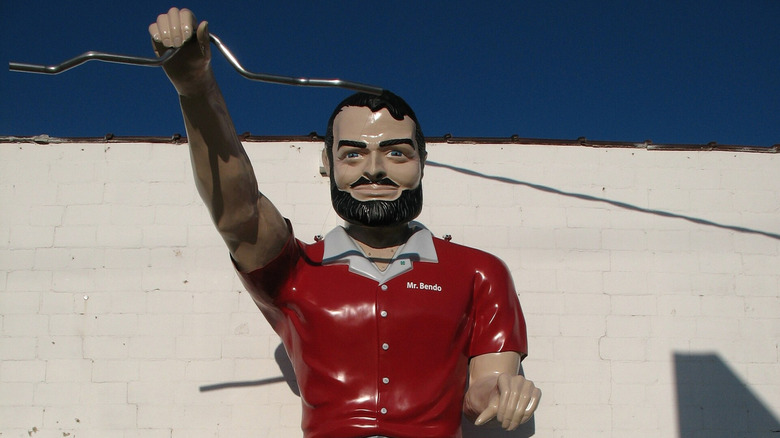
If you're not buying a muffler from a man as tall as a building, are you really buying a muffler? In the 1960s and '70s, Steve Dashew, owner of International Fiberglass, put that theory to the test. He was a boatbuilder by trade, but when the shop was slow, it would cast roadside attractions for advertising purposes. In 1963, Dashew acquired a mold for a Paul Bunyan stature that held an ax, but he quickly realized that not many businesses needed a giant lumberjack. His team modified the mold in various ways, including one that replaced the ax with a muffler, giving birth to the 21-foot-tall Muffler Men that would loom over auto shops across the nation.
The Cabazon dinosaurs in Cabazon, California, Albert the Bull in Audubon, Iowa, and Carhenge in Alliance, Nebraska are all favorite roadside attractions, but they aren't just for looks. Following the opening of Route 66 in 1926, tourist traps like these began to pop up all over. The "world's largest" this or that, themed hotels, and eccentric public art soon dotted 66 and other American roadways. Each Polaroid worthy in its own right, their ultimate mission was to lure drivers off the road so they'd spend money in the connected business.
These curiosities' advertising power began to decline once construction of the interstate highway system began in the late 1950s, letting motorists buzz to their destinations in record time. This didn't stop Dashew from building hundreds of roadside giants in forms like cowboys, Indians, and gas station attendents, all collectively known as the Muffler Men. Many are still standing tall, but tragedy struck in March 2026 when one, a rare Mr. Bendo edition, was critically injured in a hit-and-run.
What is the origin of the Muffler Men statues?
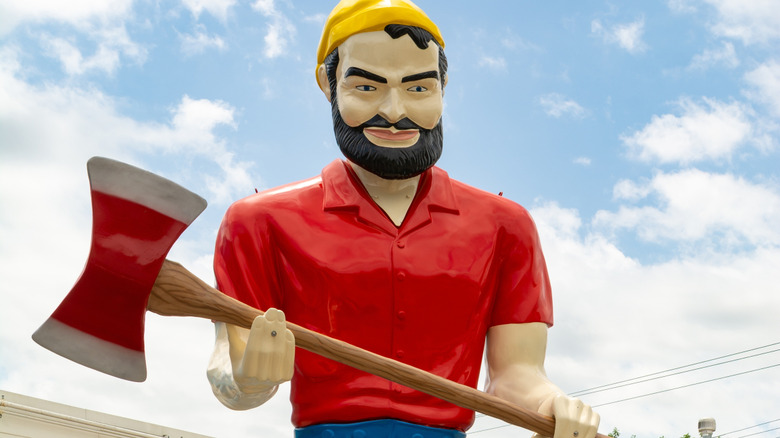
In 1958, Bobbie Lee "Bob" Prewitt of Lawndale, California crafted a fiberglass horse to advertise a new horse hauler he'd built. That cast would launch a whole new career for Prewitt, who received more offers for the inanimate animal than for the trailer. Taking advantage of the situation, he started Prewitt Fiberglass Animals to produce lifeless critters at scale.
His success in the fiberglass animal industry led to a job casting a larger-than-life human that ultimately sold to the Paul Bunyan Cafe in Flagstaff, Arizona, which later rebranded as the Lumberjack Cafe. That statue, standing today on the campus of Northern Arizona University, is the forefather of the hundreds of giants that would be found at automotive service centers around the nation in the 1960s and '70s.
When Dashew purchased the fiberglass animal business from Prewitt in 1963, the deal included the original Paul Bunyanesque mold. He modified it to create a new cast of characters that became known as the Muffler Men. To avoid major retooling costs, only minimal changes would be made to the cast, meaning the hand position would remain. Several major corporations placed orders, leading to the Phillips 66 cowboys and a request for up to 3,000 Texaco Big Friends, though only 300 ended up being produced.
Numerous variations of these giants sold to local auto shops, too. While several hundred made their way around the country, less than 10 of those remaining are known as Mr. Bendo. One of these rare giants resides at Ralph's Muffler and Brake Service in Indianapolis, where he has been watching over the business since 1965. His reign nearly came to an end when an Audi amputated a portion of his right foot.
What happened to Mr. Bendo, the Muffler Man in Indianapolis?
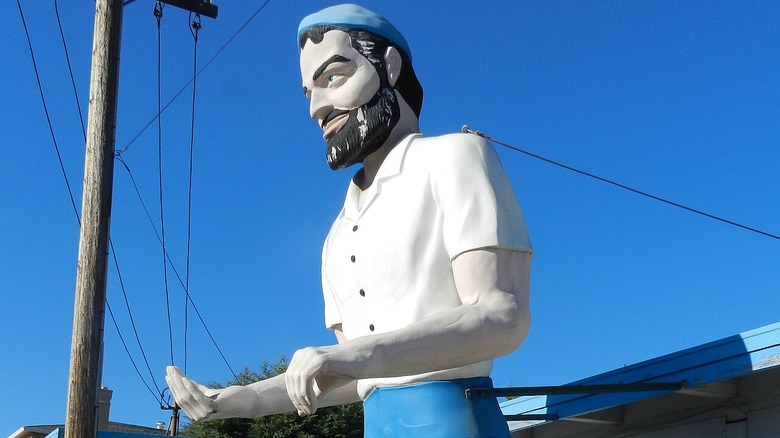
Hit-and-run crashes are killing more people than ever, and in the early morning of March 22, 2026, one nearly destroyed an iconic statue. At around 3 a.m., a driver collided with the 27-foot-tall Mr. Bendo statue at Ralph's, mangling his leg. Indianapolis' giant celebrity, created sometime in the early 1960s, was left without a right foot following the crash. Employees got him upright and fashioned supports that will keep him steady until permanent repairs can be made. This isn't the first time the giant's existence has been threatened. A 1985 fire heavily damaged the shop but left Mr. Bendo unhurt. He wasn't so lucky this time.
Mr. Bendo has a few distinct features compared to more common Muffler Men. Along with Mr. Bendo branding on his chest, the statue's arms are designed to hold an exhaust pipe, though the figure at Ralph's no longer has one in his grasp. In addition, Mr. Bendo has a full head of hair, while many of the other Muffler Men wear hats.
As for the future of Indiana's Mr. Bendo? Shop owner Kevin Potter, whose father originally purchased the statue, told the Indianapolis Star he's confident Bendo will get back on his feet. The restoration may be assisted by the American Giants Museum in Atlanta, Illinois. Appropriately situated just off old Route 66, the display is dedicated to telling the story of the Muffler Men. A visit ensures an opportunity to get personal with a collection of rare giants.
It's places like this museum that continue to make Route 66 a great American road trip. But if you visit, or spot one in the wild, we don't recommend trying to high-five a Muffler Man. They aren't known for their flexibility.