

Here's How To Tell If Your Piston Rings Are Stuck (And What To Do About It)
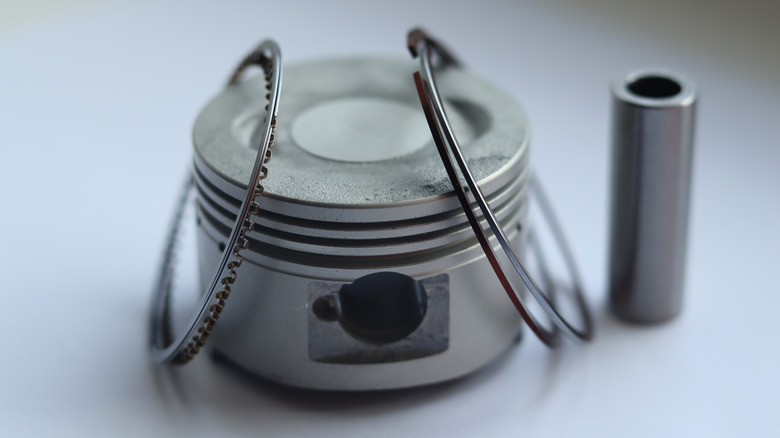
Depending on the size and design, engines can be made up of anywhere from between 2,000 and 15,000 individual parts, per Spinny Post. This is important to understand, because some seemingly simpler pieces can actually cause you a heap of trouble. Take, for instance, piston rings, which, as the name implies, go around each piston, keeping excess oil out of the combustion chamber and maintaining compression by forming a seal.
Most engine pistons have a total of three rings. The lowest ring works to remove extra oil from the walls of the cylinder, which requires a minimal coating for proper lubrication. The middle and top rings are the ones forming a seal and helping to contain combustion gases.
However, rings can become stuck in the channels they occupy, due to engine deposit buildup. You may have a stuck piston ring if you notice sudden lackluster performance from your engine, sputters, or even misfires. Other signs of stuck pistons could be oil that smells like gasoline, smoke out of the exhaust, a PCV valve with excess oil around it, or even a seized engine. Although, what causes an engine to seize and whether it can be fixed varies and isn't necessarily due to a stuck piston ring. If a ring becomes stuck, depending on the circumstances, you may be able to use an additive to remove deposits or a chemical solvent to dislodge them. If this fails, you may need to take the engine apart, address the issue, and then have it rebuilt.
So, what's going on exactly?
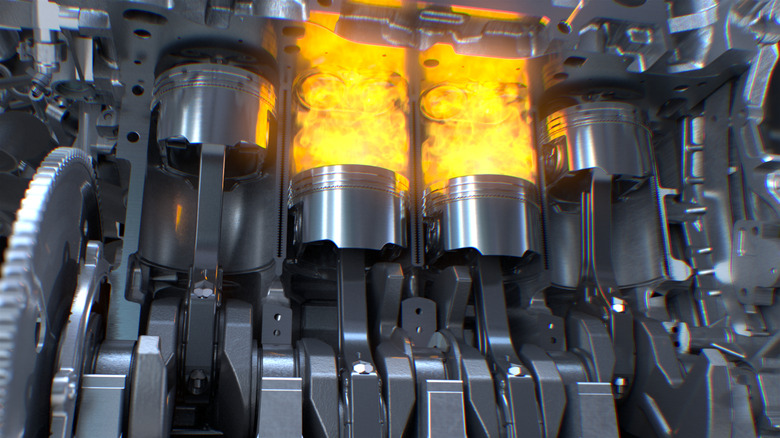
When a piston ring gets stuck, oil, which was held back when the rings were healthy, is now free to meander in larger quantities to places it shouldn't, resulting in things like tailpipe smoke and oil levels dropping more quickly. Your engine's oil may also have a distinct gasoline smell to it, because the lack of a seal allows fuel and oil to mix. Although, if your engine oil smells like gas, a stuck piston ring is only one of the possible causes, and none of them are good news for your engine. Essentially, when fuel mixes with oil, both the lubrication qualities and the thickness of the oil are negatively affected, leaving your engine in a vulnerable state.
Why you may notice performance deficiencies with a stuck piston ring has to do with loss of compression. In order for your vehicle to generate energy, the combustion process requires pressure within the chamber. When a piston ring is no longer able to contain the air and fuel mixture, compression drops, leading to suboptimal output and efficiency losses. The severity of these symptoms depends on how many cylinders are affected.
While pressure inside a cylinder is a good thing, excess pressure in other areas like the crankcase must be able to vent. When a stuck piston ring can no longer adequately contain the pressure, it moves into the crankcase, which does have a release valve (the PCV). But as pressure mounts in the crankcase, the valve can't keep up, resulting in oil coming out of the PCV.
Your options if you have stuck piston rings
If problems are caught early enough and are minor, you may have success with a decarbonizer fuel additive, which is just one way to prevent and clean carbon buildup. Bear in mind, this isn't an instant fix and works incrementally as you drive the vehicle.
Another option that's minimally invasive involves removing the spark plugs, which grant you enough access to pour a solvent down into the cylinder. If the piston ring is stuck because of internal deposits, a chemical solvent soak can help dissolve the excess carbon, freeing the ring. Although, before attempting to start the engine, you must carefully remove the solvent to avoid damage. One method involves engaging the starter for a second to get the engine to partially rotate, shooting the solvent back out from where you removed the spark plug. However, if the ring has been compromised as a result of getting stuck, even freeing it with a solvent won't completely correct the issue.
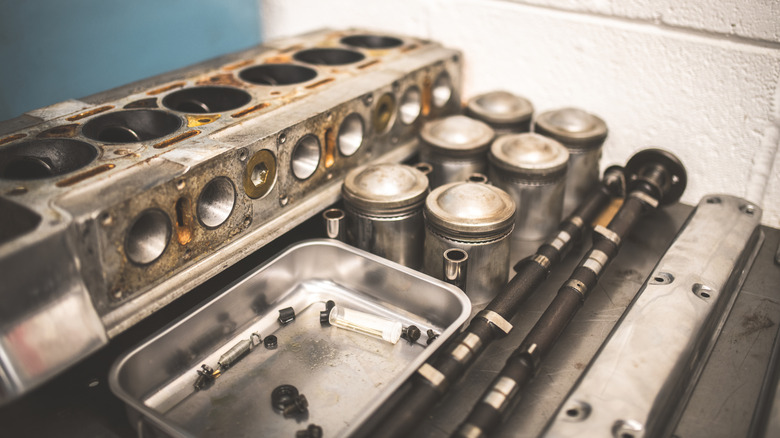
Unfortunately, if these routes don't solve the problem, you may be left with no choice but to take apart the engine and rebuild it. This can cost you anywhere from $2,500 to north of $8,000 at a mechanic, depending on the vehicle type, according to CarTalk.Pandahub. Once you're able to access to the cylinders, the rings can be replaced. If the inside of the cylinder was damaged by a stuck piston, it may be necessary to hone the affected cylinder to repair and smooth the walls.